Feeds:
Posts
Comments

Posts Tagged ‘biographies of women’

At a 1968 British society wedding in Kent, Hollywood legend Elizabeth Taylor snaps a souvenir picture of the Queen Mum (seated), mother of Queen Elizabeth II. The Queen Mum

At a 1968 British society wedding in Kent, Hollywood legend Elizabeth Taylor cannot resist snapping a souvenir picture of "the Queen Mum" (seated), mother of Queen Elizabeth II.

“The Queen Mum,” born Elizabeth Bowes-Lyon (1900-2002), was the beloved British Royal Family matriarch from 1953 until her death at age 101. Of Scottish birth, she served as Queen consort to her husband King George VI from 1936 until his death in 1952, when their daughter Princess Elizabeth took the throne as Elizabeth II.

During the London Blitz in WWII, the Queen Mum – who was then naturally referred to as Queen Elizabeth – insisted that she and the King remain in Buckingham Palace after it was bombed by the German luftwaffe. The Queen remarked to her mother-in-law that she was more affected by the bombing of the East End of London than by the bombing of the Palace:

“I’m glad we have been bombed,” she said. “Now, I can look the East End in the eye.” (1)

British King George VI and his wife Queen Elizabeth (later Elizabeth, the Queen Mother) survey the damage to Buckingham Palace from German bombs. Both the King and Queen were in the Palace when the attack hit the palace grounds and chapel on the morning of September 13, 1940. As they made their way to the palace shelter, they felt the Palace shake under the assault of high explosive and incendiary bombs. They were unhurt. Undeterred by the danger, the royal couple vowed to stay in London in the Palace.

I am still just as frightened of bombs as I was at the beginning,” the Queen wrote to a favourite niece. “I turn bright red and my heart hammers….I’m a beastly coward but I do believe that a lot people are, so I don’t mind! Well, darling, I must stop. Tinkety tonk old fruit and down with the Nazis.”(2)

Her indomitable spirit in the face of German aggression boosted British morale to such a degree that Adolf Hitler called her “the most dangerous woman in Europe.”

Her scary skinny sister-in-law, Wallis, the Duchess of Windsor, hated and mocked her, calling her by the unflattering nickname “Cookie” behind her back, mocking her love of sweets and resulting plumpness. The Queen Mum, however, did not hide her love of fun, jokes, champagne, and good food. In the 2010 movie, “The King’s Speech,” the Queen Mum, played by Helena Bonham Carter, is shown eating candies in the backseat of a car.

Her ultimate accolade for anyone or anything was “delicious.”(2)

Elizabeth, the Queen Mother

A new book by British monarchy chronicler, Brian Hoey, gives us yet another “behind the palace walls” glimpse of the Queen Mum enjoying her sweets.  Not in Front of the Corgis, scheduled for a June 2012 release, relates this anecdote: 

Lord Callaghan, when he was prime minister (1976-1979), was a frequent guest of the Queen Mother’s at Clarence House. Once, when just the two of them were present, she was eating from an enormous box of chocolates when he arrived.  She asked him if he would like one. He said, “Yes.” She then pointed to one in the middle of the box and said, “Have that one.” During the time he was eating his one specified chocolate, she ate three more. 

She then invited him to take another, once again selecting the one he should have. This went on for the remainder of the morning, with Her Majesty always pointing to the ones he could have.

As Callaghan left, he spoke to The Queen’s Page, asking why he was offered only particular chocolates by the Queen. The Page let him in on the secret:

“Those are the ones with hard centers. Her Majesty only eats the chocolates with soft centers.”(3)

(1) Source: BBC

(2) Source: The Daily Beast

(3) Source: The Daily Beast

Faithful readers:

  •  For more on the Queen Mum on this blog, click here.
  • For more on the British Royal Family on this blog, click here.
  • For more on Elizabeth Taylor on this blog, click here.
  • For more on Wallis, the Duchess of Windsor on this blog, click here.

Read Full Post »

Amy Winehouse died of alcohol poisoning.

Yesterday, as I reported, the coroner at St. Pancras Coroner’s Office, London, released the toxicology report on Amy Winehouse, the 27-year-old British singer found dead in her flat on July 23. The official finding is that Winehouse’s death was due to alcohol poisoning. Her blood alcohol contained five times the legal limit of alcohol, which stopped her breathing and sent her into a coma. Three empty vodka bottles were found near her body in her bedroom.

Ironically, Amy Winehouse burst upon the international music scene with her 2006 hit single, “Rehab,” in which she famously refuses treatment for her alcohol and drug abuse:

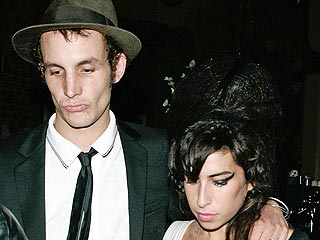
“Rehab” became her anthem over the next five years as we watched, played out in the press, her very public spiral downward, in particular, the tumult that led up to her divorce from Blake Fielder-Civil, her husband of two years, whom she had met in a bar:

Blake Fielder-Civil and Amy Winehouse

“In addition to the reported drug use, Winehouse was famously caught on video carving the words ‘I Love Blake’ into her stomach with a shard of glass, and during an interview with Rolling Stone magazine, she displayed photos of the couple passing pills to each other with their tongues.

But the Sid-and-Nancy-style love affair was also accompanied by photos of heated arguments that ended with both sporting bruises and scratches, as well as an arrest in Norway in October 2007 for marijuana possession; the couple were released with a fine. Just months after the wedding, Fielder-Civil was arrested on charges of suspicion of attacking a bar landlord and attempting to bribe him to drop the allegation. Following his incarceration, Winehouse was frequently seen wandering the streets of her Camden neighborhood in a daze, and she subsequently canceled a U.S. tour.” (source)

Some people laughed at Amy’s troubles; others scolded her for her misbehavior. Those familiar with addiction did neither. They knew all too well this predictable pattern. If Amy didn’t get treatment for addiction, she would die.

At yesterday’s inquest, Amy’s parents and friends listened as Amy’s doctor recounted how Amy had been totally resistant to any therapies that could have helped her with her drinking problems. That foolish decision robbed her of her health, beauty, freedom, and happiness, and, finally, her life.

In reporting the inquest’s findings, I have run across some websites with headlines saying, to the effect, that Amy did it to herself, that she deserves no pity: she drank herself to death. You will find none of these attitudes here. Yes, Amy Winehouse is responsible for her own troubles and the suffering she caused herself and others. But Amy was grappling with something she was powerless to control. She was an alcoholic who tried to control her drinking, which she could not.

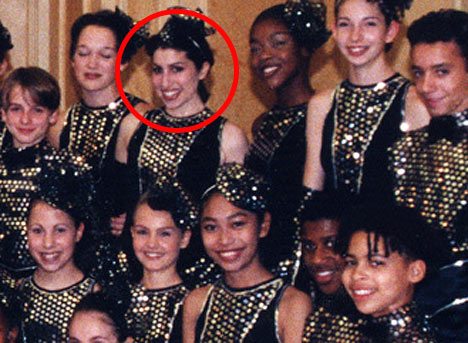
Amy Winehouse, circled, as a 13-year-old pupil at the Sylvia Young Theatre.

Addiction is an illness. It is chronic, progressive, and, if left untreated, sometimes fatal. Amy Winehouse suffered from an illness she dangerously thought she could manage alone. Rest in peace, Amy Winehouse.

For more on Amy Winehouse on this blog, click here.

Read Full Post »

British singer Amy Winehouse lost her battle with addiction.

It looks like we have an explanation for Amy Winehouse‘s tragic death. A coroner says the singer died from drinking too much alcohol, ruling it a “death by misadventure.” A pathologist says Winehouse (1983-2011) consumed a “very large quantity of alcohol” prior to her death and that her blood registered at 4.5 times over the legal drunk-driving limit. Winehouse, who died this summer at the age of 27, had struggled with drug and alcohol addiction for years.

Her doctor says she had resumed drinking in the days before her death after a period of abstinence (which we don’t have to believe).

O blessed Lord, you ministered to all who came to you:
Look with compassion upon all who through addiction have lost their health and freedom.
Restore to them the assurance of your unfailing mercy.
Remove from them the fears that beset them.
Strengthen them in the work of their recovery;
And to those who care for them, give patient understanding and persevering love.
Amen.

source: The Book of Common Prayer

Read the coroner’s report on Amy Winehouse at the Associated Press.

Read about Amy Winehouse last days at the Daily Mail Online.

Read more about Amy Winehouse on this blog by clicking here.


Read Full Post »

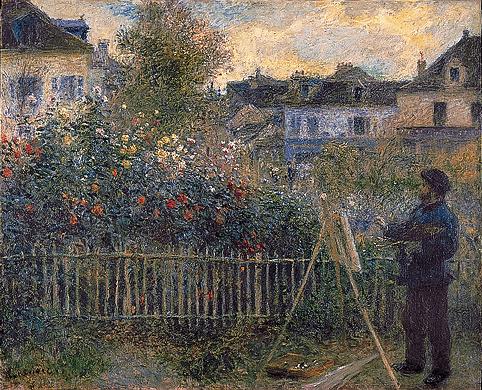
As a young man, French painter Claude Monet (1840-1926) abandoned the traditional approach to painting – standing in a studio, copying the old masters – in favor of painting scenes in the open air. Monet delighted in the interplay of color and light found in nature. He loved to paint in his garden at Argenteuil, a pretty, bustling village just outside of Paris.

"Monet Painting in His Argenteuil Garden," by Auguste Renoir, 1873

A spectacular stretch of the Seine, where the river reached its widest and deepest points, ran through Argenteuil.  Shortly after moving there in 1871, Monet bought a boat and converted it into a floating studio. He kept it moored near his home and used it to get a vista of the riverbank from the water.

"Claude Monet Painting on His Studio Boat," by Édouard Manet, 1874. The shadowy female figure sitting with the artist is his wife and model Camille Doncieux Monet.

Living with Monet at Argenteuil were his wife Camille Doncieux and their son Jean. Camille had been Monet’s model since they met in 1865. The couple lived in depressing poverty.

Claude Monet (1860) and wife Camille Doncieux Monet (undated)

Right up to her death, Camille posed for her husband’s paintings, more often than not, appearing as an indistinct female figure in a rural landscape.

"River Scene at Bennecourt," Claude Monet, 1868

Sometimes Camille has her back to the observer; othertimes her face is veiled or hidden.

"Camille on the Beach at Trouville," by Claude Monet, 1870

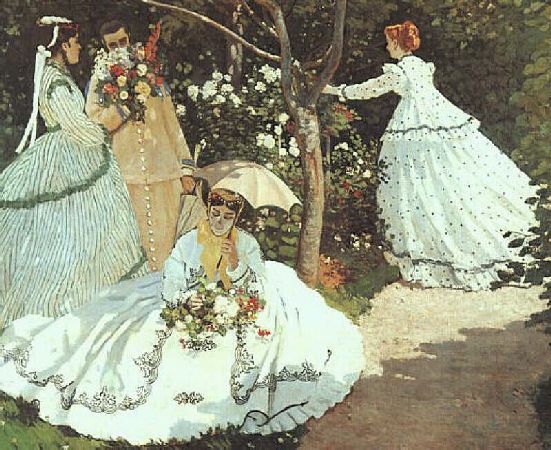
Camille was quite the devoted model. In Monet’s painting, “Women in a Garden” (1866-67), she posed for all four female figures!

"Women in a Garden," Claude Monet, 1866-67

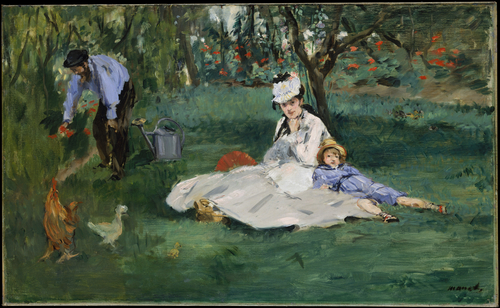
Camille was so cooperative that she freely posed for Monet’s painter friends, too.

"The Monet Family in Their Garden at Argenteuil," by Édouard Manet, 1874. Camille and son Jean relax while Claude Monet tends his garden.

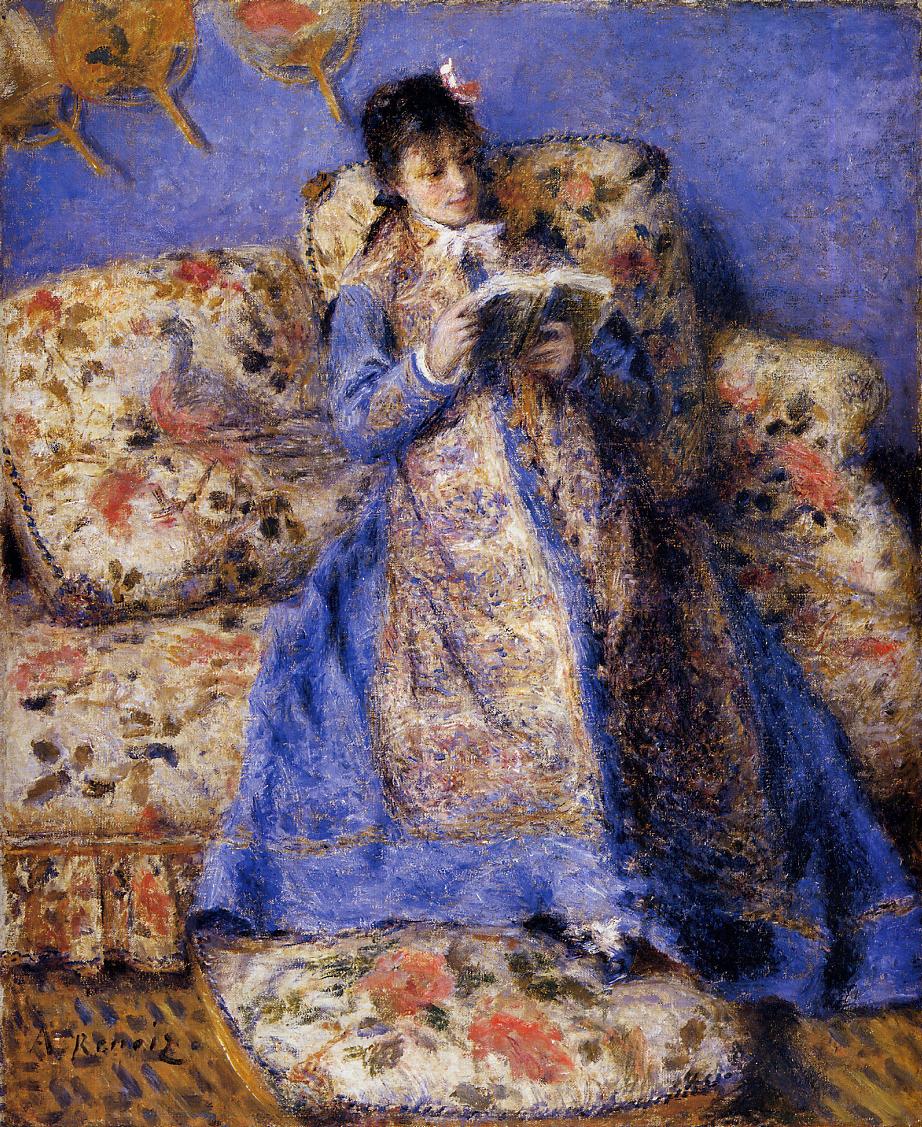
Auguste Renoir painted Madame Monet – known as “La Monette” – several times.

"Camille Monet Reading," by Auguste Renoir, 1872

Here is one of the rare times her husband paints her face clearly enough to distinguish her features, particularly her huge and sad-looking eyes. She often looks melancholy.

"The Bench," by Claude Monet, 1873

In 1876, Camille Monet fell ill with what is believed to have been cervical cancer. In “Camille Holding a Posy of Violets,” below, one can see the toll the disease has had on her health. She looks tired, older, and pale. It is speculated that her expression betrays her disgust with her husband who, by then, was openly carrying on a flirtation with their mutual friend, Alice Hoschede. Alice and her two children shared a house with the Monets.

"Camille Holding a Posy of Violets," or "Portrait," by Claude Monet, 1877

In 1878, Camille gave birth to a second son, Michel. Her health was dangerously weakened. Although Monet was not as attentive as he could have been to his wife, he loved Camille and was devastated that she was dying. For a time, he lost the desire to paint.

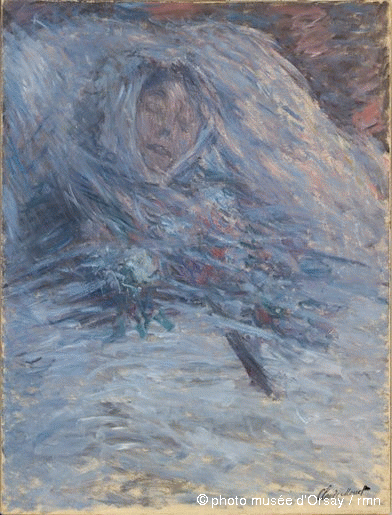
Finally Camille’s long suffering came to an end on September 5, 1879. Monet was grief-stricken. But even his internal pain could not stifle his passion to paint. Camille – his model-wife – was his muse, his inspiration to paint. At her deathbed, he took out his paints and painted her last portrait.

"Camille on her Deathbed," by Claude Monet, 1879

“I caught myself watching her tragic forehead,” Monet wrote afterwards to a friend, “almost mechanically observing the sequence of changing colours that death was imposing on her rigid face. Blue, yellow, grey and so on… my reflexes compelled me to take unconscious action in spite of myself.”

Little is known about Camille Doncieux Monet (1847-1879) mainly because Monet’s mistress and second wife, Alice Hoschede, was so jealous of Camille that she demanded that Monet destroy all mementos – letters, photos – anything – that attested to Camille’s very existence. (1)

(1) Gedo, Mary Mathews. Monet and His Muse: Camille Monet in the Artist’s Life. Chicago: University of Chicago Press, 2010.

Read Full Post »

Jackie Kennedy

In 1966, multimillionaire Robert David Lion Gardiner invited Jackie Kennedy to visit him on to his private islet, Gardiners Island, off the coast of Long Island. Gardiners Island had been in Gardiner’s family for four centuries and was one of the largest privately-owned islands in the world.

Eunice Bailey Oakes Gardiner and Robert David Lion Gardiner

Gardiner arranged a dinner party for Jackie which was attended by both Gardiner and wife, the former British model Eunice Bailey Oakes, and several others.

After dinner, the guests retired to the lavish wood-paneled den, where coffee and cognac were served. According to Gardiner, he watched as Jackie took out a cigarette and looked around for a light. A gold cigarette lighter belonging to Eunice lay on a  nearby table. Jackie picked it up and used it to light her cigarette. Then, inexplicably, she slipped the lighter into her evening bag.

Gardiner was aghast. Jackie Kennedy had deliberately stolen his wife’s lighter.

Gardiner didn’t know what to do. Several uncomfortable minutes later, he went over to his humidor and took out a cigar. Turning to the roomful of guests, he asked:

Have any of you seen my wife’s gold cigarette lighter?” 

Getting no response, he addressed his most distinguished guest:

Did you, Mrs. Kennedy? I believe you were the last one to use it.”

Jackie shrugged, replying in her little girl voice:  

I have no idea where it went. ”

The lighter was never returned to its owner. Gardiner was furious and retaliated by spreading stories accusing Jackie of kleptomania.

Jackie Kennedy and Aristotle Onassis, June 5, 1969, at Kennedy Airport, New York. The couple had been married less than a year.

The gossip reached the Greek ears of Aristotle Onassis, Jackie’s husband from 1968-75, who sent Gardiner a check for $5,000, along with a note threatening legal action for slander. Jackie had admitted to Ari that she had accidentally placed the lighter in her purse that evening at Gardiner’s but had, since then, simply lost track of it.

At some point, though, the missing lighter “resurfaced.” After Jacqueline Kennedy Onassis’s death in 1994, the lighter was auctioned off at Sotheby’s in New York as part of her multi-million-dollar estate.

Source: Bobby and Jackie: A Love Story. New York: Atria, 2009.

Readers, for more posts on Jackie Kennedy on this blog, click here.

Read Full Post »

Pigeons gather in a square in Barcelona.

Note: Pigeons and doves form the bird family Columbidae, of which there are 300 species. Ornithologically, there is no simple way to distinguish a pigeon from a dove. Some specialists refer to the smaller species as “doves” and the larger ones as “pigeons,” but this is not consistently applied.
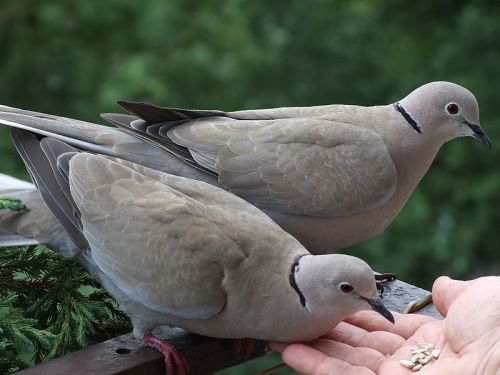
Collared Doves can be tamed in urban areas, such as these two being handfed in Poland.

Collared doves can be tamed in urban areas, such as these two sweeties being handfed in Poland.

In reference to the works of Spanish artist Pablo Picasso, the issue is further muddled. The titles of many of his works include the Spanish word la paloma, which means both “pigeon” and “dove,” so we aren’t sure which bird he intended to depict, if, indeed, he did intend to create such a distinction.

Finally, Picasso biographers, art curators, and translators have added their own layers of confusion. For example, the painting, “Child Holding a Dove,” (National Gallery, London) has been given two different French title translations: “L’Enfant A La Colombe” (Child With the Dove)  and “L’Enfant Au Pigeon” (Child With A Pigeon).

Therefore, for the purpose of this article, the terms, “pigeon” and “dove,” are used interchangeably, as is common practice, except when otherwise explicitly stated.

Now for our story:

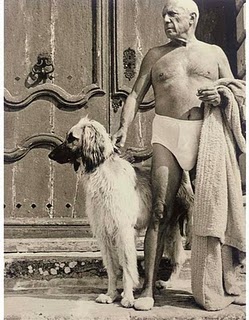
“Picasso in Underwear,” photo by David Douglas Duncan, 1957. From the earliest age, the most famous artist of the 20th Century did whatever he wanted, which might include posing in his jockeys on his front doorstep at age 76.

Famed Spanish artist Pablo Picasso (1881-1973) grew up around pigeons. His father, José Ruiz Blasco, an artist in his own right, bred pigeons (rock doves), which became his favorite subject to paint. Ruiz became known as El Palomero (The Pigeon Fancier). Pablo’s father taught him how to paint pigeons. (1)

In Pablo’s hometown of Málaga, Spain, pigeons roosted in the sycamore trees in the Plaza de la Merced, where he and his sisters played. While the girls frolicked in the square, Pablo used a stick to make bird drawings in the dirt. (2)

Much to the dismay of his elementary school teachers, Little Pablo, or “Pablito,” drew constantly. Every once in a while, he brought a pigeon to class and spent his time sketching it rather than doing his assigned schoolwork.

Pablo used every inch of his drawing paper, covering the page with scenes of his favorite subjects: bullfights and pigeons. (3)
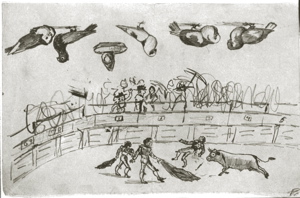
Guided by his father, Picasso received professional art instruction. His talent grew and was recognized. By the age of 15, he was successfully exhibiting his artwork. By 1901, he was splitting his time between Barcelona and Paris, falling increasingly in the company of artists heavily influenced by post-impressionists such as Vincent Van Gogh.

That same year, at the age of 20, Picasso had become so respected an artist that he had a Paris show in the Galerie Vollard almost to himself, sharing it with another Basque. At this exhibition, Picasso

sold 15 of his 65 paintings and drawings before the exhibition had even opened.” (4)

Through all these changes, however, pigeons still charmed him, as is evident in his sentimental 1901 painting, “Child Holding a Dove” (1901), a piece that ushered in his somber Blue Period.

Pigeons even appeared during his cubist period, as in “Woman With Pigeons” ( 1930).
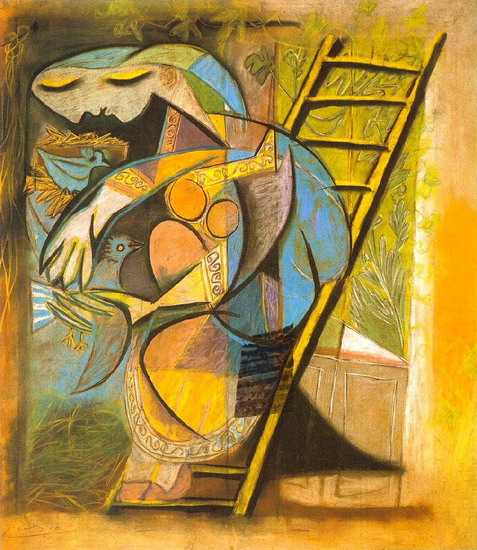
“Woman With Pigeons,” by Pablo Picasso, 1930.

Before 1937, Picasso had not used his art for political expression. It was in that year, though, that he was to create his most famous work. Commissioned by the Spanish Republican government, Picasso created an enormous mural called “Guernica.” It was named after a Spanish town in the Basque country that had been firebombed by Nazis, backers of the Nationalist forces of General Franco during the Spanish Civil War (1937-1939).

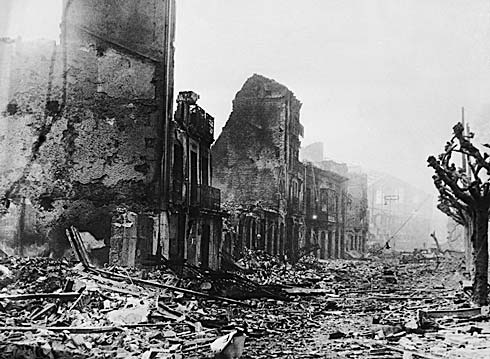
Guernica, Spain, after the April 26, 1937, aerial bombing by Nazis. It was market day and the quiet village was filled with women and children. There were few men left in Guernica, as most were off fighting in the Spanish Civil War against Franco. The Nazis bombed the town for two hours, slaughtering hundreds of innocents. When the town caught fire, those not burned to death tried to escape the inferno by taking refuge in the outskirts of town. Yet there was no escape, as they found themselves trapped all around by bombed-out bridges and roads. Some of these women and children were gunned down by aerialists. The Nazis supported the rebel forces of General Franco to test out war tactics and weapons. Although there was a military target outside Guernica, a munitions factory, it was left unscathed by the April 1937 bombing. It is believed that the bombing was used to intimidate those in opposition to Franco’s impending rule.

After the painting “Guernica” (see below) was exhibited in the Paris International Exhibition (1937), it toured Europe and the U.S., drawing international attention to the Spanish Civil War and the horrors of war.
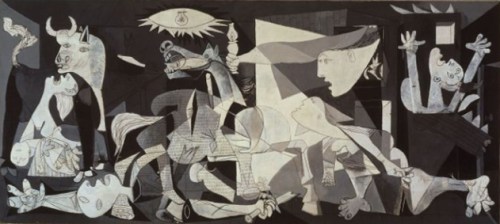
“Guernica,” by Pablo Picasso. (1937)

 “Guernica” gained monumental status, becoming a potent anti-war symbol and thrusting Pablo Picasso to the forefront of the Peace Movement. In May of 1940, Hitler invaded France. Throughout WWII, Picasso lived in Nazi-occupied Paris, where he was continually harassed by the Gestapo who were familiar with his anti-Nazi mural.

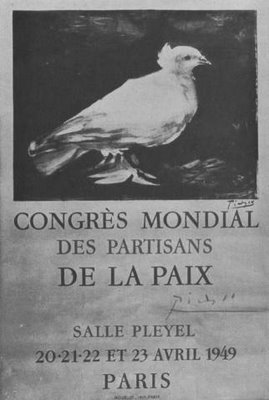
Picasso continued to paint and draw pigeons and doves. In 1949, author Louis Aragon chose the artist’s lithograph, “La Colombe,” (The Dove) for the poster commemorating the Peace Conference in Paris. (5)

“La Colombe” (The Dove) by Picasso, 1949

Posters of “La Colombe” were all over Paris when Picasso’s daughter was born that April so he named his daughter Paloma (Spanish for dove).
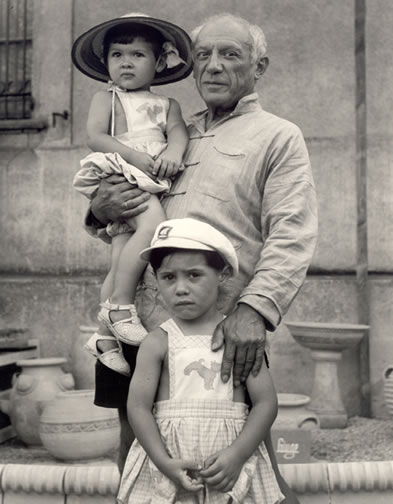
In this 1951 image, Pablo Picasso is shown with 2 of his 4 children, whose mother was Francoise Gilot: Paloma (b. 1949) in his arms and Claude (b. 1947) Photo Edward Quinn, © edwardquinn.com

The model for the famous “peace dove” was one of artist Henri Matisse ‘s doves.
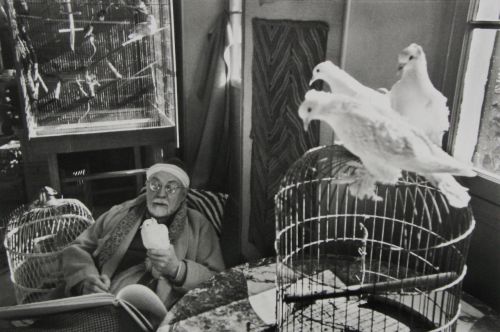
Henri Matisse in his studio with his doves. Vence, France. 1944. photo by Henri-Cartier Bresson

Matisse and Picasso had known each other since 1904 when they were introduced at the Paris salon of Gertrude Stein, an important collector of art, particularly Matisse’s. Matisse and Picasso had a profound influence on one another and their art.

After Matisse died in 1954, Picasso was deeply saddened. He moved his family to a large villa near Cannes in the south of France and painted a series called “Studio” in homage to Matisse. He painted almost a dozen canvases of the same view from his third floor studio window – with the lush background of sky and garden and sea – while, in the foreground, “white doves” (6) nested and played in a dovecote Picasso had built on his terrace. Picasso did not ordinarily paint what he saw; he drew upon his imagination for artistic inspiration. It was his old friend Matisse who drew from nature. Therein lay Picasso’s tribute to Matisse.
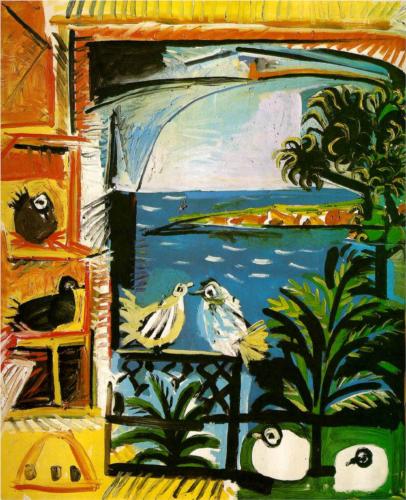
“The Studio (Pigeons),” by Picasso, 1957, is painted in a style reminiscent of Matisse.

Meanwhile, the “Dove of Peace” Picasso had created for the 1949 Paris Peace Conference had caught on. It had become a symbol for the peace movement, the Communist Party, and other liberal groups. In the years that followed, Picasso agreed to create other peace doves for conferences across Europe.

The modern peace dove is a more whimsical bird than the 1949 original. This proud bird is portrayed in happy flight, bearing numerous bouquets of olive branches and flowers in its wings, beak, and feet.

one of the many versions of Picasso’s iconic “Dove of Peace”

(1)”Lines That Kept Moving and Knew No Boundaries,” by Smith, Roberta. New York Times, October 7, 2011.

(2) Hart, Tony. Famous Children: Picasso. New York: Barron’s Educational Series, 1994.

(3) Krull, Kathleen. Lives of the Artists: Masterpieces, Messes (and What the Neighbors Thought). New York: Harcourt Brace & Company, 1995.

(4) link

(5) Clark, Hiro. Picasso: In His Words. New York: Welcome Books, 2002.

(6) Douglas, David. Viva Picasso: A Centennial Celebration 1881-1981. Studio, 1980.

Read Full Post »
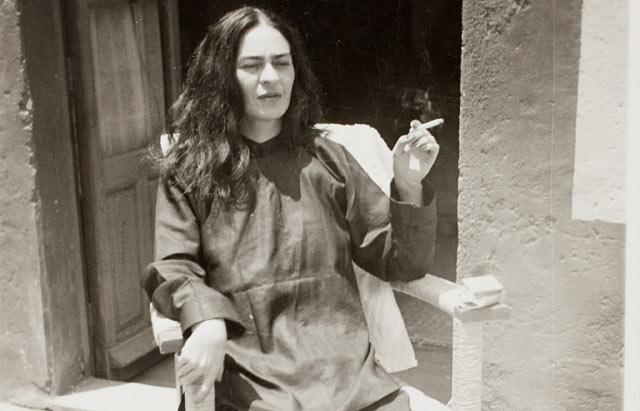
Addiction claims another victim. Amy Winehouse is dead at age 27.

Chemical dependence claimed another victim today: 27 year old Amy Winehouse, British rocker, was found dead at her London flat this afternoon. 

The Definition of Addiction 

Answer yes or no to the following seven questions. Most questions have more than one part, because everyone behaves slightly differently in addiction. You only need to answer yes to one part for that question to count as a positive response. 

  1. Tolerance. Has your use of drugs or alcohol increased over time?
  2. Withdrawal. When you stop using, have you ever experienced physical or emotional withdrawal? Have you had any of the following symptoms: irritability, anxiety, shakes, sweats, nausea, or vomiting?
  3. Difficulty controlling your use. Do you sometimes use more or for a longer time than you would like? Do you sometimes drink to get drunk? Do you stop after a few drink usually, or does one drink lead to more drinks?
  4. Negative consequences. Have you continued to use even though there have been negative consequences to your mood, self-esteem, health, job, or family?
  5. Neglecting or postponing activities. Have you ever put off or reduced social, recreational, work, or household activities because of your use?
  6. Spending significant time or emotional energy. Have you spent a significant amount of time obtaining, using, concealing, planning, or recovering from your use? Have you spend a lot of time thinking about using? Have you ever concealed or minimized your use? Have you ever thought of schemes to avoid getting caught?
  7. Desire to cut down. Have you sometimes thought about cutting down or controlling your use? Have you ever made unsuccessful attempts to cut down or control your use?

If you answered yes to at least 3 of these questions, then you meet the medical definition of addiction. This definition is based on the of American Psychiatric Association (DSM-IV) and the World Health Organization (ICD-10) criteria.(1

Read more about the death of Amy Winehouse at the Daily Mail.

Read more about Amy Winehouse’s life at NPR.

Read Full Post »

Dodi Al Fayed looks over Princess Diana’s shoulder just minutes before the two of them will die in a Paris tunnel.

Keith Allen, the director of the controversial film, “Unlawful Killing,” is interviewed today by the UK Daily Mail regarding his decision to include in the “documentary” a previously unseen and graphic black and white photo of Princess Diana as she lay dying August 31, 1997.  The photo was probably sold by one of the paparazzi in the Paris tunnel with her at the time of her fatal car crash. (1)

“Unlawful Killing” debuts tomorrow at the Cannes Film Festival. Allen defends his tasteless use of the disturbing photo of the much beloved princess on the heels of the Royal Wedding:

The photo is not used in the film for the purpose of shock. It is included as evidence, because it shows clearly that, although Diana had been injured in the crash, she was alert and very much alive. I repeat: it is not a picture of a dying woman.

As medical evidence presented at the inquest confirmed, if Diana had been taken promptly to hospital by Dr Jean-Marc Martino, she could well have survived.

Instead, due to a series of delays that have never been properly explained, it took one hour and 43 minutes to get her to a hospital just a couple of miles away, by which time her life was ebbing away.

We briefly use one photograph as part of a sequence which asks: why was she not taken to hospital more quickly? What took place within Dr Martino’s ambulance (inside which she remained for well over an hour)? Why is Dr Martino’s evidence greatly at variance with the known facts? And why did no official inquiry ever interview (or even name) most of other people in the ambulance?

Surely, if the inquest and police enquiries were as ‘thorough’ and ‘open’ as the voices of authority insist, that is the very least they would have done?

My film is not about a conspiracy before the crash, but about a conspiracy after the crash, culminating in a six-month inquest which (it is my contention) sought to bury the truth, rather than reveal it. I don’t know whether I’ll convince you or not, but I hope you’ll reserve judgement until you have seen it for yourselves.

Admittedly, that’s difficult at the moment, because the film cannot be shown in the UK (mainly because the questions it asks about the conduct of the coroner and police chiefs could lead to us all being imprisoned under contempt of court laws). But it will soon be showing widely throughout the world, so many of you will be able to see it elsewhere.” (2)

Allen admits that “Unlawful Killing” is backed by Mohamed Al Fayed, the former owner of Harrods Department Store in London.  Al Fayed is the  father of  Dodi Fayed, Diana’s lover, who also died in the Paris crash.

Summer 1997: Dodi Al Fayed and Princess Diana

Mohamed Al Fayed is convinced that Dodi and Diana were murdered by a collaboration between the British spy agency M16 and Queen Elizabeth’s husband, Prince Philip.

Mohamed Al Fayed has pursued his elaborate conspiracy theory for over a decade, memorably presenting it at an official British inquest into the deaths of Dodi and Diana. (3) However, on April 7, 2008, the jury released an official statement that sharply dismissed Al Fayed’s claim:

Diana and Dodi were unlawfully killed by the grossly negligent driving of chauffeur Henri Paul and the paparazzi. Though the official verdict implicated the pursuing vehicles, the jury also named the intoxication of the driver and the victims’ decisions to not wear seat-belts as contributing factors to their deaths. Additionally, the Mercedes had been travelling at over twice the legal speed limit of that particular section of road and had long since left the paparazzi vehicles far behind by the time the accident occurred.” (4)

Princess Diana (1961-1997). Mohamed Al Fayed created many myths about his son Dodi and Princess Diana’s romance, particularly that they were getting ready to announce their wedding plans. He even went so far as to claim that Diana was pregnant at the time of her death. The British inquest into Diana’s death concluded that she was not pregnant at the end.

(1) The Daily Mail

(2) The Daily Mail

(3)The New York Times

(4) Wiki

Readers: Check out “Diana’s Death Photos Leaked, Part 1 “The Shrine at Harrods,” and other posts on the British Royal Family on this blog.

Read Full Post »

Newspapers chronicle the August 31, 1997 Paris car crash that killed Princess Diana.

“A shocking paparazzi photo of a dying Princess Diana could be shown for the first time on Friday in a documentary at the Cannes Film Festival.

The 90-minute documentary about her fatal car accident, called “Unlawful Killing,” includes a graphic, black-and-white close-up of the princess taken moments after the Mercedes she was riding in crashed in a Paris underpass.

One of the movie’s financial backers is former Harrods department store owner Mohamed Al Fayed, whose son Dodi died in the car with Diana.

British media report that he didn’t know the image of Diana’s face would be included in the movie and plans to stop it from being shown.”

This photo released in 2008 shows Princess Diana in the backseat of the Mercedes roaring away from the Paris Ritz before the fatal accident. Diana glances back at the pursuing paparrazzi. Dodi Al Fayed sits next to her. In front of Al Fayed is the driver, Henri Paul. Seated also upfront is Al Fayed's bodyguard, Trevor Rees-Jones (The Daily Mail)

For details and photos of the 1997 crash, click here.

Now Read: Princess Diana: Death Photo Leaked, Part  2

Readers: I have written many posts on Princess Diana and the British Royal Family. For more background on Diana’s death, please read, “The Shrine at  Harrod’s.” For other posts on the British Royal Family, click here.

Read Full Post »

In its coverage of the fashion displayed by guests at the British Royal Wedding of William and Catherine, The New York Times wrote that the outfits of the guests “were generally tasteful and royal-friendly. A few things stuck out. The exotic costumes of foreign dignitaries, seeming throwbacks to imperial times. The hats worn by the ladies, which resembled, variously

overturned buckets, flowerpots, lampshades, fezzes, salad plates, tea cozies, flying saucers, abstract artworks or, in one case, a pile of feathers. There were also a number of fascinators, decorative shapes with flowers or feathers, that are stuck in one’s hair but are not hats.”

It now appears that 36 of the wild headpieces worn at the royal wedding can be traced to a single eccentric Irish milliner, Philip Treacy, referred to by the UK’s The Daily Mail as the man “responsible for all this fashion roadkill.” 

In this 1999 photo, milliner Philip Treacy poses with the late hat fancier Isabella Blow

Princesses Eugenie and Beatrice arrive at Westminster Abbey for the Royal Wedding in their much-ridiculed hats by Philip Treacy. Beatrice's hat was described in the Daily Mail as "beige pretzel-like" and Eugenie's as a "catastrophic confection...with a rose the color of dried blood."

For more pictures of royal wedding hats on this blog, click here.

Princess Beatrice wore this Treacy creation to another wedding. A swarm of butterflies seems to be attacking her head.

At another fancy occasion, Princess Eugenie wears a feather headpiece designed by Philip Treacy

Victoria Beckham wore one of Philip Treacy's creations to her husband David's O.B.E. ceremony. Note that Mrs. Beckham is showing her teeth, something rarely seen in her photos.

David and Victoria Beckham arrive at Westminster Abbey for the royal wedding. Victoria is wearing one of Treacy's hats, perched precariously on the front of her head. Though almost seven months pregnant with their fourth child, she opts for fashion footwear, wearing sky-high Christian Louboutin heels. David proudly wears his O.B.E. - but on the wrong lapel!

Once inside the Abbey, you can see that David Beckham has switched his O.B.E. medal from his right lapel to the left one - the correct one. Someone must have mentioned the faux pas and he made the swap. He's chatting up a Beefeater, rather nervously, I think!

While we are on the subject of propriety, let me mention that several people have remarked that Kate Middleton chose to wear a wedding gown with sleeves so that she didn’t bare her arms in the Abbey, which is firmly against the dress code.

Royal Wedding: William and Catherine are shown in the Abbey with best man Prince Harry of Wales and maid-of-honor Pippa Middleton.

I checked this out and there seems to be no such rule, at least in writing. Here is the dress code recorded on the Abbey website:

There is no specific dress code for the Abbey. For services we ask that you dress in a respectful manner, although we are aware that some people are on holiday – bear in mind that during the winter months it can become quite cold inside.


Besides, if Abbey rules require covered arms, then how was Pippa Middleton exempt?

Newsweek magazine clarified the matter. Royal protocol requires that the arms of a royal bride must be covered.

Prince William wore the scarlet coat of an Irish Guards mounted officer, the uniform of his senior honorary army appointment. He wore gold sword slings, but no sword. Although unconfirmed, my sources report that no weapons are allowed in the Abbey.

Back to the mad hatter and more of his crazy, over-the-top designs for The Rich and Famous:

American Actress Sarah Jessica Parker wears a Philip Treacy design. Saloon girl? More unpleasant things have been said about this hat like, "What do you get when you cross a small cowpat with a pair of yellow butterflies, a sickly green rose and a clump of brown chicken feathers?" (the Daily Mail)

British model Jade Parfit allows another Philip Treacy odd creation to rest on her right ear.

You knew it was coming.

That's Lady Gaga in the wreath by Treacy with Beyonce.


Jodie Kidd wears a Treacy saucer hat with pheasant feather antennae.

In this 2005 photo, Prince Charles and Camilla Parker-Bowles, newly-minted as the Duchess of Cornwall, are just married. She wears a Philip Treacy "wheatsheaf halo" hat for which Prince Charles later awarded him an honorary O.B.E. Camilla is so chummy with Treacy that she sent Treacy's dog a Christmas card every year until the dog's death. At the dog's funeral, Grace Jones sang and Kate Moss sent flowers. (the Daily Mail)

Readers: 


On this site, read, “Kate Rocks the Fascinator.”

For more pictures of Catherine, the Duchess of Cambridge (Kate Middleton) in hats, click here.

For more posts on the British Royal Family and the Royal Wedding, click here.

Read Full Post »

Jackie Kennedy wears the famous pink suit in this 1962 photo. She is looking at plans for Lafayette Square.

President John F. Kennedy looked out the window of his Fort Worth, Texas, hotel suite. The November sky was dark and threatening. It looked like rain. Forecasters predicted cool weather. The president advised his wife Jackie to dress warmly for the long and demanding day and personally selected her oufit. He chose a pink wool suit with three-quarter-length sleeves and a blue underblouse. To it, Jackie added a pink pillbox hat and white gloves.   

Jackie, 34,  had worn the suit before – she called its color “raspberry” – and it was one of the president’s favorites.  He had told mutual friend Susan Mary Alsop that Jackie, his wife of ten years, looked “ravishing in it.” (1)   

President and Mrs. Kennedy at the White House, October 1962. Jackie Kennedy is wearing the pink wool Chez Ninon she wore in Dallas, November 22, 1963

Jacqueline Kennedy‘s pink suit was made in 1961 by the New York dress salon, Chez Ninon. It was a copy of a Chanel pink boucle wool suit trimmed with a navy blue collar. (1)   


Jackie Kennedy was a style icon. People noticed what she wore. Kennedy critics were quick to pounce when Jackie wore Paris fashions. Jack urged his wife to buy American and she did. Such a move was both financially and politically savvy. The Chez Ninon knockoff cost between $800 and $1,000 compared to over $10,000 for a custom-made Chanel suit.  Plus, he and Jackie were in Texas with Vice President Lyndon Johnson and wife Lady Bird to officially kick off their 1964 presidential campaign. They had to minimize the fallout from Jackie’s expensive French taste.   

Jackie’s pink suit was a hit at the Fort Worth breakfast that morning. The president beamed at the attention she drew, noting that “nobody notices what Lyndon and I wear.” A short plane ride later, they were disembarking at Dallas Love Field to a promising reception. Jackie was presented red roses.   

President John F. Kennedy and First Lady Jackie Kennedy arrive at Love Field in Dallas, Texas, on November 22, 1963.

The sun had come out and the day had become unseasonably warm. The Kennedys climbed into the back seat of the presidential limousine to begin the winding 11-mile route through downtown Dallas where the president was to speak at a Trade Mart luncheon. Texas Governor John Connally and wife Nellie got into the jumpseat in front of the Kennedys and behind the driver and two Secret Service agents.   

The presidential limo was a midnight blue 1961 Lincoln that had been flown in from Washington, D.C. Because the weather was so nice, the plastic bubble top had been removed and the bullet-proof side windows were rolled down. This is how President Kennedy preferred to ride. At 11:50 a.m., the 12-car motorcade with its motorcycle escort and Secret Service attendants left the airport “on its rendevous with fate.” It was November 22, 1963. (2)   

The crowds lined the parade route so thickly that the motorcade moved at a crawl of only 6-7 miles an hour. The president clearly loved the warm Texas welcome, smiling and waving at all the friendly faces.   

JFK and Jackie ride in the presidential limo through the streets of Dallas, November 22, 1963. Texas Governor John Connally sits up front.

The temperature was 76 degrees. The sun was blindingly hot. Jackie was wearing wool.  She shielded her eyes from the big Texas sun with her trademark sunglasses.   

The people shouted, “Jack, Jackie!” recalled Nellie Connally. “They seemed to want her as much as they wanted him.” She could hear Jack say to Jackie,” Take your glasses off….When you’re riding in a car like this, in a parade, if you have your dark glasses on, you might as well have stayed at home.”

November 22, 1963: Up front, Texas Governor John Connally and wife Nellie ride with the President and Mrs. Kennedy through downtown Dallas.

Nellie Connally smiled to know that Texans were treating their president with such courtesy. She turned to him and said,   

Mr. President, you can’t say that Dallas doesn’t love you.” (3)

Thirty seconds later, at 12:30 p.m., three shots rang out. The 35th President of the United States was shot. As the car sped toward Parkland Hospital, Kennedy slumped in his wife’s lap, his blood and brain fragments staining her pink wool suit, gloves, stockings.  Jackie crawled out the back of the limo for help from the Secret Service riding in the car behind them.

In an image from the Zapruder film, a fatally-wounded President Kennedy slumps over as Secret Service agent Clint Hill leaps onto the president’s car and pushes Jacqueline Kennedy back.

At the hospital, the doctors worked feverishly to save the president but it was futile. President Kennedy was declared dead, his once vital body loaded limply into a coffin. Jackie accompanied his body to Dallas Love Field where it was loaded onto Air Force One to be flown to Washington.

In her bedroom on board the plane, Jackie’s personal assistant had laid out a fresh outfit for the First Lady. Despite urging from staffers and handlers to “clean up her appearance,” Jackie  refused to get out of her bloodied clothes. She shook her head hard:

No, let them see what they’ve done.”  

Just hours after her husband's assassination, widow Jackie Kennedy stands next to Lyndon Johnson on Air Force One as he is sworn in as the 36th President of the United States. Although her personal assistant laid out a fresh change of clothes on her bed aboard the plane, Jackie refused to change out of her blood-spattered clothing. Also aboard Air Force One was the casket carrying the body of President John F. Kennedy, age 46.

Somehow, that was one of the most poignant sights,” Mrs. Johnson later wrote, “that immaculate woman exquisitely dressed, and caked in blood.”  

At Andrews Air Force Base in Washington, D.C., JFK's brother Attorney General Bobby Kennedy meets Jackie Kennedy when she arrives on Air Force One with the coffin carrying her slain husband's body. Note Jackie's bloodstained suit. Her left leg is caked in blood.

It was not until 5 a.m. the next morning at the White House that Jackie took off the bloodied suit, bathed, and changed outfits. Her mother put the suit in a plastic bag and stored it in her house for many years.   

The suit was never cleaned and never will be. It sits today, unfolded and shielded from light, in an acid-free container in a windowless room somewhere inside the National Archives and Records Administration’s complex in Maryland; the precise location is kept secret. The temperature hovers between 65 and 68 degrees; the humidity is 40 percent; the air is changed six times an hour. (4)  

Meanwhile, the whereabouts of the pink pillbox hat remain a mystery. It has never been found.  Somewhere inside Parkland Hospital, the hat came off.  Jackie’s personal secretary, Mary Gallagher recalls:

While standing there I was handed Jackie’s pillbox hat and couldn’t help noticing the strands of her hair beneath the hat pin. I could almost visualize her yanking it from her head.”

What happened to the hat after that is unknown. Mary Gallagher lost track of it.

(1) Source   

(2) Source   

(3) Source   

(4) Source: The Los Angeles Times, Jan. 30, 2011. 

Readers: For more on Jackie Kennedy, click here.

Read Full Post »

Actress Natalie Wood (1938-1981) in an undated photo

“Ever since I was knee high,” Natalie Wood would say later, “I  was waiting for my break.”

Natalie’s mother – whom she called “Mud” – had convinced Natalie that the only thing that mattered in life was to be a great actress. Mud had moved her family to Hollywood for the sole purpose of getting Natalie (1938-1981) into pictures. By the time Natalie was six, though, she had been paraded by Mud in front of scores of casting directors who paid her no mind.

In February 1945, Mud managed to get Natalie a screen test for “Tomorrow is Forever,” a picture directed by Irving Pichel. Natalie was one of six pretty little girls to audition for the role of a traumatized German war orphan named Margaret. In the film, Margaret has several heartrending scenes, one of which was chosen for the screen test. The scene called for Margaret to cry.

“She [Natalie] played the scene and it was not very good,” recalled Pichel. Natalie had not been able to cry. She didn’t get the part.

Mud became frantic that Natalie didn’t get the part. “My mother got mad and said, ‘What do you mean, you didn’t cry?'” recalled Natalie. That night at home, Mud commanded Natalie to phone Pichel and beg for a second chance. Pichel was moved by Natalie’s call and agreed to another screen test.

Mud then set her mind to preparing Natalie to cry on cue. She enlisted the aid of Natalie’s older sister, Olga, as coach. Olga remembered her drama teacher instructing the class to think of something sad when they needed to cry. Olga told Natalie to remember the day their dog was hit by a truck. Horrorstruck, Natalie relived the nightmare of her puppy being crushed to death.

 “I got her to cry,” recalls Olga.

Olga’s technique was not lost on Mud.

Both Mud and Olga were at the studio for Natalie’s second screen test. Before the camera rolled, Olga whispered to Natalie to think about their little dog dying, coaxing Natalie to cry. Then, even worse, her mother pulled the sobbing Natalie to the side where no one could see, and,

‘took a live butterfly out of a jar and tore the wings off it.'” (1)

Natalie became hysterical at her mother’s sadistic act, which only she had witnessed. Mud then grabbed Natalie by the hand, shouting at the crew, “She’s ready,” and propelled the screaming Natalie in front of the cameras. The cameras rolled.

Pichel, unaware of Olga and Mud’s behind-the-scenes brutality, recalled that Natalie’s tears that day “seemed to come from the depth of some divine despair.”

Natalie Wood’s 1946 publicity shot for “Tomorrow is Forever”

Natalie got the part, which allowed her to act alongside such Hollywood greats as Orson Welles and Claudette Colbert.

In a short time, Mud’s determination and Natalie’s talent achieved Mud’s desired result: Natalie Wood became a star. At the age of seven, she was supporting her family.

In 1947, she rocketed to superstardom as Susan Walker in the Christmas classic, “Miracle on 34th Street.” A few months after the film’s release, Natalie Wood was so popular that Macy’s  invited her to appear in the store’s annual Thanksgiving Day parade. She would star in 20 films as a child.

(1) Finstad, Suzanne. Natasha: The Biography of Natalie Wood. New York: Three Rivers Press, 2001. This story was recounted by Natalie Wood to actor Robert Redford twenty years later.

American actors Robert Redford and Natalie Wood, ca. 1965-66. They starred in two films together, Inside Daisy Clover and This Property is Condemned.

Readers, for more on Natalie Wood on Lisa’s History Room, click here.

Read Full Post »

Carly Simon in 1973

In 1973, American singer Carly Simon scored the biggest global hit of her career with the release of  “You’re So Vain.” That year, the song hit #1 on the U.S. Pop and Adult Contemporary charts and sold over a million copies in the United States alone. “You’re So Vain”  is ranked at seventy-two on Billboard’s Greatest Songs of All-Time.    

Written and performed by Simon, the hit became her signature song. In it she speaks critically of a self-absorbed lover.    

You’re So Vain Lyrics    

 
You walked into the party like you were walking onto a yacht
Your hat strategically dipped below one eye
Your scarf it was apricot
You had one eye in the mirror as you watched yourself gavotte
And all the girls dreamed that they’d be your partner
They’d be your partner, and….
  
You’re so vain, you probably think this song is about you
You’re so vain, I’ll bet you think this song is about you
Don’t you? Don’t you?
 
You had me several years ago when I was still quite naive
Well you said that we made such a pretty pair
and that you would never leave
But you gave away the things you loved and one of them was me
I had some dreams they were clouds in my coffee, clouds in my coffee and….
 
 You’re so vain, you probably think this song is about you…..
 
Well I hear you went up to Saratoga and your horse naturally won
Then you flew your Lear jet up to Nova Scotia to see the total eclipse of the sun
Well, you’re where you should be all of the time
And when you’re not you’re with
Some underworld spy or the wife of a close friend
Wife of a close friend, and….
 
You’re so vain, you probably think this song is about you….. 
  

Carly Simon, "Anticipation." 1970

James Taylor and Carly Simon in an undated photo

Since the year of its release, the public has been obsessed with solving the puzzle in the song:

Who exactly is Simon referring to when she asserts in the song, “You’re so vain”?

Is it a lover from her past?

If so, then who is it?

 Carly Simon has dated many famous men.    

She has turned the speculation into a long-running guessing game, creating an intense media buzz and keeping the spotlight on herself. In countless interviews, she has dropped hints as to whom she is singing about but manages to never reveal his identity.  Her ex-husband musician James Taylor, to whom she was married when she recorded the song, is not in the running, she vows.    

 Interest has focused on four possible candidates, all of whom are Simon’s ex-lovers:    

rocker Mick Jagger (who sings back-up vocals on “You’re So Vain”)    

Mick Jagger marries Bianca De Macias in St. Tropez in 1971.

  actor Warren Beatty 

Actors Julie Christie and Warren Beatty, 1972.

 actor/musician Kris Kristofferson  

Carly Simon and Kris Kristofferson, 1974

 musician/activist Cat Stevens/Yusuf Islam

Cat Stevens and Carly Simon in London, 1970, during the recording of Simon's song, "Anticipation." Simon wrote the song while waiting for her first date with Stevens.

The strongest contender is Warren Beatty – who actually phoned Simon and thanked her for writing the song about him.     

Here is a little bit of what Simon has said:    

The Washington Post – 1983

WP: Who was ‘You’re So Vain about? Mick Jagger?    

Carly: No.    

WP: Warren Beatty?    

Carly: It certainly sounds like it was about Warren Beatty. He certainly thought it was about him – he called me and said thanks for the song….    

WP: You had gone with him?    

Carly: Hasn’t everybody?    

WP: No.    

Carly: That only means you haven’t met him, though at the time I met him he was still relatively undiscovered as a Don Juan. I felt I was one among thousands at that point – it hadn’t reached, you know, the populations of small countries….    

 CNN – People In The News – 2004    

Paula Zahn : Long ago, you once admitted that it could potentially be a composite of a number of men that were dear to you in your life. Whether that be Mick Jagger, Warren Beatty or maybe even a little bit of James Taylor in there?    

Carly: Well, I guess for those who are interested in clues – the name of the person it was about had an “E” in it.    

PZ: Oh, well thank you…that’s very helpful Carly. That could be Mick, Warren or James. We still have the same three in the pot.    

Carly: Maybe I could disclose another letter. OK, it also has an “A”.    

PZ: (Laughter) Ok, we’ll be asking you about this for the next thirty years.    

Carly: Well listen, two vowels ain’t bad    

 Regis & Kelly – 2004

Regis : Isnt’ it time for you to tell the world – who’s the guy you’re singing about? Is it Warren Beatty? Is it Mick Jagger? Or is it me? Tell us!    

Carly: If I tell it, it’s going to come out in dribs and drabs. And I’ve given out two letters already, and “A” and an “E”. But I’m going to add one to it. I’m going to add an “R”, in honor of you.    

(End of Interviews) 

An a, an e, and an r – Warren Beatty certainly passes Simon’s letter test – and you can definitely put a checkmark in the vanity column, too.  In the New York Times bestseller, Natasha: The Biography of Natalie Wood, author Suzanne Finstad recalls a 1960 wrap party for the filming of  “Splendor in the Grass,” in which Natalie Wood starred opposite newcomer Warren Beatty.     

Actors Warren Beatty and Natalie Wood in 1962

At the party, Director Elie Kazan passed out gag gifts to the cast. He presented Warren Beatty with a hand mirror that said, “Good God, Warren.”    

“According to Kazan’s assistant director, Kranze, the mirror was a symbol for Beatty’s vanity during filming. ‘I recall distinctly getting on the set early in the morning and he’s in there before his make-up call….he’s in front of a mirror, a set stage, where the mirror’s right on the stage—and he’s got a straight pin, right? He’s putting that pin into each eyelash, and separating and moving them forward. He’s separating every ___ eyelash! He’s going one by one by one. Oh, my G__, this is six feet of pure ego!'”    

Besides, Beatty’s family comes from Nova Scotia, the place mentioned in the song, adding more credence to those who believe Simon wrote the song about him.    

In the new book, Star: How Warren Beatty Seduced America, author Peter Biskind estimates that Beatty has slept with over 12,000 women.

Read Full Post »


American movie actress Grace Kelly (1929-1982) had an encounter with a “Bust Inspector” during the production of the 1954 film Rear WindowHowever, this “BI” was not a censor dispatched by the Motion Pictures Production Code crew (See “Elizabeth Taylor and the Bust Inspector.”) The person attempting to meddle with Grace’s bust was none other than the film’s director: Alfred Hitchcock. Grace recalled: 

“At the rehearsal for the scene in Rear Window when I wore a sheer nightgown, Hitchcock called for [Paramount costume designer] Edith Head. He came over here and said, ‘Look, the bosom is not right, we’re going to have to put something in there.’ He was very sweet about it; he didn’t want to upset me, so he spoke quietly to Edith.

 When we went into my dressing room and Edith said, ‘Mr. Hitchcock is worried because there’s a false pleat here. He wants me to put in falsies.’ Well, I said, ‘You can’t put falsies in this, it’s going to show and I’m not going to wear them.’ And she said, ‘What are we going to do?’

 So we quickly took it up here, made some adjustments there, and I just did what I could and stood as straight as possible – without falsies. When I walked out onto the set Hitchcock looked at me and at Edith and said, ‘See what a difference they make?'”

Grace Kelly wears a silky negligee in a movie still from the 1954 murder-mystery, “Rear Window.” Costume designer Edith Head recalled Kelly giggling upon spotting her reflection in the mirror. “Why, I look like a peach parfait!” she said.

Readers: For more on Grace Kelly (Princess Grace of Monaco), click here.

Read Full Post »
Elizabeth Taylor sizzes as "Maggie the Cat" in the 1958 film, "Cat on a Hot Tin Roof."

From 1930-1968, the Motion Picture Production Code spelled out clearly what was acceptable conduct to be shown in Hollywood movies. When  British-born actress Elizabeth Taylor (b. 1932) appeared as Maggie the Cat in the 1958 movie version of Tennessee Williams’ Pulitzer Prize-winning play, Cat on a Hot Tin Roof, the movie censors dogged the set.

“It’s hard to believe how strictly we were supervised in those days when it came to anything involving sex,” recalled Elizabeth. “It wasn’t just homosexuality that was concealed; heterosexual behavior was subject to almost as many restrictions.”

One day when she was on camera for a wardrobe test, an “inspector” showed up.

When a BI (Bust Inspector, if you can believe it) appeared, he took one look at me and called for a stepladder. He climbed up, peered down, and announced that I needed a higher-cut dress, too much breast was exposed.”

To satisfy the BI, the costume designer Helen Rose pinned Elizabeth’s bodice with a brooch. But as soon as the BI left, that brooch came off and Elizabeth Taylor’s legendary cleavage was bared. (1)

Paul Newman and Elizabeth Taylor have more bitter conversation in a still from the 1958 film, "Cat on a Hot Tin Roof."

(1) Kashner, Sam and Schoenberger, Nancy. Furious Love. New York: Harper Collins, 2010.

Readers, for more on Elizabeth Taylor, click here.

Read Full Post »

« Newer Posts - Older Posts »