Feeds:
Posts
Comments

Posts Tagged ‘biographies of women’

Richard Burton and Elizabeth Taylor photographed on the set of “Cleopatra” in Rome. Life Magazine, April 13, 1962

During the 1962 filming of “Cleopatra” in Rome, Elizabeth Taylor and Richard Burton began a very public affair. The two were both married to other people at the time. The scandal made headlines worldwide and was met with moral outrage.

After five months in Rome, filming moved to the island of Ischia, Italy, off the Amalfi Coast, with the paparazzi in hot pursuit. It was on Ischia that the scenes on Cleopatra’s barge were shot. The following candid photos of Elizabeth Taylor sunbathing and swimming were taken by celebrity portrait photographer Bert Stern.

Elizabeth Taylor and Richard Burton relax in Ischia, Italy, in June 1962, during the filming of the "Cleopatra" barge scenes.

Elizabeth Taylor on location for "Cleopatra" off the coast of Ischia, Italy, June 1962

That same month, the Hollywood stars visited the neighboring island of Capri as guests of entertainer Dame Gracie Field at her exclusive hotel, La Canzone Del Mare. The hotel’s name – “Singer of the Sea” – is a reference to the incredible view over the rocks below where the mythological sirens were said to have lured sailors to their deaths. The photo shown here is being shown publicly for the first time in an auction of Field’s scrapbooks

Elizabeth Taylor and Richard Burton arrive on the island of Capri in June 1962. The screen stars, who were both married, were guests at Dame Gracie Field’s exclusive hotel on Capri, La Canzone Del Mare.


Rumours of their relationship had been sizzling since filming of Cleopatra began the year before, but exploded that June when the scandalised Vatican accused them of ‘erotic vagrancy’ and the U.S. government threatened to ban them from the country. In the photograph, however, they look as though they haven’t a care in the world as they stroll side by side to the waterfront, him holding a cigarette in a casual white top and trousers, Taylor standing beside him in a one-piece bathing suit and cap, their hands almost brushing together.”

After the picture “Cleopatra” was completed filming the next month (July 1962), Taylor and Burton would continue their off-screen romanace. Another two and a half years would elapse before they would divorce their respective spouses and be free to marry one another. After their March 1964 wedding in Montreal at the Ritz Carlton, “the Burtons” would continue to captivate the public’s attention for the rest of the sixties, grabbing headlines, making movies together, throwing glamorous parties, having nasty public arguments, buying ridiculously large and expensive jewels and yachts, jetting here and there, and hobnobbing with royalty like the exiled Duke and Duchess of Windsor and other glitterati. 

But by 1970, the glitter had worn off the golden couple. Their endless and needless spending and self-indulgence were wearisome and tacky. Their film reviews were terrible and their relationship was worse. They made each other miserable. They were in bad health. Both drank heavily and Elizabeth liked pills.  They would divorce each other only to remarry, then divorce again.   

Readers: For more on Elizabeth Taylor, click here.

Read Full Post »

Elizabeth Taylor and Richard Burton tie the knot in Montreal on March, 1964.

Since they began their affair on the movie set of “Cleopatra” in January, 1962, Richard Burton delighted in giving bride Elizabeth Taylor extravagant jewels.

The Taylor-Burton Diamond

One of the most famous pieces Burton gave Taylor is the pear-shaped, 69.42 carat Taylor-Burton Diamond. Fifth husband Richard Burton bought the diamond from Cartier in 1969 after a Sotheby’s auction, paying over $1 million for it. Burton agreed to allow the jeweler to display the jewel for a limited period in New York and Chicago, beginning on November 1. Crowds of more than 6,000 a day circled the store’s Fifth Avenue shop in New York to “gawk at a diamond as big as the Ritz.”

Meanwhile, Taylor had Cartier remount the stone as a pendant suspended from a V-shaped necklace of graduated pear-shaped diamonds, mounted in platinum. Elizabeth admitted that even for her the Cartier Diamond – now called the Taylor-Burton Diamond – was too big to wear as a ring.

The Taylor-Burton Diamond hangs from a diamond necklace created by Cartier.

Elizabeth is no stranger to heavy rings. She wears the Krupp Diamond on her left hand almost every day and has worn it in most if not all of her films and TV appearances since she bought it in 1968 for $305,000. The stone weighs 33.19 carats.

Liz Taylor's everyday ring: The Krupp Diamond

The Krupp Diamond, Liz Taylor’s everyday ring

Elizabeth chose to debut the Taylor-Burton Diamond at Princess Grace of Monaco’s  fortieth birthday bash at L’Hermitage in Monte Carlo. Princess Grace, formerly known as film star Grace Kelly (1929-1982), who would officially turn 40 on November 12, 1969, wanted to share this special occasion with sixty of her closest friends. Many of them were celebrities she knew from her film days like Rock Hudson, the Taylor-Burtons, and David and Hjordis Niven.

Film star Grace Kelly marries Prince Rainier III of Monaco in Monte Carlo, April 1956 and becomes Her Serene Highness The Princess of Monaco.

Princess Grace’s invitations were designed like horoscopes and the party was to have a Scorpio theme – as that was Grace’s astrological sign. Grace was a lifelong believer in astrology, and often called a Hollywood astrologer for a personal daily horoscope. (1)

Princess Grace of Monaco (center) is flanked by her 2 sisters on the day of her fortieth birthday party. Monte Carlo, Monaco. November 15, 1969.

Meanwhile, Elizabeth Taylor (b. 1932) planned her big entrance to Princess Grace’s party. Aside from choosing her wardrobe and hairstyle, she and Richard decided that the Taylor-Burton Diamond required more then ordinary security:

First, the diamond was flown from New York to Nice in the company of two security guards, who delivered it to Elizabeth Taylor and her husband aboard their yacht, the Kalizma. The Burtons were then escorted to the party with their security guards, who were armed with machine guns as added protection.” (2) 

Richard Burton and Elizabeth Taylor arrive at Princess Grace’s 40th birthday party, Monaco, November, 1969. Notice that Liz Taylor wears a robe in keeping with the party’s Scorpio theme, the Princess’s astrological sign. On her left hand she wears the Krupp Diamond. The necklace pendant is the Taylor-Burton Diamond. November, 1969 (“Bling-Bling, Bang-Bang: Elizabeth Taylor Attends Princess Grace’s Scorpio Ball,” Lisa’s History Room)

Princess Grace of Monaco with Richard Burton at her 40th birthday party, Monaco, November 1969

Princess Grace of Monaco, 1969

Although it was Grace’s birthday, Elizabeth Taylor clearly upstaged the princess, dazzling all the guests with her new jewel and her beauty. After the ball, Grace wrote friend Judy Balaban Quine that she found it hard to take her eyes off Elizabeth, whom she considered

 “unbearably beautiful.”

Turning forty, added Grace, was equally unbearable. (1)

Richard Burton escorts wife Elizabeth Taylor to the April 1970 Academy Awards. Elizabeth wears the Taylor-Burton Diamond necklace and an Edith Head chiffon gown.

After the Taylor-Burton divorce in 1978, Elizabeth sold the diamond for $5 million, pledging to use part of the profit to build a hospital in Botswana (which, my mother tells me, blew away).

(1) Glatt, John. The Royal House of Monaco: Dynasty of Glamour, Tragedy, and Scandal. New York: St. Martin’s Press, 1997.
(2) Taylor, Elizabeth. Elizabeth Taylor: My Love Affair with Jewelry. New York: Simon & Schuster, 2002.

Read Full Post »

American actress Grace Kelly looks over her shoulder in Hollywood, California, March 1954. In April 1956, Kelly married Rainier III, Prince of Monaco, and became Her Serene Highness the Princess of Monaco. (“Grace Kelly: Floating on Chiffon,” Lisa’s History Room)

I was so excited to read in Vanity Fair that London’s Victoria & Albert Museum was featuring an exhibition of Grace Kelly‘s clothes. What a treat! I thought. Imagine all those beautiful 1950s dresses designed for actress Grace Kelly (1929-1982) together in one place. Of course I couldn’t get to London, I knew; I was recovering from spine surgery and we were building an addition to our house.

But what did that matter? I had my computer. With a few keystrokes and mouse clicks, I could cyber fashion stroll. I just assumed the V & A Museum would put the collection online as they had done with Queen Victoria and Prince Albert‘s jewelry collection. (See “Victoria & Albert: Art & Love & Teeth”)

I jumped to the museum website and found the exhibition: “Grace Kelly: Style Icon.” I got even happier after I read the promising blurb:

“Featuring dresses from her films including ‘High Society’ and ‘Rear Window,’ as well as the gown she wore to accept her Oscar in 1955, the display will examine Grace Kelly’s glamorous Hollywood image and enduring appeal.

It will also explore the evolution of her style as Princess Grace of Monaco, from the outfit she wore to her first meeting with Prince Rainier in 1955 to her haute couture gowns of the 1960s and ’70s by her favourite couturiers Dior, Balenciaga, Givenchy and Yves St Laurent.”

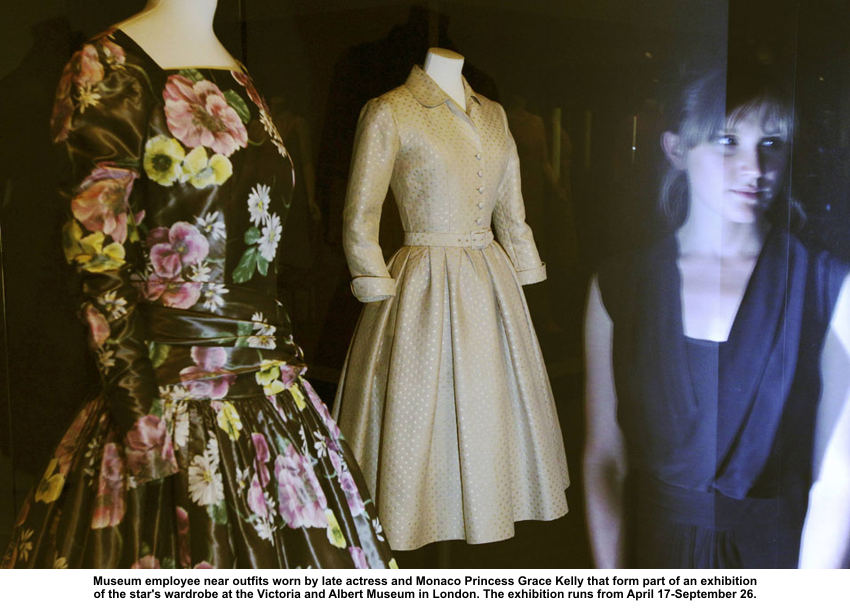
But much to my chagrin, I discovered that the exhibit is not posted online at the V & A. I was, at first, incredibly disappointed. In a mad haste, I scoured the Internet for images of the fashion display on newssites and blogs. I found a lot of articles but precious few images of the actual exhibit. But what I did find told a lot. To illustrate a point, here are two of those V & A showcase windows:  

A mannequin displays the dress Grace Kelly wore in “The Swan.” (1956) The exhibit, “Grace Kelly: Style Icon,” is at the Victoria & Albert Museum in London from April 17- September 26, 2010

The exhibition at the Victoria & Albert Museum in London, “Grace Kelly: Style Icon,” includes dresses worn by Grace Kelly after she became Princess Grace of Monaco in 1956.

Yawn. Pretty dry stuff, huh? Dresses on mannequins have no sparkle. What they needed was Grace Kelly.

Grace Kelly as Lisa Fremont in Alfred Hitchcock’s 1954 thriller, “Rear Window.” (“Grace Kelly: Floating on Chiffon,” Lisa’s History Room)

So instead of trying to catalog for you all the dresses in the V & A, I have picked my personal favorite and shown it as worn by the eternally beautiful Grace Kelly. It is the Paris dress she wore as sophisticate Lisa Carol Fremont in the 1954 Alfred Hitchcock classic, “Rear Window.”

The dress with a fitted black bodice and deep V-cut bustline was designed for Kelly by Paramount Picture’s chief costume designer Edith Head. The full skirt falls to mid-calf, gathered and layered in white chiffon and tulle. From the nipped-in waist, a spray branch pattern falls playfully over the hip. Grace accessorized her high-fashion gown with white silk gloves, pearls, and a chiffon shoulder wrap.

To read the “Rear Window” script excerpt wherein “Lisa-Carol- Fremont” enters Jimmy Stewart‘s apartment wearing this outfit, click here.

Grace Kelly sits on steps in her “Paris” dress she wore in Alfred Hitchcock’s 1954 “Rear Window.” The gown had a light & airy quality with a slender waist and a beautiful skirt made from yards and yards of tulle and chiffon. The black and white confection was created by Paramount Pictures costume designer Edith Head. (“Grace Kelly: Floating on Chiffon,” Lisa’s History Room)

For more on Grace Kelly, click here.

Read Full Post »

Imelda Marcos (b. 1929), “one of the ten richest women in the world” (Cosmopolitan magazine, December, 1975)

In December, 1975, Cosmopolitan magazine named Imelda Marcos, the First Lady of the Phillippines, as one of the ten richest women in the world. It even went a step further and speculated that Imelda was perhaps the richest woman in the world, richer than Queen Elizabeth II of Great Britain.

Everyone knew Imelda was rich; she made sure of that. She had an insatiable desire for expensive things and flaunted them. No one at the time really knew where she got all the money that she spent so impulsively. She was, after all, unemployed and had no independent wealth. In addition, her husband, the dictator, Ferdinand Marcos, had made less than $5,000 a year for the last ten years in office.

Nonetheless, there was Imelda, spending $40,000 on a Honolulu shopping spree in 1974, without trying anything on. Her excess knew no limits and she spared herself no luxury:

“Another report had Imelda and a gaggle of friends demanding Bloomingdale’s in New York be closed for a private shopping extravaganza, then marching through the store pointing to desired items and saying, ‘Mine. Mine. Mine. Mine.’”(1) She was referred to by one sales clerk as ‘the Mine Girl.’

Imelda Marcos from a Vanity Fair interview, 2007

Imelda Marcos from a Vanity Fair interview, 2007

Responding to criticism of her self-indulgence and the spending of public money for high-profile projects that did nothing to alleviate the poverty of the Filipinos, Imelda remarked that is was her “duty” to be “some kind of light, a star to give [the poor] guidelines.”

By 1981, Imelda’s personal popularity was at an all-time high. She jetsetted around the globe, shopping and hobnobbing with celebrities such as the perennially-tanned American actor George Hamilton.

After having secured the Miss Universe Pageant for the Philippines in 1974 – which necessitated the rapid construction of the 10,000-seat Folks Art Center – Imelda continued to indulge her “edifice complex,” building 14 luxury hotels, a multimillion-dollar Nutrition Center, Convention Center, Heart Center and, in 1981, the infamous Manila Film Center.

Imelda Marcos designed the Manila Film Center after the Greek Parthenon, shown here.

Imelda wanted Manila to rival Cannes as a world film capital. At the cost of $25 million, Imelda approved plans for the Manila Film Center to be built to host an international film festival. Opening night was set for January 18, 1982. The project was grandiose and expensive; the building on Manila Bay was designed to look like the Parthenon.

Delays hampered the progress. As the deadline drew nearer, it required 4,000 workers, working in 3 shifts, around the clock, if the building was going to be ready.

Then, at 3 a.m. on November 17, the upper scaffold collapsed and sent workers falling into wet cement. A witness said that some of the workers were impaled on upright steel bars.

Imelda was contacted about the accident. She was told that the recovery of the bodies would take alot of  time – time, evidently, that Imelda didn’t want to give up. She ordered the construction to continue as planned and that the bodies – maybe as many as 169 – be covered with cement. It is believed that many of those who fell into the cement may have been buried alive.

The full story has never been told, as news crews, rescuers, and ambulance teams were barred from the scene for nine full hours, while the government, under martial law, prepared its official version of events, censoring all news and silencing all witnesses.

Despite all, the festival opened on schedule on January18, 1981, and had among its guests Brooke Shields, Franco Nero, Ben Kingsley, and Robert Duvall. The first film shown in the theater was the tasteful bioepic, “Gandhi.”  Unknowingly, the stars partied atop a mausoleum of dead workers.

Brooke Shields (b. 1965) was only 16 years old when she traveled to Manila for the international film festival as the guest of First Lady Imelda Marcos.

“During opening night, Imelda ‘strode on stage in a Joe Salazar black and emerald green terno with a hemline thick with layer upon layer of peacock feathers.’ “Some said there were diamonds embedded in the skirt.

The next year, as a result of the accident scandal, the government withheld $5 million in festival funding. Imelda was in a fix. She had to pay for the festival somehow, so she ran pornography films in the festival’s second and, understandably, last year.

(1) Klaffke, Pamela. Spree: A Cultural History of Shopping.

Readers: For more on Imelda and Ferdinand Marcos on this blog, click here.   

A close-up of Imelda Marcos looking into a gold-plated compact mirror, her first name encrusted in diamonds. Called the ‘Steel Butterfly,’ Imelda Marcos was the beautiful wife and confidante of Philippine dictator Ferdinand Marcos. The Marcos regime (1965-86) was marked by notorious corruption, political repression, and financial improprieties of the highest order.

For other resources, click here.


Read Full Post »

Mary Mallon (1869-1938) was nicknamed "Typhoid Mary," and gained notoriety as history's most famous super-spreader of disease. ("Typhoid Mary," Lisa's History Room)

Yes, there really was a Typhoid Mary. She was Mary Mallon (1869-1938) an Irish immigrant who cooked for wealthy New York families. She is history’s most famous super-spreader of disease.  

Mary Mallon was first caught in 1906 when a sanitary engineer was hired to investigate a typhoid outbreak at Oyster Bay, Long Island. Six members of banker Charles Henry Warren’s household had fallen dangerously ill. Warren hired George Soper to discover the source of the contamination before the highly-contagious and deadly disease spread across the privileged enclave of Oyster Bay. (1)  Oyster Bay was the site of Sagamore Hill, known as “the Summer White House” of President Theodore Roosevelt from 1902-1908.

George Soper took his assignment very seriously. He first checked the household plumbing. He put dye in the toilet to see if it contaminated the drinking water. It didn’t.  He checked the local shellfish to see if the bay was polluted with sewage. It wasn’t. He examined the milk supply in case it was contaminated. It, too, was free of bacteria. (2)   

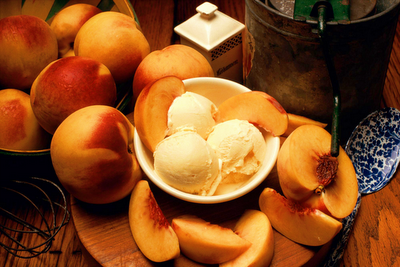
Next, he interviewed the staff. He found that the family had changed cooks on August 4th, when Warren had hired Mary Mallon. Shortly after Mary began as cook, Soper was informed, she had served the household a favorite dessert for Sunday dinner: ice cream topped with freshly-cut peaches

"Typhoid Mary" Mallon served homemade ice cream and freshly-cut peaches to the Warren household before six of them were sickened.

"Typhoid Mary" Mallon served homemade ice cream and freshly-cut peaches to the Warren household. ("Typhoid Mary," Lisa's History Room)

On August 27, Warren’s daughter, Margaret, fell ill with typhoid fever. Next, Mrs. Warren and two maids became ill, followed by the gardener and another of the Warrens’ daughters.  

Knowing that typhoid typically goes from exposure to outbreak in three weeks’ time, Soper had Clue #1: The epidemic had begun with the arrival of the new cook. If his suspicion was correct, Mary Mallon was a carrier who had passed on the disease when preparing the peaches with unscrubbed hands.  

Unfortunately, when Soper made this astonishing discovery, Mary no longer worked at the Warrens’. Undeterred, Soper set out to find her. Checking with her employment agency, Soper discovered a second and even more astounding truth:  Typhoid had struck seven of the last eight families Mary had worked for. Mary Mallon was spreading typhoid in her path – and she had to be stopped.

But, first, Soper had to prove scientifically that Mallon was a carrier.  

This 1883 Puck drawing shows the New York City Board of Health wielding a bottle of the disinfectant, carbolic acid, in an attempt to keep cholera at bay. Immigrants poured into New York City at the turn of the Twentieth Century. Crowded into unsanitary slums, disease ran rampant. By 1890, the era of bacteriology had arrived and scientists understood that diseases like typhoid and cholera arose from germs. Efforts were made to not just clean up the cities but isolate the disease carriers. ("Typhoid Mary," Lisa's History Room)

Mary was difficult to find, but Soper tirelessly tracked her down. Rather overzealously, he  

“confronted her in her next employer’s kitchen and asked for blood, urine, and stool samples; she swore she had never been sick and advanced on him with a carving fork. He called in the New York City health department; she threatened its doctor.  

Finally, it took five police officers and a chase over backyard fences to subdue her and get her a hospital. High levels of Salmonella typhosa bacilli were found in a stool sample. She was quarantined in a cottage on the Riverside Hospital grounds on an island in the East River.”  (1)

Mary Mallon - "Typhoid Mary" - in quarantine on North Brother Island in the East River

Mary Mallon was a medical prisoner. She had been jailed without a trial. Although she was a carrier of typhoid, she was perfectly healthy. She had been shut up in a sanitarium with tubercular patients. She had been treated like a leper.  

She sued. People felt sorry for her. Not everyone felt her imprisonment was deserved. In time, she went from Public Menace #1 to a cause célèbre.  

Part of the New York American article of June 20, 1909, which first identified Mary Mallon as "Typhoid Mary."

“Eventually, a new health commissioner decided that Mallon could be freed from quarantine if she agreed to no longer work as a cook and to take reasonable steps to prevent transmitting typhoid to others.  

 Eager to regain her freedom, Mallon accepted these terms. On February 19, 1910, Mallon agreed that she “[was] prepared to change her occupation (that of cook), and w[ould] give assurance by affidavit that she w[ould] upon her release take such hygienic precautions as w[ould] protect those with whom she c[ame] in contact, from infection.”   

She therefore was released from quarantine and returned to the mainland.” (3)  

But, alas and alack, that’s not the end of the story. For a while after her release, Mary kept her word and worked as a laundress, which paid lower wages than a cook.  It was not long afterward, though, that she adopted an assumed name – Mary Brown – and went back to work as a cook. 

In 1915, while working as a cook at New York’s Sloane Hospital for Women, she infected 25 people, one of whom died. The typhoid bacteria was traced to a pudding Mary had prepared. She was subsequently arrested and returned to quarantine on the island, where she was confined until her death in 1938.  

The cottage on North Brother Island in New York's East River where Mary Mallon, better known as "Typhoid Mary," was quarantined (1907-1910; 1915-1938).

Mary Mallon (wearing glasses) photographed with bacteriologist Emma Sherman on North Brother Island in 1931 or 1932, over 15 years after she had been quarantined there permanently. She worked at the facility and her lab coat was reported to be filthy. (Typhoid Mary: An Urban Historical by Anthony Bourdain)

(1) “The Deadly Trails of Typhoid Mary,” by Donald G. McNeil, Jr. The New York Times, April 14, 2003.  

(2) “The Most Dangerous Woman in America,” NOVA, aired Oct. 12, 2004.

Read Full Post »

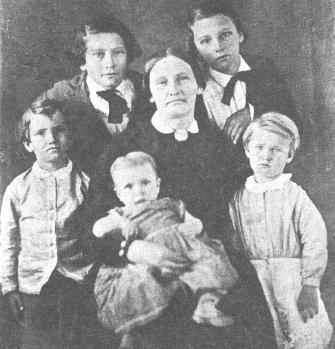
In this 1851, Texas pioneer Mary Adams Maverick is shown with 5 of her children. In 21 years, she bore 10 children. Four died of illness before reaching the age of 8. Her first-born, Sam, Jr., lived to be 98.

In this 1851 photograph, Texas pioneer Mary Adams Maverick is shown with 5 of her children. In 21 years, she bore 10 children. Four died of illness before reaching the age of 8. Her first-born child, however, lived to be 98!

On August 4, 1836, Mary Ann Adams Maverick (1818-1898) married Samuel A. Maverick, in Mary’s hometown of Tuskaloosa, Alabama. Mary was 18: Sam, 33. Sam had recently returned from Texas where he had fought in the Texas Revolution.

For the next several months, the newlyweds traveled throughout the South, visiting relatives, before arriving at Sam’s family home in South Carolina. There, on May 14, 1837, Mary gave birth to their first child, a boy.

Sam’s father did everything in his power to induce his son and family to settle with him in South Carolina. “Father Maverick” offered Sam and Mary a plantation complete with mills, vineyards, orchards, lands, and shops. Or, if a plantation wasn’t their fancy, he offered instead a new style house and improvements.

But Father Maverick’s efforts were “all in vain,” wrote Mary in her memoirs,

“for my husband dreamed constantly of Texas, and said: ‘We must go back.'” (1)

Sam wanted to build his land empire in the new Republic of Texas.

In October 1837, Mary, Sam, and their baby boy left South Carolina for Alabama. For the next six weeks, they – and their 10 “negroes” – stayed with Mary’s family while they made final preparations for their long overland journey to Texas.

“December 7, 1837, we set off for Texas. With heavy hearts, we said goodbye to Mother, and my brothers and sister. Mother ran after us for one more embrace. She held me in her arms and wept aloud, and said: ‘Oh, Mary, I will never see you again on Earth.’ I felt heartbroken and often recalled that thrilling cry; and I have never beheld my dear Mother again.” (1)

 
(1) Green, Rena Maverick (ed.). Memoirs of Mary A. Maverick. The Alamo Printing Co., San Antonio, 1921.

Read Full Post »

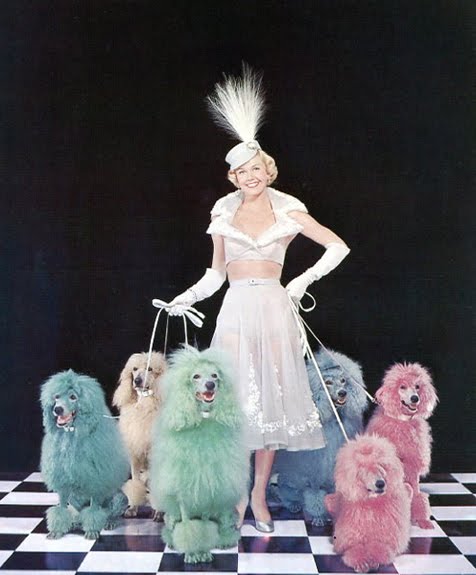
To promote the film, "April in Paris," Doris Day appeared on a 1952 Collier's magazine cover with six dyed poodles.

Doris Day appears on the cover of Collier's 1952 magazine to promote her new film, "April in Paris." With her are 6 dyed poodles. Poodles became the most popular dog in the 1950s, when poodle skirts made their debut.

In post WWII America, the poodle dog became the rage. It went from being the 25th most popular dog in 1946 to No. 1 in 1960. All of a sudden, poodles

…were chic; they stood for modernity and sophistication, which anyone could shoot for, whether they were rich or just wanted to appear a la mode. Teenage girls wore stylish poodle skirts decorated with felt-appliqued French poodles wearing rhinestone collars; ladies bought handbags with embroidered poodles on the side and decorated their powder rooms with wallpaper that had pictures of poodles strolling down the Champs-Elysees. (1)

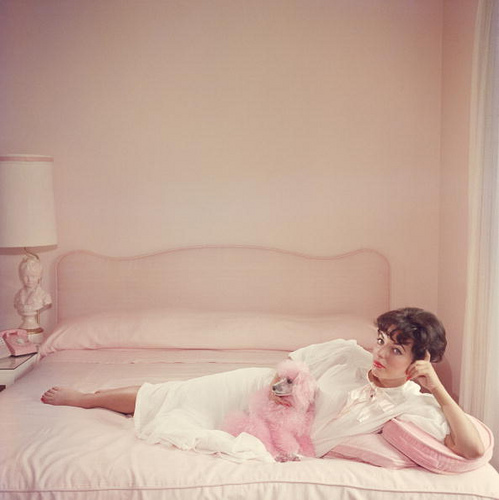
In the fifties, every glamorous movie star had a poodle – or was photographed with one.

Actress Joan Collins with her dyed pink poodle

Although they are not French, poodles came to be called “French poodles,”  recalled for their clever antics in French circuses. Thus, Americans bought poodles and gave them French names like Fifi, Gigi, and Pierre. They also took them to fancy groomers:

To gaze upon a standard (full-size) poodle in a “Miami Sweetheart” cut with centered fur hearts on hips and back, pantaloon legs sculpted lathe-smooth, tassel ears, a Van Buren mustache drooping from its muzzle, a ribboned topknot, and a wagging pompon tail, parading along the boulevard in a rhinestone collar at the end of a jeweled lead, is to see an animal that has become a walking, barking work of art.

Then the poodle enthusiasts went a step further. They attempted to make an animal that was already cute even cuter. They began to use vegetable dyes to dye the dogs to match their owners’ houses, moods, and outfits. Movie actress Doris Day epitomized this fad when she appeared in the movie, “April in Paris,” with six dyed poodles on leashes.

Read Full Post »

"What I Saw in the Water or What the Water Gave Me," by Frida Kahlo, 1938. Frida painted herself in the bath. The right foot shows a bleeding sore between the deformed big toe and second toe. By the early 1940s, Frida would be in constant pain from her back and right foot. She would be forced to take to her bed and wear a series of body casts.

(First see “Frida Kahlo Had Childhood Polio Part 1.”)

Frida Kahlo (1907-1954)

Mexican artist Frida Kahlo‘s childhood polio caused more than a slight deformity in her right leg. The decreased circulation to the limb caused her lifelong problems and pain.

From November 1-15, 1938, the first exhibition of Frida’s paintings was held at the avant-garde Julien Levy Gallery in New York City. At her opening, Frida looked spectacularly exotic in her Mexican costume, her starched bouffant skirts falling below her ankles.

"Frida on White Bench," photograph by Nickolas Muray, 1939

While the effect of her unusual outfit was striking and a perfect complement to her 25 paintings displayed in Mexican folkloric frames of metal, glass, and tin, Frida’s skirts played more than a decorative role. Frida explained:

“I must have full skirts and long, now that my sick leg is so ugly.”

The press was delighted with the paintings and Frida was the “flutter of the week in Manhattan.” During the course of the exhibition, Julien Levy wanted to show Frida the town. He took her bar-hopping in Harlem. He recalls:

“She didn’t jump to it, possibly because she was tired, and she couldn’t enjoy herself late at night. Bar-hopping is not easy to do if you are not light on your legs. She couldn’t overcome invalidism. After walking three blocks, her face would get drawn, and she’d begin to hang on your arm a little bit. If you kept walking, that would force her to say, ‘We must get a cab.'”

Frida’s right foot was the problem – again. She had developed warts on the sole of her foot. Of course, her spine ached. After her exhibit closed, she fell seriously ill. She saw a round of specialists, finally discovering Dr. David Glusker, who succeeded in closing the trophic ulcer that she had had on her foot for years.

Frida Kahlo in bed c.1950s

That was in 1938. Frida was to suffer pain for many more years, her degenerative spinal condition a result of the childhood polio and her streetcar accident in 1926. Some historians have suggested that Frida may have suffered from yet a third problem. They think that Frida could have been born with spina bifida, which further complicated her spine and leg issues.

Over the course of her lifetime, Frida would endure over 30 surgeries, multiple hospitalizations, and countless months of bedrest. Frida managed the constant pain with copious amounts of brandy and pills.

In 1953, gangrene set into her right foot and her leg had to be amputated below the knee. Frida was devastated.

After the 1953 amputation of her right leg below the knee because of her gangrenous right foot, Frida drew this image of her feet in her diary. She tried to make light of the loss, writing the poignant phrase, "Pies para que los quiero, si tengo alas pa' volar?" (Feet, why do I want them if I have wings to fly?)

The next year, Frida was dead from a morphine overdose, self-administered, probably a suicide.

READERS: For more posts on Frida Kahlo, click here.

Read Full Post »

“Portrait of My Father,” (1951), Mexican artist Frida Kahlo shows us her photographer father Guillermo Kahlo with the tool of his trade – a camera.

From an early age, Mexican artist Frida Kahlo (1907-1954) identified with her German-born father, Guillermo Kahlo, a portrait photographer. In her diary, she wrote (in Spanish):

“My childhood was marvelous because, although my father was a sick man [ he had epilepsy], he was an immense example to me of tenderness, of work (photographer and also painter)….”

Frida Kahlo as photographed by her father, Guillermo Kahlo (1872-1941) in 1926 at about age 19. This was taken after Frida's horrific bus accident.

Guillermo Kahlo taught young Frida how to use a camera and how to develop, retouch, and color photographs. He adored Frida and photographed her often. Perhaps this is when Frida developed her obsession for self-portraiture.

Frida Kahlo (l) at about age 19 with her family (c. 1927)

Definitely, by this time, Frida Kahlo had discovered how to seduce the camera. In this 1927 (perhaps 1924?) family photo, Frida appears androgynous, flouting convention by wearing a man’s suit and slicking back her hair. She was quite the rebel. Meanwhile, her sisters and mother pose demurely nearby in period flapper attire. Frida, however, has adopted a jaunty pose and an expression that says:

“Don’t look at them. Look at me!”

We can’t help staring at her.  At 19 she is already an exotic creature. Thus began Frida Kahlo’s long and celebrated career of using personal dress as theatre.

READERS: For more posts on Frida Kahlo, click here.

Read Full Post »

Mexican artist Frida Kahlo (1907-1954)

At the age of six, Frida Kahlo was stricken with polio. It affected her right leg. She spent nine months in bed.

“‘It all began with a horrible pain in my right leg from the muscle downward,” she remembered. ‘They washed my little leg in a small tub with walnut water and small hot towels.'”

Once she was out of bed, her doctor insisted that Frida exercise to build up her weaker leg. Her father got her involved in all kinds of sports, a decidedly male domain in 1914 Mexico. However, Frida played soccer, boxed, wrestled, and became a champion swimmer. (1) She climbed trees, rowed on the lakes of Chapultepec Park, and played ball.

Frida Kahlo is shown at far right, with sister Cristina (l) and best friend Isabel Campos (c). The photo was taken by Frida’s father, Guillermo Kahlo, in 1919, when Frida was about 12.

Despite her best efforts, her right leg remained very skinny. To disguise that fact, she wore three or four socks on her thin calf and shoes with a built-up right heel. While some of her friends admired her stamina despite her deformity, other children teased her:

“Frida’s childhood friend, the painter Aurora Reyes, says: ‘We were quite cruel about her leg. When she was riding her bicycle, we would yell at her, ‘Frida, pata de palo!’ [Frida, peg leg], and she would respond furiously with lots of curses.'”

Frida Kahlo and Diego Rivera at a demonstration of the Syndicate of Technical Workers, Painters, and Sculptors, May 1, 1929

In this photo, Frida is shown marching in a skirt that hits below the knee – thus exposing her obviously thinner right calf. Not long after this photo was taken, Frida began to wear elaborate, floor-length skirts –  to hide her emaciated leg from public view.

Frida Kahlo with pigeons, ca. 1940s by Juan Guzmán.

(1) Herrera, Hayden. Frida: A Biography of Frida Kahlo. New York, Harper, 1983.

Now read: “Frida Kahlo Had Childhood Polio Part 2.”

READERS: For even more posts on Frida Kahlo, click here.

Read Full Post »

Jackie and President Jack Kennedy land at Orly Airport, Paris, on May 31, 1961

It was May 31, 1961, when Air Force One, carrying  American President John and First Lady Jackie Kennedy, landed on the tarmac at Orly Airport in Paris. The president was less than five months into his term of office and this was his first European stop. The Kennedys were greeted by French President Charles DeGaulle and Madame DeGaulle. The contrast between the trim and stylist Americans and their “grizzled” counterparts was striking.

“As soon as the crowds pressed against the airport fences spotted Jackie in her navy-blue silk suit and black velvet pillbox hat, they broke into a rhythmic chant: ‘Vive Jacqui! Vive Jacqui!’ (1)

First Lady Jackie Kennedy is greeted warmly by Parisians on May 31, 1961. Her style was understated: a wool suit, double strand of pearls, and her trademark pillbox hat. The French were captivated by "Zhak-kee."

Hundreds of thousands of people followed their motorcade through the streets of Paris, waving little French and American flags as the open limousine carrying Jack and DeGaulle passed by. When the second car appeared, carrying Jackie and Madame DeGaulle, the crowd sent up a wild roar.  Later, during an official luncheon at the Palais de L’Elysée, Jackie chattered away in French about Louis XVI, the Bourbons, and French geography. DeGaulle turned to Jack Kennedy and said:

‘Your wife knows more French history than any Frenchwoman!’ [He then] turned back to Jackie and did not take his eyes off her for the rest of the meal.” (1)

The Hall of Mirrors at Versailles

The next night was the big event of the three-day visit: a candlelit supper in the Hall of Mirrors at the Palais de Versailles. Jackie wanted to look extra good. But to look good, Jackie had to “feel good” – and Jackie didn’t.  She suffered from migraines and depression since her C-section 6 months earlier.  Jack didn’t feel good either. His back pain was  agonizing.  That’s why, on this trip to Europe, Jack had brought along not just his extra-firm horsehair mattress but New York physician Max Jacobson. Presidential photographer and friend Mark Shaw had referred President Kennedy to Dr. Jacobson. Jacobson’s “miracle injections” instantly stopped Jack Kennedy’s pain. Jack didn’t know what was in the shots – only that they worked.

First Lady Jackie Kennedy wore this graceful Givenchy gown to the June 1, 1961 dinner at the Palace of Versailles.

The night of the Versailles dinner, Max visited Jack Kennedy at the Palais des Affaires Estrangères. Jack occupied a suite of rooms called “the King’s Chamber” in the elegant 19th Century palace on the Quai d’Orsay. The president soaked his back in “a gold-plated bathtub the size of a pingpong table” (2) then Max gave him his customary injection. Max then ambled down the long hallway to the Queen’s Chamber and was admitted to Jackie’s bedroom.

“Jackie sat in front of a mirror, being fussed over by Alexandre, the famous Parisian hairdresser, and a bevy of his assistants….In another part of the room, Jackie’s maid was laying out two different gowns for the evening – one an American design by Oleg Cassini, and the other a French creation by Hubért de Givenchy. Earlier, Jackie had planned to wear the Cassini [Jack preferred her to wear American clothes], but then she was not so sure.”   (2)
 

Alexandre finished with Jackie’s hair and left the room so she could slip into her gown. But first Jackie motioned to Max. She was ready for her shot. The short, dark-haired man with the red cheeks and German accent reached into his black doctor’s bag and withdrew a syringe.

“He injected his magic elixir into her buttock. She was ready for Versailles. She took one last look at the two ball gowns hanging side-by-side…and chose the one she knew would attract the more favorable reaction from the French press [and play up her French bloodline]. She slipped into the Givenchy….” (2)

Jackie Kennedy with French President, Charles de Gaulle, June 1, 1961

Jackie Kennedy dazzled French President Charles DeGaulle at this June 1, 1961, dinner in the Hall of Mirrors at the Palace of Versailles. 150 guests ate a 6-course dinner served on Napoleon's gold-trimmed china. Jackie sported an elaborate topknot with a diamond tiara. Her rhinestone-studded white satin gown with embroidered bodice was by French designer Givenchy.

Jackie dazzled everyone at the dinner, and it is no wonder. Dr. Jacobson’s shots were a mixture of amphetamines, vitamins, painkillers, and human placenta. (3)  The mysterious physician referred to his particular brand of therapy as “miracle tissue regeneration.”

“You feel like Superman,” said writer Truman Capote, one of the high-profile clients who experienced instant euphoria from Dr. Feelgood’s injections of ‘speed.’ “You’re flying. Ideas come at the speed of light. You go 72 hours straight without so much as a coffee break….Then you crash….” (2)

The crash for Dr. Jacobson came in 1969 when his patient and Kennedy friend Mark Shaw died at the young age of 47 due to “acute and chronic intravenous amphetamine poisoning.” The Bureau of Narcotic and Dangerous Drugs discovered that Dr. Jacobson was buying huge quantities of amphetamines in order to deliver high level amphetamine doses to his clients. “Miracle Max” and many of his clients had become amphetamine addicts. Dr. Jacobson’s medical license was revoked in 1975.  

(1) Spoto, Donald. Jacqueline Bouvier Kennedy Onassis: A Life. New York: St. Martin’s Press, 2000.

(2) Klein, Edward. All Too Human: The Love Story of Jack and Jackie Kennedy. New York: Simon & Schuster Inc., 1996.

(3) Leaming, Lawrence. The Kennedy Women: The Saga of An American Family. New York: Random House, 1994.

Read Full Post »

Elizabeth Taylor with husband #2: Michael Wilding: Married 21 February 1952, Divorced 30 January 1957

On May 12, 1956, Anglo-American film actress Elizabeth Taylor and her second husband Michael Wilding threw a dinner party at their Beverly Hills home. It was a bad night for a party. For the first thing, it was foggy and the Wildings lived up a long and winding road in Benedict Canyon. For the second thing, the Wildings’ marriage was on the rocks. Elizabeth was having an affair and Michael’s out-of-control drinking had led to several indiscretions with other women. 

The guest of honor was to be Father George Long, a hip priest who ran with the Hollywood set. Rock Hudson and his new wife Phyllis Gates were invited. So was Kevin McCarthy, who was then making “Invasion of the Body Snatchers.” 

Montgomery Clift was another actor on the guest list. That spring, he and Elizabeth were shooting the MGM Civil War melodrama, “Raintree County.” 

Montgomery Clift and Elizabeth Taylor in "Raintree County" (1957)

(Elizabeth had just finished filming “Giant” which would be released in October of that same year.) 

Elizabeth Taylor and Rock Hudson in "Giant" (1956)

Monty and Elizabeth had become best friends in 1951 during the filming of “A Place in the Sun.” Monty affectionately referred to Elizabeth as “Bessie Mae.” She was his confidante. Monty Clift was a rising star, known for his sensitive and brooding portrayals of troubled young men. He was very intense and deeply serious about acting. 

"A Place in the Sun" (1951) with Montgomery Clift and Elizabeth Taylor

At first Monty declined the invitation at Liz’s. He was awkward being around the Wildings while their marriage was so bad. But he changed his mind and agreed to join the group for dinner, leasing a car and driving up the mountain road to the Wildings’ house. 

The party turned out to be a terrific bore. The guest of honor didn’t even show. Michael Wilding wasn’t feeling well and spent the evening lounging on the couch, saying virtually nothing to the company and acting aloof. That made Elizabeth nervous so she was unusually chatty. Monty grumbled about the way the MGM director Edward Dmytryk was shooting everything in “Raintree County” in giant close-ups. He was depressed and angry. He sensed the film would be a colossal disaster. 

The party broke up about midnight with Monty and Kevin bidding each other goodbye in the driveway and taking off down the road Elizabeth called a “cork twister.” Kevin was in the lead. Within minutes, Kevin was back at Elizabeth’s house, ringing the bell. Monty Clift had had a serious car accident. His car had struck a utility pole as he rounded one of the hairpin turns in the fog. Elizabeth shrieked and demanded that Kevin immediately take her to the scene. 

Montgomery Clift, Elizabeth Taylor, and Eva Marie Saint in "Raintree County" (1957)

Since the 1950, many unflattering things have been written about Elizabeth Rosemond Taylor who is now a Dame of the British Empire, and much of it was justified. (She tended to steal people’s husbands.) But what was to happen next on that foggy stretch of midnight road below her house was to be Elizabeth’s finest hour. 

She and Kevin arrived at the wreck:

“Monty’s car was demolished, an ‘accordion-pleated mess,’ Elizabeth said. A 4,800 transformer, knocked off the pole by the impact, had narrowly missed hitting the car. McCarthy thought his friend was dead. ‘The doors were so jammed that we couldn’t get to him,’ he said.” (1)  

Broken glass was everywhere – but that didn’t faze Elizabeth. She climbed in the car through a back window.  

“‘Adrenaline does something to you,’ she remembered.” 

Elizabeth hauled herself over the bloody seat. Monty’s motionless body lay beneath the steering wheel. His face was barely recognizable. 

“‘It was like pulp,’ she remembered.” 

Elizabeth called out to Monty. He reacted to her voice and indicated to her that he was choking. Several of his teeth had broken off and had lodged in the back of his throat. Reaching inside his mouth, Elizabeth pulled the teeth out, one by one. Elizabeth saved his life. Monty could once again breathe.

It was nearly an hour before an ambulance arrived and, with it, a handful of frenzied photographers. Elizabeth positioned herself between the stretcher carrying Monty and the photographers’ cameras. “She was remarkable,” said McCarthy. She told the photographers that if they so much as snapped one photo of Monty’s bloodied face, she’d never allow her to take another photo of her. (That would never do. Elizabeth Taylor was one of Hollywood’s top actresses and would become one of the most photographed women in the world.) The photographers backed off.

The car accident left Elizabeth with persistent nightmares. She couldn’t get Monty’s bloody face out of her mind.

“It would come up like a balloon in front of me at night.” 

"The Misfits" (1961) stars Clark Gable, Marilyn Monroe, and Montgomery Clift

Understandably, filming on “Raintree County” was put on hold as Monty underwent a long hospitalization and painful facial reconstruction. Despite these efforts, Monty never looked as beautiful as before. His face remained scarred and partially paralyzed. This was the beginning of Monty’s long and deadly slide into alcohol and drug addiction. He became a wrecked man.

Marilyn Monroe, who appeared alongside Monty in the 1961 film, “The Misfits,”  described him as 

“the only person I know who is in worse shape than I am.” 

Monty’s post-accident career has been called “the longest suicide in Hollywood history.” In 1966, ten years after his car accident, Montgomery Clift died alone in his New York apartment while watching “The Misfits” on TV. He was only 45. 

(1) Mann, William J. How to Be a Movie Star: Elizabeth Taylor in Hollywood. New York: Houghton Mifflin Harcourt Publishers, 2009.

Read Full Post »

"The Broken Column," by Frida Kahlo (1944). This self-portrait shows the artist's spine as a broken Ionic column. Frida's health had deteriorated to the stage that she had to wear a steel corset.

"The Broken Column," by Frida Kahlo (1944). This self-portrait shows the artist's spine as a broken Ionic column. By 1944, Frida's health had deteriorated to such a degree that she had to wear a steel corset to sit up. Her persistent health problems stemmed from childhood polio, a traffic accident, and botched spinal surgeries.

For her entire adult life, artist Frida Kahlo (1907-1954) suffered unbearable pain from her spine and foot. (See “Frida’s First Bad Accident.”) She endured over thirty surgeries to correct the problem (in both Mexico and the U.S), was subjected to batteries of tests, X-rays, and spinal taps, given blood transfusions, physical therapy, and strong medicine . Yet, despite such extreme measures, Frida’s health continued to deteriorate.

After 1944, Frida’s doctors prescribed months of  bed rest, encasing her tortured body in a succession of plaster or steel corsets that helped her to sit or stand. Frida described these corsets and the treatments that accompanied them as “punishment.”

“There were twenty-eight corsets in all–one made of steel, three of leather, and the rest of plaster. One…allowed her neither to sit nor to recline. It made her so angry that she took it off, and used a sash to tie her torso to the back of a chair in order to support her spine.

There was a time when she spent three months in a nearly vertical position with sacks of sand attached to her feet to straighten out her spinal column. Another time, Adelina Zendejas, visiting her in the hospital after an operation, found her hanging from steel rings with her feet just able to touch the ground. Her easel was in front of her. “We were horrified,” Zendejas recalls. “She was painting and telling jokes and funny stories….”

Yet another gruesome tale comes from Frida’s friend the pianist Ella Paresce. A Spanish doctor who knew nothing about orthopedics put a plaster corset on Frida….”[D]uring the night, the corset began to harden, as it was supposed to do. I happened to be spending the night there in the next room, and about half past four or five in the morning, I heard a crying, nearly shrieks. I jumped out of the bed and went in, and there was Frida saying she couldn’t breathe!….The corset had hardened…so much that it pressed her lungs. It made pleats all around her body. So I tried to get a doctor. Nobody would pay any attention at that hour…so…I took a razor blade…and made about a two-inch cut [in the cast over her chest] so that she could breathe….[S]he painted the corset, which is still visible in the museum in Coyoacán.” (1)

Diego Rivera kisses his wife Frida Kahlo at the ABC Hospital in Mexico City, 1950

Diego kisses Frida at the ABC Hospital 1950

In the photo here, Mexican muralist Diego Rivera tenderly kisses his wife Frida Kahlo at the Hospital Ingles ABC in Mexico City, 1950. Frida’s botched spinal fusion of 1946 began the “calvary that would lead to the end,” said her friend Cachucha Miguel N. Lira. Her leg was in constant pain. Four toes on her right foot had turned black; gangrene had set in. An amputation was advised. Frida spent a year in the hospital. In the photo, notice that Frida had painted the Communist symbols, a hammer and sickle on her plaster corset. Visitors also signed Frida’s corsets and decorated them with feathers, mirrors, photographs, pebbles, and ink. When Frida’s doctors removed her paints from her sick room, instead, she used lipstick and iodine to paint her cast. (1)

(1) Herrera, Hayden. Frida: A Biography of Frida Kahlo.New York: HarperCollins Publishers Inc., 1983.

READERS: For more posts on Frida Kahlo, click here.

Read Full Post »

Frida Kahlo sits on a white bench, wearing traditional Mexican clothing, in her heavily ornamented and embroidered signature look. Photographed in 1939 in New York by her friend and lover, Nickolas Muray.

Frida Kahlo, New York, 1939, photo by Nicholas Muray. She sits on a white bench, wearing traditional Mexican clothes in the heavily ornamented and embroidered style that became her signature.

“Frida was often heard to say, ‘I look like a lot of people and a few things,’ as if everything that made up her personal appearance was a matter of chance. In fact, it was quite the opposite. Dressing each day was an almost ceremonial affair during which she would try innumerable combinations of blouses and skirts. Her clothes were always immaculately clean and freshly ironed; she was meticulous about the appearance of her pleated petticoats, pure white and starched. She wore native Mexican costumes long after her sophisticated friends had given up this nationalistic gesture, in part for the long skirts that hid her thin leg [from childhood polio] and orthopedic shoe [from a bus accident]….

Frida selected her jewelry each day with equal care, especially the rings she wore on the fingers of both hands. She meticulously applied her make-up and painted her fingernails, sometimes purple, green, or orange….Only a little over 5′ 2″ tall, she seemed taller bcause of the heightening effect of her long skirts, accentuated even more by her elegantly long neck and her upswept hairdo with bows and flowers arranged on top of her head. Her olive skin was covered with a light fuzz; her upper lip had a pronounced moustache, which she made obvious in her self-portraits. The heavy dark eyebrows that grew together across her forehead she turned into a trademark….

When she was finally finished dressing, she looked “like a princess, like an empress’….Scrupulously clean and heavily perfumed…” (1)

Frida Kahlo smoking,  photograph by her friend and lover Nickolas Muray, ca. 1940

Frida Kahlo smoking, photo by her friend and lover, Nickolas Muray, ca. 1940

Frida was a heavy smoker and is often photographed holding a lit, unfiltered cigarette. She seldom smiled for the camera – with good reason. The few photos that have caught her laughing reveal blackened teeth.

(1) Zamora, Martha. Frida Kahlo: The Brush of Anguish. San Francisco: Chronicle Books, 1990.

READERS: For more posts on Frida Kahlo, click here.

Read Full Post »

Frida Kahlo photographed by New York art dealer, Julien Levy (1938)

Mexican artist Frida Kahlo as photographed by New York art dealer, Julien Levy (1938)

“I am not sick. I am broken. But I am happy as long as I can paint.”

To Julien Levy, who prepared Frida Kahlo‘s 1938 New York art exhibition, Frida wrote (in English):

“I never thought of painting until 1926, when I was in bed on account of an automobile accident. I was bored as hell in bed with a plaster cast (I had a fracture in the spine and several in other places), so I decided to do something. I stoled [sic] from my father some oil paints, and my mother ordered for me a special easel because I couldn’t sit down [she means “sit up”], and I started to paint.” (1)

Frida Kahlo paints in bed.

Frida Kahlo paints in bed.

(1) Herrera, Hayden. Frida: A Biography of Frida Kahlo. New York: HarperCollins Publishers, Inc., 1983.

READERS: For more posts on Frida Kahlo, click here.

Read Full Post »

« Newer Posts - Older Posts »