Feeds:
Posts
Comments

Archive for February, 2010

In this 1851, Texas pioneer Mary Adams Maverick is shown with 5 of her children. In 21 years, she bore 10 children. Four died of illness before reaching the age of 8. Her first-born, Sam, Jr., lived to be 98.

In this 1851 photograph, Texas pioneer Mary Adams Maverick is shown with 5 of her children. In 21 years, she bore 10 children. Four died of illness before reaching the age of 8. Her first-born child, however, lived to be 98!

On August 4, 1836, Mary Ann Adams Maverick (1818-1898) married Samuel A. Maverick, in Mary’s hometown of Tuskaloosa, Alabama. Mary was 18: Sam, 33. Sam had recently returned from Texas where he had fought in the Texas Revolution.

For the next several months, the newlyweds traveled throughout the South, visiting relatives, before arriving at Sam’s family home in South Carolina. There, on May 14, 1837, Mary gave birth to their first child, a boy.

Sam’s father did everything in his power to induce his son and family to settle with him in South Carolina. “Father Maverick” offered Sam and Mary a plantation complete with mills, vineyards, orchards, lands, and shops. Or, if a plantation wasn’t their fancy, he offered instead a new style house and improvements.

But Father Maverick’s efforts were “all in vain,” wrote Mary in her memoirs,

“for my husband dreamed constantly of Texas, and said: ‘We must go back.'” (1)

Sam wanted to build his land empire in the new Republic of Texas.

In October 1837, Mary, Sam, and their baby boy left South Carolina for Alabama. For the next six weeks, they – and their 10 “negroes” – stayed with Mary’s family while they made final preparations for their long overland journey to Texas.

“December 7, 1837, we set off for Texas. With heavy hearts, we said goodbye to Mother, and my brothers and sister. Mother ran after us for one more embrace. She held me in her arms and wept aloud, and said: ‘Oh, Mary, I will never see you again on Earth.’ I felt heartbroken and often recalled that thrilling cry; and I have never beheld my dear Mother again.” (1)

 
(1) Green, Rena Maverick (ed.). Memoirs of Mary A. Maverick. The Alamo Printing Co., San Antonio, 1921.

Read Full Post »

"Comanche War Party on the March, Fully Equipped," oil painting by George Catlin, 1846-1848. By the time Texas won its independence from Mexico in 1836, the frontier war between the settlers and the Comanche Indians was at full throttle, with brutal attacks being waged on both sides.

Here is an article that appeared in an 1840 Texas newspaper:

A little remedy against Indian arrows:

Take about 16 or 24 sheets of common blotting paper; lay between them some thin layers of cotton or silk; make a kind of jacket of it to be put on in the moment of danger, and you will be invulnerable from the chin to the leg, from the most of Indian arrows and even bullets. It is no more cowardice than to stand behind a tree or to be a cuirassier [a mounted soldier wearing armor]; and in our big European wars, the lives of many thousands of brave soldiers were thus preserved. I recommend it by experience.

H. Mollhausen, captain of artillery                          

Texas Sentinel, March 1840

Readers, other posts of similar interest are:

The Scalping of Robert McGee

“The Scalping of Josiah Wilbarger”

Read Full Post »

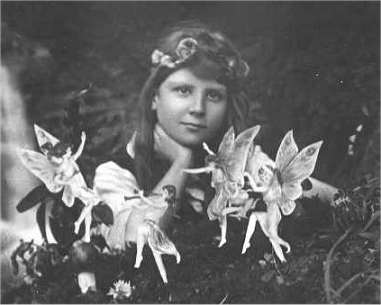
Frances Griffiths is shown playing with fairies in Cottingley Beck, near Bradford in England, in 1917. Her cousin Elsie Wright was the photographer. This is one of 5 photographs the cousins took of themselves playing along a creek with dancing fairies.

Do you believe in fairies? Frances Griffiths, 16, and her cousin Elsie Wright, 10, did. They claimed to play with dancing fairies along the enchanted stream [the beck] behind Elsie’s house in Cottingley Village, England – and they had 5 photographs to prove it. There in the frames, dancing around the girls, were four female fairies!

When Elsie’s parents saw the photos, they didn’t know what to think. Elsie’s father examined them and proclaimed them clever fakes. But Elsie’s mother wasn’t so sure. Mrs. Wright wanted to believe the girls, as she was a spiritualist. [Among the country folk in England at the time was a lively fairy-faith. ] The parents searched the girls’ shared bedroom and around the beck for scraps of paper to reveal tomfoolery. Still nothing turned up. Mrs. Wright was inclined to believe the girls. Her husband made his camera off-limits.

Time passed. At first the photographs were only shared with close friends and family, but, in 1919, Mrs. Wright attended a lecture on fairy life, bringing the prints with her. By 1920 the prints had come to the attention of one of the leading spiritualists of the time, Edward Gardner, who examined them and had two new negatives made, clarifying the pictures.

The story of the Cottingley fairies got even more attention when Sir Arthur Conan Doyle (creator of the Sherlock Holmes mysteries) learned of them.

Detective Sherlock Holmes and Doctor Watson, played by Basil Rathbone and Nigel Bruce. The characters of Holmes and Watson were created by British doctor Sir Arthur Conan Doyle, a renowned spiritualist.

Sir Arthur Conan Doyle was famous for more than his books. He was an outspoken believer in the spirit world. He immediately believed the Cottingley fairy story and began writing letters to the Wright family in support. Doyle published his book The Coming of Fairies in 1922, maintaining until his death that the Cottingley fairies were real.

Still, public opinion was divided. Supporters claimed the photos provided long-awaited proof of the existence of spirits. Others said the photos were nothing more than clever fakes. The Cottingley Fairy Photos caused heated debate. Nevertheless, the girls held to their story, even as they aged.

Finally in 1983 Elsie came clean. She divulged in a letter to a friend that the photographs were indeed a hoax. She described how she and Frances had used the fairies in Princess Mary’s Gift Book as inspiration for cut0uts. They then used hatpins to prop up the paper dolls in the bushes for pictures.

Fairy figures in Princess Mary's Gift Book


Elsie insisted that they had meant no harm. They were just having a bit of fun. It had been Elsie’s idea as a way to get back at her parents for scolding her little cousin. Evidently, her mother and father had gotten angry with Frances for getting her clothes wet one day while playing in the beck. Frances had claimed to be playing with fairies when she’d fallen, and the elder Wrights had teased her. Elsie had come up with the idea of taking the first pictures to have the last laugh. All along they had planned on confessing their little trick until Arthur Conan Doyle got involved. By then, the matter had grown so out of proportion thatthe girls became terrified of a public backlash should they confess.


Elsie Wright is shown receiving a flower from a fairy. This is one of the famous Cottingley fairy photos from 1917.

Read Full Post »

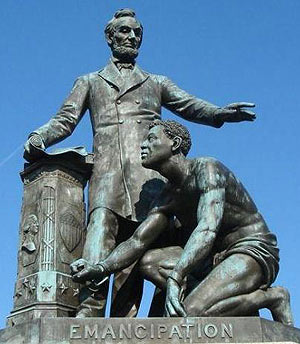
Freedmen’s Monument, Lincoln Park, Washington, D.C.; sculptor, Thomas Ball. The sculpture was funded solely from freed slaves, primarily from African-American Union veterans, to pay homage to the American president who had issued the Emancipation Proclamation, thus liberating them from bondage in the Confederate States. The statue was dedicated on April 14, 1876, 11 years after Abraham Lincoln's assassination by the Confederate rebel John Wilkes Booth. Abolitionist and former slave Frederick Douglass delivered the dedication speech.

Oration in Memory of Abraham Lincoln

Frederick Douglass delivered a speech at the unveiling of the Freedmen’s Monument in Memory of Abraham Lincoln at Lincoln Park, Washington, D.C., on April 14, 1876. This is the conclusion of what Douglass said to the crowd:


“Fellow-citizens, the fourteenth day of April, 1865, of which this is the eleventh anniversary, is now and will ever remain a memorable day in the annals of this Republic. It was on the evening of this day, while a fierce and sanguinary rebellion was in the last stages of its desolating power; while its armies were broken and scattered before the invincible armies of Grant and Sherman; while a great nation, torn and rent by war, was already beginning to raise to the skies loud anthems of joy at the dawn of peace, it was startled, amazed, and overwhelmed by the crowning crime of slavery–the assassination of Abraham Lincoln. It was a new crime, a pure act of malice. No purpose of the rebellion was to be served by it. It was the simple gratification of a hell-black spirit of revenge. But it has done good after all. It has filled the country with a deeper abhorrence of slavery and a deeper love for the great liberator.

Had Abraham Lincoln died from any of the numerous ills to which flesh is heir; had he reached that good old age of which his vigorous constitution and his temperate habits gave promise; had he been permitted to see the end of his great work; had the solemn curtain of death come down but gradually–we should still have been smitten with a heavy grief, and treasured his name lovingly. But dying as he did die, by the red hand of violence, killed, assassinated, taken off without warning, not because of personal hate–for no man who knew Abraham Lincoln could hate him–but because of his fidelity to union and liberty, he is doubly dear to us, and his memory will be precious forever.”

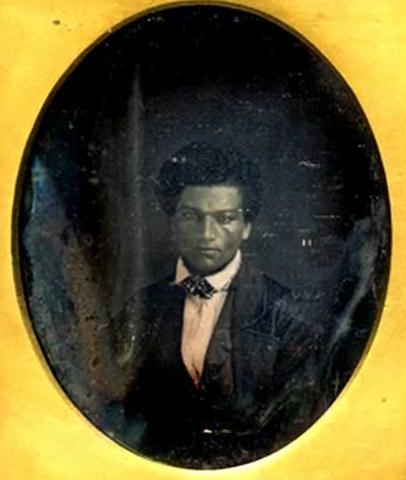
Abolitionist and former slave Frederick Douglass, daguerrotype, 1855. Douglass recruited black men to serve in the Union Army during the Civil War.

Readers, I’ve posted many articles on Abe Lincoln. Scroll down the right sidebar to Categories/People/Abraham Lincoln for more! Enjoy.

Also on this blog: “Frederick Douglass, An American Slave.”

Read Full Post »

The American abolitionist, Frederick Douglass, in a rare photo taken c. 1840, around the time he became a runaway slave.

Frederick Douglass (1817-1895)

The following is an excerpt from the Narrative of the Life of Frederick Douglass, an American Slave (1845), which includes recollections of Douglass’ experiences on a Maryland plantation:

“To describe the wealth of Colonel Lloyd [his master] would be almost equal to describing the riches of Job. He kept from 10-15 house servants. He was said to own a thousand slaves, and I think this estimate quite within the truth. Colonel Lloyd owned so many that he did not know them when he saw them; nor did all the slaves of the out-farms know him. It is reported of him, that, while riding along the road one day, he met a colored man, and addressed him in the usual manner of speaking to colored people on the public highways of the South:

‘Well, boy, whom do you belong to?’

“To Colonel Lloyd,’ replied the slave.

‘Well, does the colonel treat you well?’

‘No, sir,’ was the ready reply.

‘What, does he work you too hard?’

‘Yes, sir.’

‘Well, don’t [sic] he give you enough to eat?’

‘Yes, sir, he gives me enough, such as it is.’

The colonel, after ascertaining where the slave belonged, rode on; the man also went on about his business, not dreaming that he had been conversing with his master. He thought, said, and heard nothing more of the matter, until two or three weeks afterwards. The poor man was then informed by his overseer that, for having found fault with his master, he was now to be sold to a Georgia trader….

It is partly in consequence of such facts that slaves, when inquired of as to their condition and the character of their masters, almost universally say they are contented, and that their masters are kind. The slaveholders have been known to send in spies among their slaves, to ascertain their views and feelings in regard to their condition. The frequency of this has had the effect to establish among the slaves the maxim that a still tongue makes a wise head.”

Also on this blog: “Abe Lincoln: The Freedmen’s Monument

Read Full Post »

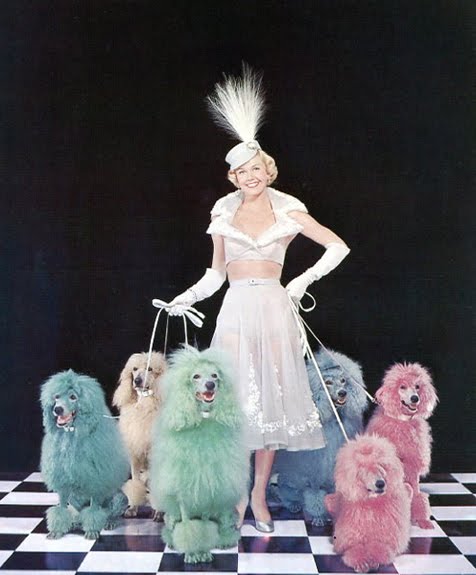
To promote the film, "April in Paris," Doris Day appeared on a 1952 Collier's magazine cover with six dyed poodles.

Doris Day appears on the cover of Collier's 1952 magazine to promote her new film, "April in Paris." With her are 6 dyed poodles. Poodles became the most popular dog in the 1950s, when poodle skirts made their debut.

In post WWII America, the poodle dog became the rage. It went from being the 25th most popular dog in 1946 to No. 1 in 1960. All of a sudden, poodles

…were chic; they stood for modernity and sophistication, which anyone could shoot for, whether they were rich or just wanted to appear a la mode. Teenage girls wore stylish poodle skirts decorated with felt-appliqued French poodles wearing rhinestone collars; ladies bought handbags with embroidered poodles on the side and decorated their powder rooms with wallpaper that had pictures of poodles strolling down the Champs-Elysees. (1)

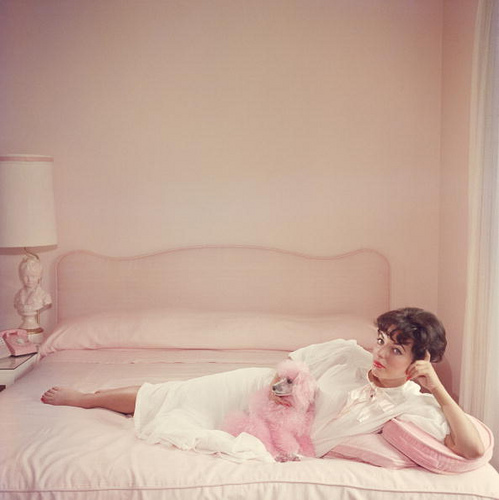
In the fifties, every glamorous movie star had a poodle – or was photographed with one.

Actress Joan Collins with her dyed pink poodle

Although they are not French, poodles came to be called “French poodles,”  recalled for their clever antics in French circuses. Thus, Americans bought poodles and gave them French names like Fifi, Gigi, and Pierre. They also took them to fancy groomers:

To gaze upon a standard (full-size) poodle in a “Miami Sweetheart” cut with centered fur hearts on hips and back, pantaloon legs sculpted lathe-smooth, tassel ears, a Van Buren mustache drooping from its muzzle, a ribboned topknot, and a wagging pompon tail, parading along the boulevard in a rhinestone collar at the end of a jeweled lead, is to see an animal that has become a walking, barking work of art.

Then the poodle enthusiasts went a step further. They attempted to make an animal that was already cute even cuter. They began to use vegetable dyes to dye the dogs to match their owners’ houses, moods, and outfits. Movie actress Doris Day epitomized this fad when she appeared in the movie, “April in Paris,” with six dyed poodles on leashes.

Read Full Post »

"What I Saw in the Water or What the Water Gave Me," by Frida Kahlo, 1938. Frida painted herself in the bath. The right foot shows a bleeding sore between the deformed big toe and second toe. By the early 1940s, Frida would be in constant pain from her back and right foot. She would be forced to take to her bed and wear a series of body casts.

(First see “Frida Kahlo Had Childhood Polio Part 1.”)

Frida Kahlo (1907-1954)

Mexican artist Frida Kahlo‘s childhood polio caused more than a slight deformity in her right leg. The decreased circulation to the limb caused her lifelong problems and pain.

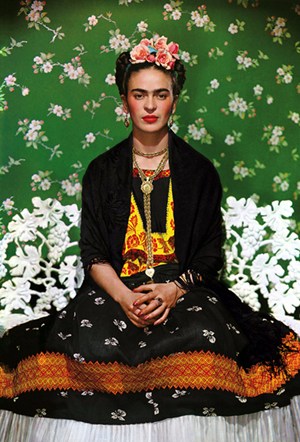
From November 1-15, 1938, the first exhibition of Frida’s paintings was held at the avant-garde Julien Levy Gallery in New York City. At her opening, Frida looked spectacularly exotic in her Mexican costume, her starched bouffant skirts falling below her ankles.

"Frida on White Bench," photograph by Nickolas Muray, 1939

While the effect of her unusual outfit was striking and a perfect complement to her 25 paintings displayed in Mexican folkloric frames of metal, glass, and tin, Frida’s skirts played more than a decorative role. Frida explained:

“I must have full skirts and long, now that my sick leg is so ugly.”

The press was delighted with the paintings and Frida was the “flutter of the week in Manhattan.” During the course of the exhibition, Julien Levy wanted to show Frida the town. He took her bar-hopping in Harlem. He recalls:

“She didn’t jump to it, possibly because she was tired, and she couldn’t enjoy herself late at night. Bar-hopping is not easy to do if you are not light on your legs. She couldn’t overcome invalidism. After walking three blocks, her face would get drawn, and she’d begin to hang on your arm a little bit. If you kept walking, that would force her to say, ‘We must get a cab.'”

Frida’s right foot was the problem – again. She had developed warts on the sole of her foot. Of course, her spine ached. After her exhibit closed, she fell seriously ill. She saw a round of specialists, finally discovering Dr. David Glusker, who succeeded in closing the trophic ulcer that she had had on her foot for years.

Frida Kahlo in bed c.1950s

That was in 1938. Frida was to suffer pain for many more years, her degenerative spinal condition a result of the childhood polio and her streetcar accident in 1926. Some historians have suggested that Frida may have suffered from yet a third problem. They think that Frida could have been born with spina bifida, which further complicated her spine and leg issues.

Over the course of her lifetime, Frida would endure over 30 surgeries, multiple hospitalizations, and countless months of bedrest. Frida managed the constant pain with copious amounts of brandy and pills.

In 1953, gangrene set into her right foot and her leg had to be amputated below the knee. Frida was devastated.

After the 1953 amputation of her right leg below the knee because of her gangrenous right foot, Frida drew this image of her feet in her diary. She tried to make light of the loss, writing the poignant phrase, "Pies para que los quiero, si tengo alas pa' volar?" (Feet, why do I want them if I have wings to fly?)

The next year, Frida was dead from a morphine overdose, self-administered, probably a suicide.

READERS: For more posts on Frida Kahlo, click here.

Read Full Post »

MERRY-GO-ROUND by Langston Hughes (1902-1967)

colored child at carnival:


Where is the Jim Crow section
On this merry-go-round,
Mister, cause I want to ride?
Down South where I come from
White and colored
Can’t sit side by side.

Down South on the train
There’s a Jim Crow car.
On the bus we’re put in the back–
But there ain’t no back
To a merry-go-round!

Where’s the horse
For a kid that’s black?

It wasn’t like young Langston Hughes to get into trouble. But, in 1914, when his seventh-grade teacher moved him and the other African-American students into a separate row in class, he got angry. So he put cards that read “JIM CROW ROW” on the black kids’ desks. He was soon expelled. But a protest rose up among the parents and Langston was eventually allowed to return to school. He had fought back and won a victory: separate seating in his school was no longer permitted.

Although Langston Hughes attended school with whites in Kansas, he wasn't allowed to play sports of join clubs. Signs throughout town read: "No Coloreds Allowed" and facilities for whites and blacks were separate. This anti-black caste system was known as Jim Crow Laws and operated mostly in the Southern United States between 1877 and the mid-1960s. It was used to keep blacks as second-class citizens.

Readers, you might also enjoy: Langston Hughes: When Sue Wears Red.

Read Full Post »

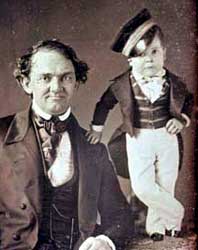
Showman P.T. Barnum (l) with his protegee, "General Tom Thumb" (born as Charles Sherwood Stratton). Daguerrotype by Samuel Root, 1850

The best known of circus pioneer P.T. Barnum‘s performers was Charles Sherwood Stratton (1838-1883), also known as General Tom Thumb. Stratton weighed 9 lbs. 8 oz. at birth, a bouncing baby boy for the time, but stopped growing at six months. When Barnum discovered him at the age of five, Stratton weighed only 15 lbs. and was 25 inches tall. 

“The boy barely came up to the showman’s knees!” (1) 

Barnum wasted no time signing up the boy as a sideshow attraction. His parents happily rented out their child for $7 a week plus room, board, and traveling expenses. Barnum installed the Strattons in a fancy New York City apartment above his museum of human curiosities. Barnum then began transforming Little Charlie into an international celebrity he christened “General Tom Thumb,” recalling the tiny fictional knight of King Arthur’s round table. The knight was so small, he rode a mouse and battled spiders. 

1844 stereograph depicting General Tom Thumb as Napoleon. Although "Tom" was really six at the time, P.T. Barnum promoted him as a 13-year-old.

Barnum taught the little dwarf to dance, sing, and tell jokes while dressed in elaborate costumes as Cupid, Napoleon, and Frederick the Great. At five, Tom learned to drink wine and at seven he took up cigar smoking. Barnum billed Tom Thumb as the “smallest man alive.”  

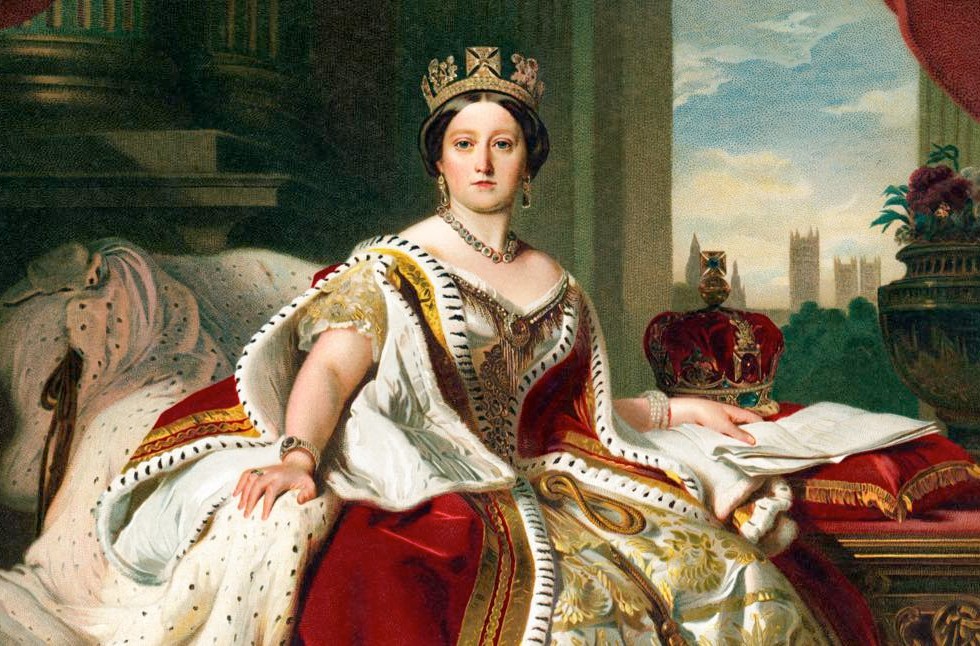
In 1844, Barnum took his young protege on a much-publicised European tour debut. Tom Thumb was a huge sensation, appearing before the crowned heads of Europe and visiting Queen Victoria not once, but twice. Audiences were enchanted with the man-boy whose charm combined innocence with pomposity. Over time, Tom made so many visits to royalty that Barnum had a special carriage built for him. 

“Only 11″ high, it was painted blue and lined with silk. Drawn by ponies only 28″ tall, and driven by children dressed in livery, it caused a sensation wherever it went.” 

Years went by and the money from Tom Thumb’s tours made him a rich man. “The Man in Miniature” moved to a specially-designed mansion for him and his parents in his hometown of Bridgeport, Connecticut. 
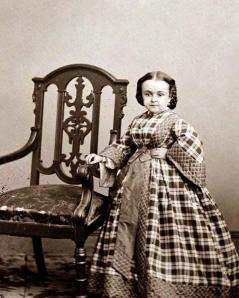
Lavinia Warren (1841-1919), photo c. 1855-1865

It was said that, by the age of 19, Tom had been kissed by a million and a half girls.Soon, though, the United States was plunged into the Civil War and Tom wanted more than just kisses from strangers. He began looking for a wife. He found her in the diminutive form of another little person, the charming and very beautiful Lavinia Warren

On February 10, 1863, the two were married at Grace Episcopal Church in New York City. The wedding was front page news. Billed as “the fairy wedding,” it was the social event of the season. People clamored for invitations, yet only two thousand people were invited. 

"The Fairy Wedding" of General Tom Thumb (Charles Stratton) and Lavinia Warren. This is a reenactment of the ceremony staged by photographer Mathew Brady after the Feb. 10, 1863 event.On the left in each picture is the best man, George Washington Morrison Nutt, known as Commodore Nutt, who had courted Lavinia unsuccessfully; Tom Thumb; Lavinia, and Minnie Bump AKA Minnie Warren, Lavinia's younger and even more petite sister


As Tom and Lavinia made their way up the center aisle to the altar, only guests seated along the aisle could see them. Once they arrived at the chancel, women stood on tiptoes and a few climbed on chairs to witness the ceremony. Afterwards, P.T. Barnum staged a reception for the newlyweds at the Metropolitan Hotel. Barnum charged $75 a ticket. Although there was a demand for 15,000 tickets, only 5,000 were sold. 

At the reception, the Strattons stood on a piano to receive their guests. Later on their honeymoon, they traveled to Washington, D.C., to the White House, where President Lincoln gave them a fancy party. In the course of the evening, the president told General Tom Thumb that he had put him completely in the shade, as he [the General] was now the center of all attention. 

(1) Fleming, Candace. The Great and Only Barnum: The Tremendous, Stupendous Life of Showman P.T. Barnum. New York: Schwartz & Wade Books, 2009.

Read Full Post »
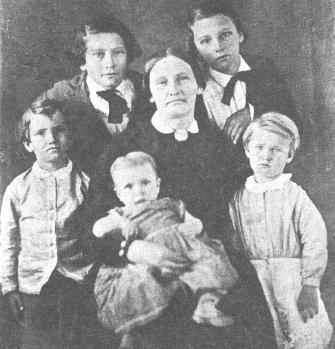
Langston Hughes (1902-1967)

Langston Hughes (1902-1967) was an African-American poet, novelist, columnist, short story writer, and playwright. His exceptional literary talents were recognized early in life; he was elected class poet at his Lincoln, Illinois elementary school.

Langston Hughes scoffed at the “honor” of the position:

“I was a victim of a stereotype. There were only two of us Negro kids in the whole class and our English teacher was always stressing the importance of rhythm in poetry. Well, everyone knows — except us — that all Negroes have rhythm, so they elected me as class poet.” 

Langston is best associated with the American literary movement known as the Harlem Renaissance (1920s-1930s)  and was one of the pioneers of a new literary form, jazz poetry.

Langston wrote his first jazz poem when he was in high school in Cleveland: “When Sue Wears Red.” Here it is:

When Sue Wears Red


When Susanna Jones wears red

Her face is like an ancient cameo

Turned brown by the ages.

Come with a blast of trumpets, Jesus!


When Susanna Jones wears red

A queen from some time-dead Egyptian night

Walks once again.

Blow trumpets, Jesus!


And the beauty of Susanna Jones in red

Burns in my heart a love-fire sharp like pain.

Sweet silver trumpets, Jesus!

Read Full Post »
Diego Rivera shown with wife, Frida Kahlo. Frida's mother called them "the Elephant and the Dove."

Elvis Presley at his shiniest

What did Mexican muralist Diego Rivera and rock sensation Elvis Presley have in common?

They both had twin brothers who died.

Diego Rivera and his twin brother Carlos were born on December 8, 1886 in Guanajato, Mexico. Carlos, however, died eighteen months later.

"The Flower Carrier" by Diego Rivera (1886-1957)

On January 8, 1935, in Tupelo, Mississippi, Gladys Presley gave birth to identical twin boys. The first one, Jesse Garon Presley, was stillborn. Thirty-five minutes later, Elvis Aaron (Aron) Presley entered this world. Gladys told Elvis that, as the surviving twin, he had been destined for great things.

READERS: For more posts on Frida Kahlo and Diego Rivera, click here.

Read Full Post »