Feeds:
Posts
Comments

Archive for the ‘EVENTS’ Category

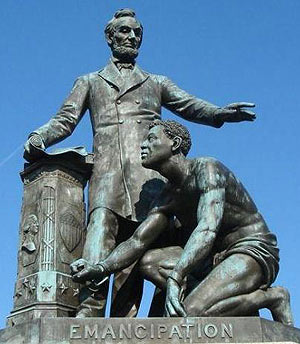
Freedmen’s Monument, Lincoln Park, Washington, D.C.; sculptor, Thomas Ball. The sculpture was funded solely from freed slaves, primarily from African-American Union veterans, to pay homage to the American president who had issued the Emancipation Proclamation, thus liberating them from bondage in the Confederate States. The statue was dedicated on April 14, 1876, 11 years after Abraham Lincoln's assassination by the Confederate rebel John Wilkes Booth. Abolitionist and former slave Frederick Douglass delivered the dedication speech.

Oration in Memory of Abraham Lincoln

Frederick Douglass delivered a speech at the unveiling of the Freedmen’s Monument in Memory of Abraham Lincoln at Lincoln Park, Washington, D.C., on April 14, 1876. This is the conclusion of what Douglass said to the crowd:


“Fellow-citizens, the fourteenth day of April, 1865, of which this is the eleventh anniversary, is now and will ever remain a memorable day in the annals of this Republic. It was on the evening of this day, while a fierce and sanguinary rebellion was in the last stages of its desolating power; while its armies were broken and scattered before the invincible armies of Grant and Sherman; while a great nation, torn and rent by war, was already beginning to raise to the skies loud anthems of joy at the dawn of peace, it was startled, amazed, and overwhelmed by the crowning crime of slavery–the assassination of Abraham Lincoln. It was a new crime, a pure act of malice. No purpose of the rebellion was to be served by it. It was the simple gratification of a hell-black spirit of revenge. But it has done good after all. It has filled the country with a deeper abhorrence of slavery and a deeper love for the great liberator.

Had Abraham Lincoln died from any of the numerous ills to which flesh is heir; had he reached that good old age of which his vigorous constitution and his temperate habits gave promise; had he been permitted to see the end of his great work; had the solemn curtain of death come down but gradually–we should still have been smitten with a heavy grief, and treasured his name lovingly. But dying as he did die, by the red hand of violence, killed, assassinated, taken off without warning, not because of personal hate–for no man who knew Abraham Lincoln could hate him–but because of his fidelity to union and liberty, he is doubly dear to us, and his memory will be precious forever.”

Abolitionist and former slave Frederick Douglass, daguerrotype, 1855. Douglass recruited black men to serve in the Union Army during the Civil War.

Readers, I’ve posted many articles on Abe Lincoln. Scroll down the right sidebar to Categories/People/Abraham Lincoln for more! Enjoy.

Also on this blog: “Frederick Douglass, An American Slave.”

Read Full Post »

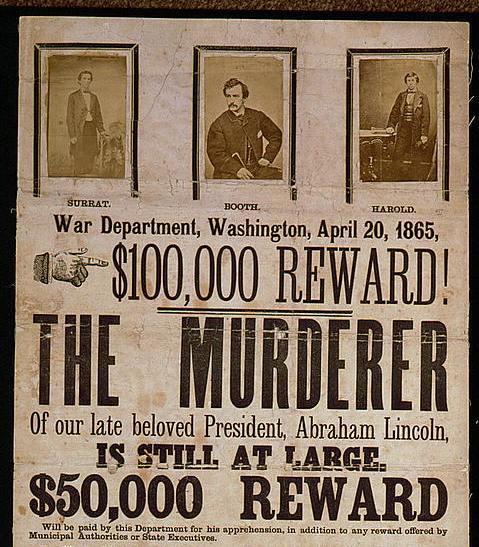
Booth reward posterIt was April 24, 1865 – ten days since President Lincoln was assassinated – and his killer still remained at large. On the night of April 14, John Wilkes Booth had shot the president in the head, jumped on a horse, and slipped across the Potomac River undetected. He had disappeared into Maryland, a state that had stayed in the Union in the Civil War (which had ended just days earlier), but was sprinkled with Confederate spies. Speculation was that Booth would cross Maryland into Virginia with the help of fellow Confederate sympathizers.
The 16th New York Cavalry was on Booth’s trail but no leads had resulted in his capture, despite a whopping $100,000 reward promised by the War Department. So on April 24, Major W.S. Hancock issued a new proclamation appealing to the black population of Washington, Maryland, and Virginia, for their help in the manhunt. Hancock calculated that Booth could not escape without encountering blacks. The following proclamation was printed on letter size handbills and distributed:

THE MURDER OF PRESIDENT LINCOLN.

APPEAL TO THE COLORED PEOPLE!

HEADQUARTERS MIDDLE MILITARY DIVISION

Washington, D.C., April 24, 1865

To the colored people of the District of Columbia and of Maryland, of Alexandria and the border counties of Virginia;

Your President had been murdered! He has fallen by the assassin and without a moment’s warning, simply and solely because he was your friend and the friend of our country. Had he been unfaithful to you and to the great cause of human freedom he might have lived. The pistol from which he met his death, though held by Booth, was fired by the hands of treason and slavery. Think of this and remember how long and how anxiously this good man labored to break your chains and to make you happy. I now appeal to you, by every consideration which can move loyal and grateful hearts, to aid in discovering and arresting his murderer. Concealed by traitors, he is believed to be lurking somewhere within the limits of the District of Columbia, of the State of Maryland, or Virginia. Go forth, then, and watch, and listen, and inquire, and search, and pray, by day and night, until you shall have succeeded in dragging this monstrous and bloody criminal from his hiding place….

Large rewards have been offered…and they will be paid for the apprehension of this murderer….But I feel that you need no such stimulus as this. You will hunt down this cowardly assassin of your best friend, as you would the murderer of your own father….

All information which may lead to the arrest of Booth, or Surratt, or Harold, should be communicated to these headquarters….

W.S. Hancock

Major General U.S. Volunteers

Commanding Middle Military Division


Read Full Post »

The Confederacy 1861-1865 (orange)

The Confederacy 1861-1865 (orange)


THE PRICE OF THE CIVIL WAR

UNION
                                                                                                                                            

Soldiers                         2,500,000-2,750,000                                           

Soldiers wounded who survived     275,175                                                                         

Soldiers who lost their lives              360,222                                                                       

Civilians who lost their lives                   None         

CONFEDERATE                                                              

Soldiers                              750,000-1,250,000                                         

Soldiers wounded who survived     102,703                                                    

Soldiers who lost their lives              258,000                                                                       

Civilians who lost their lives                50,000   


The total cost of the war was $20 billion (approximately $250 billion in today’s money), or five times the total expenditure of the federal government from its creation in 1788 to 1865. (2)

(1) Map

(2)Fleming, Candace. The Lincolns: A Scrapbook Look at Abraham and Mary. (New York: Schwartz & Wade Books, 2008)

Read Full Post »

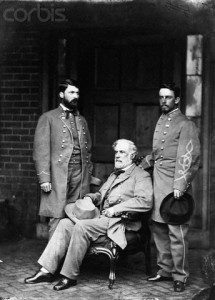
Confederate General Robert E. Lee, seated, with 2 of his officers, photographed by Mathew Brady in April, 1865, following Lee's surrender to General Ulysses S. Grant at the Appomattox Court House in Richmond, Virginia.

Confederate General Robert E. Lee, seated, with 2 of his officers, photographed by Mathew Brady in April, 1865, following Lee's surrender to General Ulysses S. Grant at the Appomattox Court House in Richmond, Virginia.

At daylight on April 10, 1865, the firing of 500 cannons spread the news throughout Washington, D.C.,  that the War Between the States was over and the Union preserved. The cannons were so loud that they broke windows on Lafayette Square, the neighborhood around the White House. (1) “Guns are firing, bells ringing, flags flying, bands playing, men laughing, children cheering – all, all jubilant,” wrote Secretary of the Navy Gideon Wells. (2)

Expecting the president to make a speech, several thousand people gathered outside the White House. President Lincoln was not sure what to say as he was planning on giving a formal address the following evening.Just then, his twelve-year-old son Tad appeared at a second-floor window, waving a captured Confederate flag. It gave the president an idea. He asked the Marine Band to play a favorite tune of his, “Dixie,” the unofficial Confederate anthem.

“I have always thought ‘Dixie” one of the best tunes I ever heard,” he told the surprised crowd. “It is good to show the rebels that with us they will be free to hear it again.”

True to the promise he made in his second inaugural address, Lincoln was already trying to bind up the nation’s wounds.
 
Now let’s hear Elvis Presley sing “Dixie.”

(1) White, Ronald C. A. Lincoln. (New York: Random House, 2009)

(2) Fleming, Candace. The Lincolns: A Scrapbook Look at Abraham and Mary. (New York: Schwartz & Wade, 2008)

Read Full Post »

Carolyn King Waller (b.1934)

Carolyn King Waller (b.1934)

My mother underwent a hip replacement last week. While waiting for Mom to be wheeled off to surgery, I had an opportunity to talk with both Mama (Carolyn) and Daddy (John) about their growing-up years in the thirties and forties.
Carolyn:You want to remember that in the 30s and later, the iceman brought ice to your doorstep. The garbage trucks would come by and the men would be standing in the truck beds knee-deep in garbage. It wasn’t very hygienic! Mother used to make me sugar and butter sandwiches. People ate a lot of cheap foods like butter beans, rice pudding, bread pudding. Think how cheap rice pudding would be. (My grandmother) Nona used to make cooked onions.
You would open a box of soap powder and you would find a little trinket in the flakes. There might be a dishcloth in it or a Shirley Temple spoon, or maybe a piece of depression glass. It cost 12 cents for a child to go to the movies and 30 cents for an adult. Think how cheap that was – to be transported into another world for two hours for only pennies! Hollywood stars would be dressed up (in the movies) in oh so fancy clothes. We didn’t have much money for clothes but we didn’t begrudge them (the stars) for that. don-winslow

The forties were a time of serial movies on Saturday afternoon. When you went to the movies on Saturday, you would get a serial thrown in. They were probably continuing week-to-week narratives, little short ones, about twenty minutes each. There was “Don Winslow in the Navy,” “The Green Hornet,” “The Green Lantern,” cowboy serials, “Zorro.”  They were always full of action. The serials came on at intermission. The serials had someone fighting against the enemy overseas or some other bad guys. The bad guys usually wore black hats; the good guys usually wore white hats. Our family wasn’t shallow but movies were our thing.

John A. Waller, Jr. (b.1930)

John A. Waller, Jr. (b.1930)


Lisa: Changing the subject, Dad, did you have a car when you went to UT in the early fifties?
John: My first car was the big white Oldsmobile that my parents had had before my wedding. They gave it to us before we got married. They’d bought it in 1947.
Carolyn: It had an automatic shift in the days when a lot of cars didn’t.
John: In 1937, my father had bought another car in Yoakum (Texas) that had an automatic shift. It was also an Oldsmobile. He didn’t buy another one for ten years, until he bought that big white one in 1947, the one he gave us. You couldn’t buy cars during the war years. All the metal, rubber and everything that had been used in car production went to the war vehicles.
Carolyn: In those days, everyone was on foot. Cars were useful, very important, if you had one. Drive-ins were a big deal. When you had a car, you went to a drive-in movie or a drive-up hamburger shop.
Lisa: Was gas rationed in the 40s?
Carolyn: Yes. There were different levels. Some people had As, some had Bs, and maybe Cs. When your grandparents passed away, Lisa, we found their ration books. They had saved them. The amount of gasoline rations you were issued depended upon your level of importance to the government. We had meatless Tuesdays. We cut down on our food consumption to save more “for the boys” (fighting the war). We had victory gardens to grow food for ourselves. In Hollywood, there had to be less fabric in the dresses so costumes were less sumptious. My mother’s cookbook at the time had recipes that were tailored to “the fighting forties.” They didn’t call for so much sugar and butter, or eggs, for that matter. They were more stringent recipes. We had sugar and meat coupons. Except for these cutbacks, we were really sheltered from the war.
John: It was all a newsreel war.
Carolyn: A gold star mother was someone in the community who had lost her son. Mrs. Pyle was one, maybe Mrs. Roscoe. Daddy and I didn’t pay any price.
John: I lived in Yoakum and they didn’t connect to anything.
Carolyn: I lived in Corpus Christi (Texas) where they had the largest naval station in the country. There may have been submarines in the Gulf of Mexico. We had black-out curtains. There was a rumor about a guy named Poenisch who was signaling Germans out on the water.
Lisa: Dad, back to your comment a while ago about World War II being “all newsreel war.”
John: That’s where we saw pictures of the war – at the movies. We saw newsreels that came on between the features. They were about 10 to 15 minutes long. Most of them were of the war, the battles. We saw pictures and heard the audio by Edward R. Murrow or Eric Severeid.
Carolyn: Oh, my gosh, he (Eric Sevareid) reported from the tops of burning buildings! Hollywood had been asked by the government to make happy propaganda. FDR asked the movie industry to do that. So we got movies like “30 Seconds Over Tokyo,” “So Proudly We Hail,” “Edge of Darkness,” “Bataan.”
best-years-of-our-livesJohn: After the war, there was “The Best Years of Our Lives.” That movie showed what it was really like for those soldiers coming home. They got the GI bill and went to college. That’s who I went to school with.
Carolyn: All through the war, we weren’t touched by the war personally, but we were affected by it because so many of the movies were about it. Oh, we can’t forget to mention “Casablanca.”

Read Full Post »

« Newer Posts