Feeds:
Posts
Comments

Archive for the ‘PEOPLE’ Category

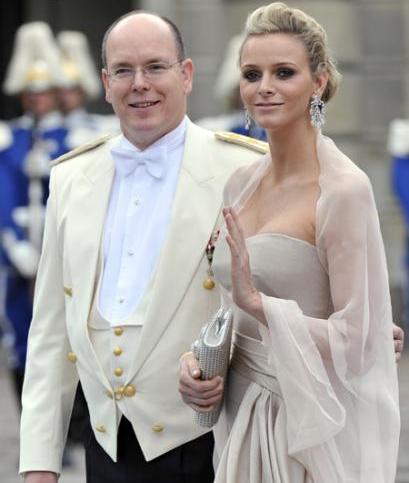
Prince Albert of Monaco is engaged to former South African Olympic swimmer Charlene Wittstock. (Lisa's History Room)

Prince Albert of Monaco is engaged to Charlene Wittstock, a former Olympic swimmer from South Africa. He is 52, she, 32. Ms. Wittstock will become the first crown princess since the 1982 death of Prince Albert’s mother, Princess Grace of Monaco. Princess Grace was the former American film star, Grace Patricia Kelly.

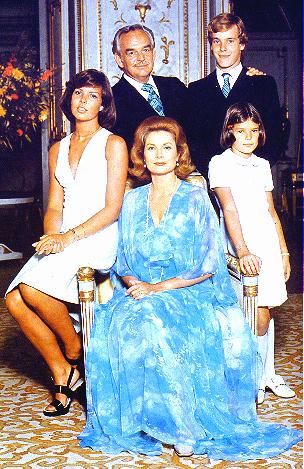
In this 1974 photo, Princess Grace of Monaco, center, poses with her husband, Prince Rainier III, and their three children. From left to right: Princess Caroline, Prince Albert, and Princess Stephanie. At the time, Princess Grace and Prince Rainier III were the reigning monarchs of the ancient royal House of Grimaldi. Both Princess Grace and Prince Rainier III are deceased. Today their son Prince Albert is the reigning prince.

Perez Hilton calls the announcement a

Pretty big deal considering Albert was a notorious bachelor, causing Parliament to change the constitution in 2002 to allow one of his sisters’ sons to take the throne if he doesn’t produce an heir!

He does have two children, but they were born out of wedlock so they are not allowed to assume the throne.

Looks like Charlene better get ready to make some babies!”

Palace protocol dictates that couples must wait at least six months between the announcement of the engagement and the wedding day. Expect a big “to-do” since this will be the first royal wedding of a reigning prince in Monaco since 1956 when Grace Kelly retired from filmmaking to wed Albert’s father, Prince Rainier III.

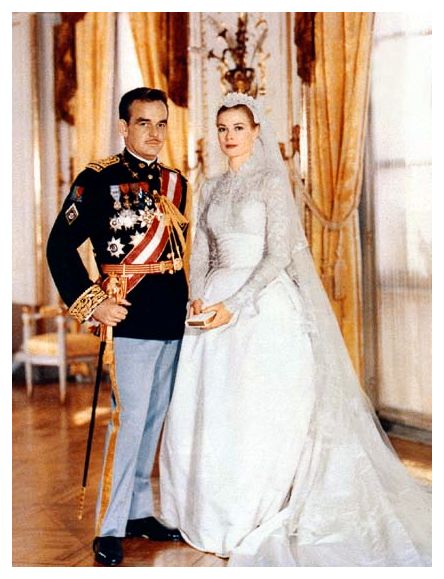
Prince Rainier III of Monaco weds American film star and fashion icon Grace Kelly. They wed twice; the civil ceremony was held on April 18, 1956, followed the next day by a religious one. Her Serene Highness the Princess of Monaco, commonly referred to as "Princess Grace," retained both American and Monegasque citizenships.

READERS: Continue the story with “Prince Albert of Monaco: A THIRD Love Child?”

READERS: For more on Grace Kelly here on Lisa’s History Room, click here.

Read Full Post »

Queen Elizabeth II of England suffered two wardrobe malfunctions at a private party in London for her cousin King Constantine of Greece. A fellow guest spilled something on her beautiful blue gown, leaving huge stains running down the right side, then the chain link strap on her silver handbag broke. (June 3, 2010)

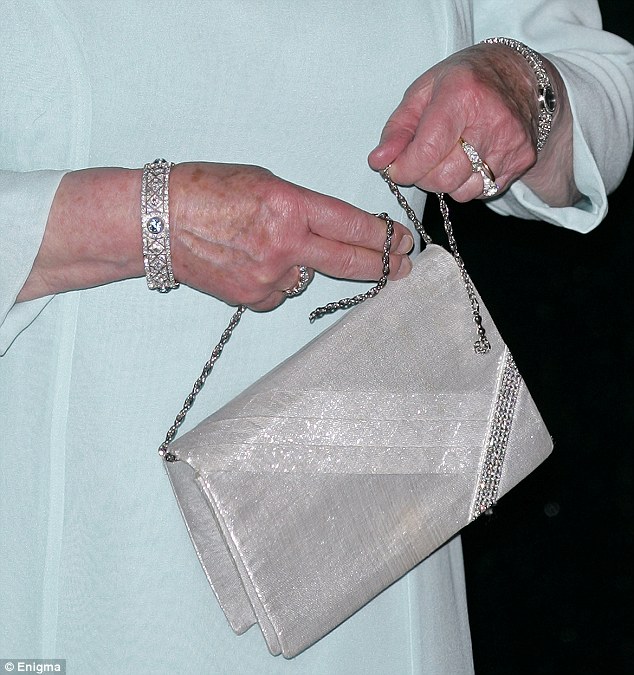
Two nights ago, Queen Elizabeth II of Great Britain helped King Constantine of Greece celebrate his 70th birthday and, at the party, had not one but two fashion mishaps. Someone – a fellow guest, possibly, or a waiter maybe – spilled what is purported to be coffee on the 84-year-old British monarch’s pale blue floor length gown, staining it permanently. Then, on top of that, the metal strap on the Queen’s ever-present handbag broke in half.

Queen Elizabeth clutches the broken strap of her evening handbag at King Constantine's 70th birthday party in a private London home.

Poor Queen! Where were all those ladies-in-waiting when she needed them most? Couldn’t someone have thrown a cloak over the Queen’s dress to hide the stains or stood in front of her to block her from the paparazzi’s unrelenting snaps?

If the Queen was ruffled by being uncharacteristically messy, she didn’t show it. Her Majesty – who is always neat, clean, and fastidiously turned-out – held high the royal chin throughout the terrible, horrible, no-good, very bad night and had a very good time, thank you, in spite of her multiple fashion faux-pas. Jolly brave, Elizabeth partied for hours alongside fellow royals — including son Prince Andrew, daughter Princess Anne, Queen Sofia of Spain, and Crown Prince Pavlos of Greece, who hosted the bash at his London home.

King Constantine of Greece escorts his cousin Queen Elizabeth down the steps at the end of his 70th birthday party. Despite the obvious food stains running down the Queen's dress and the broken strap of her glittery evening bag, the Queen maintained her always noble demeanor.

Read Full Post »

Sarah Ferguson watches polo at Windsor with Princess Diana, in 1985, the year before she married into the British Royal Family and became the Duchess of York

Sarah Ferguson –  “Fergie” –  and Princess Diana (1961-1997) knew each other for six years before Fergie married Prince Andrew in 1986 and became a member of the Royal Family. The two women had first met on the polo circuit, as Diana’s husband Prince Charles was an avid player and Fergie’s father, Sir Ronald Ferguson, was the Prince’s polo manager.

Soon after meeting, Diana and Fergie (b. 1959) became fast friends. The timid and reserved Diana was intoxicated by Fergie’s loud and breezy energy:

“The two girls would burn up the telephone wires trading gossip and irreverent royal tidbits they could share with no one else.” (1)

Since Diana’s 1981 wedding to Charles, she had been starved of fun. Diana thought about how lovely it would be to have Fergie as a mate in the Royal Family. In June of 1985, Diana decided to play royal matchmaker and make it happen. She wangled an invitation for Fergie to not only attend the Queen’s Ascot Week house party at Windsor Castle , but managed also to get the boisterous redhead seated next to the Queen’s second son, the 25-year-old Prince Andrew, a very eligible bachelor and second in line for the throne.
Sarah, the Duchess of York ("Fergie") and Diana, Princess of Wales, 1987

Within an hour of meeting Fergie, Andrew was “chatting her up” and “flirtatiously coaxing a merry-eyed Ms. Ferguson to eat every one of the chocolate profiteroles [cream puffs] on her plate.” (1) A year later, Fergie and Andrew were married at Westminster Abbey as the Duke and Duchess of York. Di had gotten her ally in the family.

This commemorative stamp was issued in Great Britain in 1986 to commemorate the Royal Wedding of Prince Andrew to Miss Sarah Ferguson. They became the Duke and Duchess of York.

 
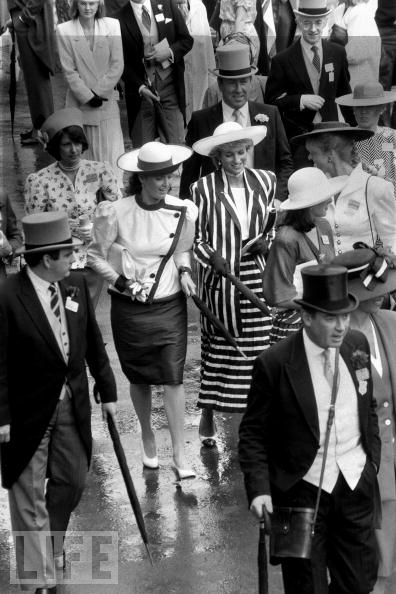
Encouraged by Fergie’s wildness, Diana began to loosen up publicly. She became a bit of a royal daredevil. Memorably, in June 1987, she and Fergie were photographed at Royal Ascot poking Fergie’s old school friend Lulu in the behind with their umbrellas, called “brollies” in England.  (2) 

Sarah Ferguson, the Duchess of York (l), and Princess Diana (r) attend the Royal Ascot, June 1987.

The Ascot Umbrella Caper – dubbed “the Brolly Folly” – drew public scorn. Woodrow Wyatt recorded in his memoirs that his wife saw Diana at Ascot

fooling about in the most childish manner, pulling people’s hair and tweaking them.”

The Sun reported the incident, referring to Fergie and Diana caustically as “silly, simpering girls.” It was the first of many desperate attempts Diana and Fergie made to “unstiffen” royal protocol. 

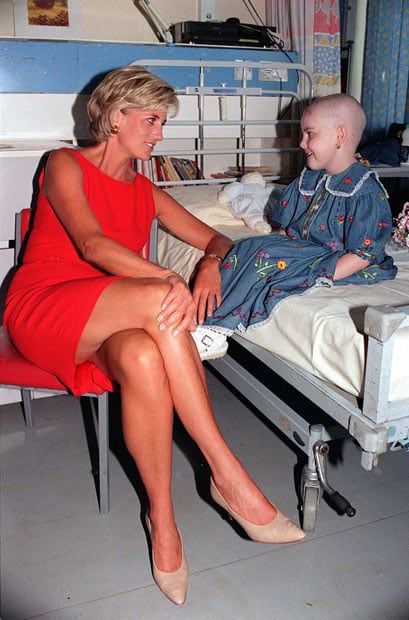
Over time, the fallout from the bad press would affect Diana and Fergie differently. Diana would weather the public criticism better than Fergie. With Diana’s tragic death, charity work, and sad marriage, the public has been more forgiving of her wild days. The late Princess Diana is lovingly remembered today as the People’s Princess.

Fergie, however, at age 50, continues to court disaster with her impetuous ways and money woes. Matter of fact, with the latest bribery scandal and “Oprah” TV appearance, the Duchess of York is being referred to in the press as the Duchess of Disaster. 


An image made from video shows the Duchess of York apparently selling access to ex-husband Prince Andrew for 500,000 British pounds to an undercover reporter from the UK tabloid, "News of the World." (foxnews.com_May 24, 2010)

(1) Brown, Tina. The Diana Chronicles. New York: Doubleday, 2007.

(2) “Births, Deaths, & Marriages.” Thirty Years of Majesty. Vol. 31, No. 5.

Read Full Post »

quoted from 

The Duchess of York’s Toe Scandal

Sarah Ferguson and Prince Andrew wave to the crowds following their 1986 wedding at Westminster Abbey, London.

“By 1992, the marriage between [British] Prince Andrew and Sarah Ferguson [Fergie] (the Duke and Duchess of York) was faltering. The Duchess was with various men including Texan multimillionaire Steve Wyatt, while her husband was away on royal duties. They agreed to separate in January 1992, but in August 1992, surreptitiously taken photographs of John Bryan, an American financial manager — apparently in the act of sucking on the toes of a topless Sarah in Southern France — were published in the British tabloid The Daily Mirror.

John Bryan sucks the toes of a topless Duchess of York, August, 1992, the Daily Mirror.

“The Duchess was at Balmoral [Scotland] with the rest of the Royal Family when the story broke. Prince Philip handed her a copy of the paper and quipped “there but for the grace of God go I.” (Notoriously picky Duke of Edinburgh liked Sarah as much as he detested Diana). The Queen was less amused; the Queen’s private secretary told the Duchess that she might feel better if she left immediately to London, effectively banishing her from the royal household. She would never be reinvited back to Balmoral until 2008. The only feeble defense both Fergie and John Bryan could muster up was that he hadn’t been sucking her toes, he was simply kissing the instep of her foot.”

Read Full Post »

Diana, Princess of Wales

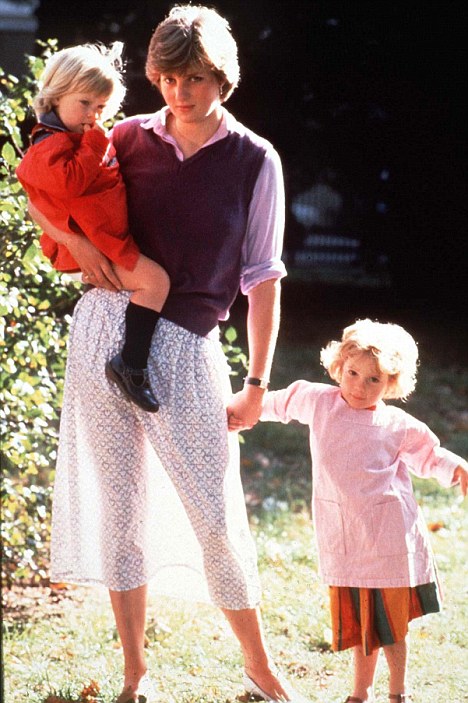
The late Diana, Princess of Wales (1961-1997), once remarked that, in marrying Prince Charles and having two sons with him, she had genetically given the British Royal family “chins.” She felt that she had a very prominent chin and that the Royal Windsors were lacking in this facial feature. Her sons, Princes William (b. 1982) and Henry (b. 1984), known as “the Heir and the Spare,” are in line for the British throne.

Queen Elizabeth II is shown wearing a lime green suit in this 1960s era photo with husband Prince Philip, the Duke of Edinburgh, and their four children, l to r: Andrew, Edward, Charles, and Anne.

Tragically, Diana didn’t live to see her boys grown into tall, strapping fellows setting new records not for chins but for height. This genetic trait was likely passed down to them through Diana’s Spencer family and their grandfather Prince Philip, the Duke of Edinburgh, who was 6′ at his prime. Princess Diana, at 5’10” & 3/4″, was almost 2  inches taller than her former husband.


At 6’3″, Prince William of Wales, second in line for the British throne, is set to become the tallest monarch in history. His brother, Prince Henry of Wales (known as Prince Harry), is right up there with him, measuring in at 6’2″.

The Great Seal of Edward I who served as the British monarch from 1272-1307

The record for the tallest British monarch has been held by Edward I, 6’2″, known as “Longshanks” for his long legs. An expert horseman, he took the throne in 1272.

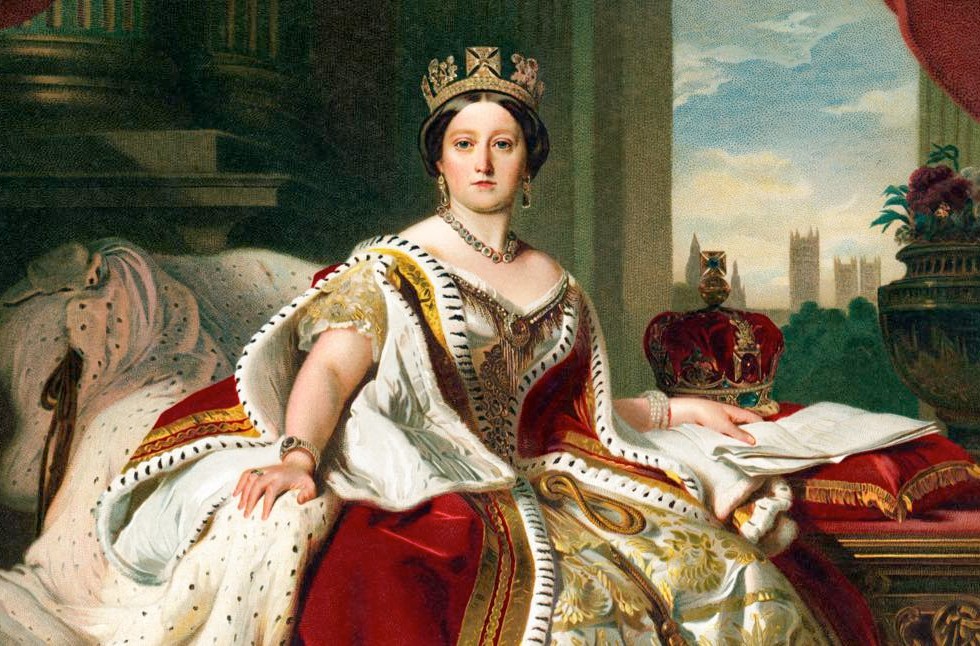
More modernly, though, the British monarchs have erred on the short side. Queen Elizabeth II, who took the throne in 1953, is only 5’4″. Her great grandmother Queen Victoria, who reigned from 1837-1901, was even more petite. She was only 5 feet tall and very stocky. At her death in 1901, Queen Victoria boasted a 50″ waist.

Queen Victoria was quite stout. With her afternoon "cuppa" tea, she fancied a sponge cake slathered with jam and whipped cream. This classic (high-calorie) British cake is known as the "Victoria Sponge."

Should Prince William decide to marry his long-time girlfriend, the 5’10” Kate Middleton, their children likely would be taller than the average royal.

Kate Middleton (black hat) is shown with Prince Harry of Wales and Camilla, Duchess of Cornwall (white hat), at the June 16, 2008 installation of Kate's boyfriend Prince William of Wales in the Order of the Garter.

Here’s how the current royals and their significant others measure up:

Men ———————————– Ladies
Prince William (6ft 3in) ——– Kate Middleton (5ft 10in)
Prince Harry (6th 2in) ——— Chelsy Davy (5ft 8in)
Prince Philip = (5ft 11in) ——– The Queen (5ft 4in)
Prince Charles = (5ft 9in) ——- Camilla, the Duchess of Cornwall (5ft 8in), Diana (5ft, 10 & 3/4 in)

Source: Article Daily Mail

Read Full Post »

Twelfth Night, celebrated on January 5 (and also called Epiphany Eve), is the traditional last day of the Christmas holiday festivities. It also marks the adoration of the Magi, and many cultures celebrate it as almost a second Christmas Eve. It marks the start of the Carnival Season which ends on Mardi Gras. Beginning in Tudor England (1485-1603), Twelfth Night was often commemorated with a large festive party - lots of cake and ale - to mark the end of the Winter Festival. William Shakespeare wrote his joyous comedy, "Twelfth Night, or, What You Will" (1600), to be performed at Twelfth Night feasts. The illustration shown here is William Harrison Ainsworth's "Mervyn Clithroe's Twelfth Night Party by 'Phiz'" (c 1840).

William Shakespeare’s high comedy, “Twelfth Night, or, What You Will,” (1600), centers on themes of love – unrequited love, lost love, secret love, fickle love. But another theme is also explored – carpe diem, or “seize the day.” The idea that we should embrace life and live it to the fullest and in the present was a very modern philosophy for Shakespeare (1564-1616) to tuck into a 17th Century play.  Plays during the Elizabethan Era were generally moralistic in nature, reflecting the prevailing Puritanism.  

Now let’s slip into a scene in “Twelfth Night” in which carpe diem is expressed:  

"Olivia" (1888) from "Twelfth Night" by Edmund Blair Leighton

detail from painting, "Twelfth-Night (The King Drinks)" 1634-40 by David the Younger Teniers show the Court Jester entertaining a crowd.

Act II, Scene iii opens in Olivia‘s vast house in dreamy Illyria on the Adriatic Coast. As Olivia is a rich noblewomen in step with the fashion of the day, she keeps a clown on staff whose name is Feste. Feste is a witty jester dressed in crazy clothes. His job is to say clever things, tell his mistress the truth (as would any decent court jester), and amuse her and her guests, who, at this moment, include her alcoholic uncle Sir Toby Belch and his drinking buddy, Sir Andrew Aguecheek, a bumbling knight who has his eye on Olivia for a bride.  

It is quite late at night when we join Sir Toby and Sir Andrew in the drawing room. They have been drinking quite a lot. By the time Feste the Clown joins them, they have gotten so noisy and stinking drunk, they are disturbing the peace of the sleeping household.   

"Twelfth Night, or, What You Will," Act II, Scene iii: (l to r) Feste the Clown, Sir Toby Belch, and Sir Andrew Aguecheek whoop it up with a drink and a song, rousing the household in the wee hours of the morning.

Both Sir Toby and Sir Andrew are in the mood to hear a song. Sir Toby gives Feste sixpence to sing a love song. Feste obliges. His beautiful song –  “O Mistress Mine” –  is an ode to free-spirited, impulsive, and delicious love. Life is short; you’ve got to grab joy when it’s within reach:  


O mistress mine, where are you roaming?

O, stay and hear! your true-love’s coming,

That can sing both high and low.

Trip no further, pretty sweeting,

Journeys end in lovers meeting—

Every wise man’s son doth know.


What is love? ’Tis not hereafter;

Present mirth hath present laughter;

What’s to come is still unsure:

In delay there lies no plenty;

Then come kiss me, sweet and twenty,

Youth’s a stuff will not endure.


(1) The Complete Pelican Shakespeare. New York: The Viking Press, 1969.

Readers, for more “Talk Like Shakespeare Today” posts, click here.

Read Full Post »

Britain's Princess Diana and Prince Charles wave to the cameras and onlookers following their fairytale wedding in July 1981 at St. Paul's Cathedral, London. To everyone, the smiling royals in the glass coach seemed like a dream couple.

Princess Diana‘s wedding tiara gave her a “cracking headache” said her brother, Charles Spencer, in an interview on the American program, “Entertainment Tonight.” 

Charles, the 9th Earl Spencer, described how he was able to spend some time with Diana, Princess of Wales, after her marriage to Britain’s Prince Charles on July 29, 1981. The royal wedding at St. Paul’s Cathedral in London was watched by an estimated global TV audience of 750 million. Spencer recalled being with his sister that memorable day: 

”In the evening we all went to a sort of semi-private party and she was there and she seemed incredibly relaxed and happy and I just remember she had a cracking headache too, because she wasn’t used to wearing a tiara all morning,” said the aristocrat during the interview posted on the U.S. show’s website. 

Diana’s wedding tiara – which is known now as the “Spencer Tiara” – is a Spencer family piece with an elaborate design of stylized flowers decorated with diamonds in silver settings. Princess Diana (1961-1997) wore this and other tiaras (or coronets) many times during her lifetime. 

Princess Diana wears the Spencer tiara at a 1983 dinner banquet in New Zealand.

Earl Spencer added that he still has a piece of his sister’s wedding cake with her name on it. 

Readers: You might also enjoy “Waity Katie and ‘The Ring.'” 

For more posts on the British Royal Monarchy, scroll down the right sidebar to “Categories”/”Royalty.”

Jewelry Lovers, you might try “Queen Victoria’s Tiny Crown” and “Queen Alexandra’s Royal Bosom.”

Read Full Post »

British royal Prince William of Wales and his girlfriend Kate Middleton at the 2009 Audi Polo Match

Is Prince William of Wales finally going to propose to his girlfriend of nine years, Kate Middleton? Tina Brown, Editor-in-Chief of The Daily Beast, says so. She predicts the engagement will be announced by Buckingham Palace on June 3 or 4 of this year.

Kate Middleton – known as “Waity Katie”  in the British press – has dated Prince William since they met in 2001 at the University of St. Andrew’s in Scotland. They have been together almost continuously, even living together. (1)

Woolworth's High Street Store in Great Britain anticipated a 2007 royal wedding between Kate Middleton and Prince William of Wales. They were so sure a ceremony was imminent that they unveiled designs for mugs, thimbles, mouse mats, and even sweets bearing a picture of the Prince and his sweetheart in 2006. Unfortunately, Kate and William broke up shortly after this announcement and Woolworth's was forced to scrap this line of merchandise. It is unlikely the product line will be revived as William no longer resembles the 2006 photo. He no longer sports a boyish look as his hairline has receded considerably since then.

Tina Brown’s column has caused a surge in speculation, Brown, the famous ex-Vanity Fair and ex-New Yorker editor and best-selling biographer of William’s mother, Princess Diana, is known to have excellent sources in Buckingham Palace, although the Palace has denied her prediction. Nevertheless, British tabloids like The Daily Mail went nuts thinking about a royal wedding in the future with headlines like,

“She’ll Wear Diana’s Tiara!”

Diana, Princess of Wales (1961-1997), wears her Cambridge Love Knot Tiara

Americans got feverishly excited, too. People magazine put William and Kate on the cover last month under the headline, “The Next Princess!” Inside, was a report that William was overheard calling Kate’s father “Dad” while they were all on a ski holiday in the French Alps in March 2010. (2)

(2) “A Date for William & Kate?” USA TODAY, May 13, 2010.

Readers: You might also enjoy “Princess Diana’s Wedding Tiara.”  For more posts on the British Royal Monarchy, scroll down the right sidebar to “Categories”/”Royalty.”

Read Full Post »

Richard Burton and Elizabeth Taylor photographed on the set of “Cleopatra” in Rome. Life Magazine, April 13, 1962

During the 1962 filming of “Cleopatra” in Rome, Elizabeth Taylor and Richard Burton began a very public affair. The two were both married to other people at the time. The scandal made headlines worldwide and was met with moral outrage.

After five months in Rome, filming moved to the island of Ischia, Italy, off the Amalfi Coast, with the paparazzi in hot pursuit. It was on Ischia that the scenes on Cleopatra’s barge were shot. The following candid photos of Elizabeth Taylor sunbathing and swimming were taken by celebrity portrait photographer Bert Stern.

Elizabeth Taylor and Richard Burton relax in Ischia, Italy, in June 1962, during the filming of the "Cleopatra" barge scenes.

Elizabeth Taylor on location for "Cleopatra" off the coast of Ischia, Italy, June 1962

That same month, the Hollywood stars visited the neighboring island of Capri as guests of entertainer Dame Gracie Field at her exclusive hotel, La Canzone Del Mare. The hotel’s name – “Singer of the Sea” – is a reference to the incredible view over the rocks below where the mythological sirens were said to have lured sailors to their deaths. The photo shown here is being shown publicly for the first time in an auction of Field’s scrapbooks

Elizabeth Taylor and Richard Burton arrive on the island of Capri in June 1962. The screen stars, who were both married, were guests at Dame Gracie Field’s exclusive hotel on Capri, La Canzone Del Mare.


Rumours of their relationship had been sizzling since filming of Cleopatra began the year before, but exploded that June when the scandalised Vatican accused them of ‘erotic vagrancy’ and the U.S. government threatened to ban them from the country. In the photograph, however, they look as though they haven’t a care in the world as they stroll side by side to the waterfront, him holding a cigarette in a casual white top and trousers, Taylor standing beside him in a one-piece bathing suit and cap, their hands almost brushing together.”

After the picture “Cleopatra” was completed filming the next month (July 1962), Taylor and Burton would continue their off-screen romanace. Another two and a half years would elapse before they would divorce their respective spouses and be free to marry one another. After their March 1964 wedding in Montreal at the Ritz Carlton, “the Burtons” would continue to captivate the public’s attention for the rest of the sixties, grabbing headlines, making movies together, throwing glamorous parties, having nasty public arguments, buying ridiculously large and expensive jewels and yachts, jetting here and there, and hobnobbing with royalty like the exiled Duke and Duchess of Windsor and other glitterati. 

But by 1970, the glitter had worn off the golden couple. Their endless and needless spending and self-indulgence were wearisome and tacky. Their film reviews were terrible and their relationship was worse. They made each other miserable. They were in bad health. Both drank heavily and Elizabeth liked pills.  They would divorce each other only to remarry, then divorce again.   

Readers: For more on Elizabeth Taylor, click here.

Read Full Post »

American author and humorist Samuel Langhorne Clemens, well-known by his pen name of “Mark Twain,” served as a steamboat pilot on the Mississippi River until the American Civil War broke out in 1861. The Mark Twain image shown here adorns an early Twentieth Century cigar box. Mark Twain was beloved and enjoyed public goodwill all his days.

 I used to have a notion that there was only one place in the world where I could write,” American author Mark Twain once told a friend, “That was Elmira, where I used to spend all my summers. But I’ve got over that notion now. I find that I can write anywhere.” (1) 

Anywhere meant exactly that: anywhere. Twain didn’t even require a desk to write. As it turns out, Mark Twain (1835-1910), also known as Samuel Clemens, did a good deal of his writing in bed. Unlike many other authors who complained of the difficulty of the writing process, Twain did not find creative work difficult. 

Just try it in bed sometime. I sit up with a pipe in my mouth and a board on my knees, and I scribble away. Thinking is easy work, and there isn’t much labor in moving your fingers sufficiently to get the words down.” (1) 

In his old age, Mark Twain was often photographed in his heavenly bed, smoking away on a cigar or a pipe and writing.

Mark Twain writing in his heavenly bed.

While Twain had many houses in his lifetime and all of them special, he had but one favorite bed, which he kept with him all of his life.  He had bought it in 1878 in Venice, Italy, when he and his wife Olivia were furnishing their ridiculously- expensive three-story Victorian palace in a Hartford, Connecticut neighborhood known as “Nook Farm.” 

The Mark Twain House in the Hartford, Connecticut, community known as "Nook Farm." Mark Twain said of this house, "To us, our house . . . had a heart, and a soul, and eyes to see us with." (Mark Twain Wrote (and Smoked!) in Bed," Lisa's History Room)

The master bedroom at Nook Farm occupied its own wing on the second floor. The massive Venetian oak bed dominated the room. The bed was heavy and made of carved oak. It featured: 

a headboard carved into a bas-relief of cupids, nymphs and seraphs, the six-wing angels who guard God’s throne. [Twain] claimed he found it so sublime he had put the pillows down at the foot of the bed and slept backward so that this heavenly vision of worldly success would be the first thing he saw every day when he awoke.” (2) 

Mark Twain's carved oak bed. ("Mark Twain Wrote (and Smoked!) in Bed," Lisa's History Room)

It was in this bed that Twain died. (3) The bed remains the most famous furnishing of the Mark Twain House in Hartford, Connecticut. This house proved so costly to furnish and maintain that it drove Twain into bankruptcy in 1891. He was forced to go on tour in Europe to raise funds.

Mark Twain and family at Nook Farm

However foolhardy the house was, it was during those spendthrift years at Nook Farm that Twain wrote many of his best-known and most-loved works, probably while smoking in his favorite heavenly bed: 

  • The Adventures of Tom Sawyer (1876),
  •  The Prince and the Pauper (1881),
  •  Life on the Mississippi (1883),
  •  Adventures of Huckleberry Finn (1884), and
  • A Connecticut Yankee in King Arthur’s Court (1889). (2)

(1) “How Mark Twain Writes in Bed. The New York Times, April 12, 1902. 

(2) Wolfe, Tom. “Faking West, Going East.” The New York Times, April 24, 2010.
(3) Power, Ron. Mark Twain: A Life. New York: Free Press, 2005.

Read Full Post »

Elizabeth Taylor and Richard Burton tie the knot in Montreal on March, 1964.

Since they began their affair on the movie set of “Cleopatra” in January, 1962, Richard Burton delighted in giving bride Elizabeth Taylor extravagant jewels.

The Taylor-Burton Diamond

One of the most famous pieces Burton gave Taylor is the pear-shaped, 69.42 carat Taylor-Burton Diamond. Fifth husband Richard Burton bought the diamond from Cartier in 1969 after a Sotheby’s auction, paying over $1 million for it. Burton agreed to allow the jeweler to display the jewel for a limited period in New York and Chicago, beginning on November 1. Crowds of more than 6,000 a day circled the store’s Fifth Avenue shop in New York to “gawk at a diamond as big as the Ritz.”

Meanwhile, Taylor had Cartier remount the stone as a pendant suspended from a V-shaped necklace of graduated pear-shaped diamonds, mounted in platinum. Elizabeth admitted that even for her the Cartier Diamond – now called the Taylor-Burton Diamond – was too big to wear as a ring.

The Taylor-Burton Diamond hangs from a diamond necklace created by Cartier.

Elizabeth is no stranger to heavy rings. She wears the Krupp Diamond on her left hand almost every day and has worn it in most if not all of her films and TV appearances since she bought it in 1968 for $305,000. The stone weighs 33.19 carats.

Liz Taylor's everyday ring: The Krupp Diamond

The Krupp Diamond, Liz Taylor’s everyday ring

Elizabeth chose to debut the Taylor-Burton Diamond at Princess Grace of Monaco’s  fortieth birthday bash at L’Hermitage in Monte Carlo. Princess Grace, formerly known as film star Grace Kelly (1929-1982), who would officially turn 40 on November 12, 1969, wanted to share this special occasion with sixty of her closest friends. Many of them were celebrities she knew from her film days like Rock Hudson, the Taylor-Burtons, and David and Hjordis Niven.

Film star Grace Kelly marries Prince Rainier III of Monaco in Monte Carlo, April 1956 and becomes Her Serene Highness The Princess of Monaco.

Princess Grace’s invitations were designed like horoscopes and the party was to have a Scorpio theme – as that was Grace’s astrological sign. Grace was a lifelong believer in astrology, and often called a Hollywood astrologer for a personal daily horoscope. (1)

Princess Grace of Monaco (center) is flanked by her 2 sisters on the day of her fortieth birthday party. Monte Carlo, Monaco. November 15, 1969.

Meanwhile, Elizabeth Taylor (b. 1932) planned her big entrance to Princess Grace’s party. Aside from choosing her wardrobe and hairstyle, she and Richard decided that the Taylor-Burton Diamond required more then ordinary security:

First, the diamond was flown from New York to Nice in the company of two security guards, who delivered it to Elizabeth Taylor and her husband aboard their yacht, the Kalizma. The Burtons were then escorted to the party with their security guards, who were armed with machine guns as added protection.” (2) 

Richard Burton and Elizabeth Taylor arrive at Princess Grace’s 40th birthday party, Monaco, November, 1969. Notice that Liz Taylor wears a robe in keeping with the party’s Scorpio theme, the Princess’s astrological sign. On her left hand she wears the Krupp Diamond. The necklace pendant is the Taylor-Burton Diamond. November, 1969 (“Bling-Bling, Bang-Bang: Elizabeth Taylor Attends Princess Grace’s Scorpio Ball,” Lisa’s History Room)

Princess Grace of Monaco with Richard Burton at her 40th birthday party, Monaco, November 1969

Princess Grace of Monaco, 1969

Although it was Grace’s birthday, Elizabeth Taylor clearly upstaged the princess, dazzling all the guests with her new jewel and her beauty. After the ball, Grace wrote friend Judy Balaban Quine that she found it hard to take her eyes off Elizabeth, whom she considered

 “unbearably beautiful.”

Turning forty, added Grace, was equally unbearable. (1)

Richard Burton escorts wife Elizabeth Taylor to the April 1970 Academy Awards. Elizabeth wears the Taylor-Burton Diamond necklace and an Edith Head chiffon gown.

After the Taylor-Burton divorce in 1978, Elizabeth sold the diamond for $5 million, pledging to use part of the profit to build a hospital in Botswana (which, my mother tells me, blew away).

(1) Glatt, John. The Royal House of Monaco: Dynasty of Glamour, Tragedy, and Scandal. New York: St. Martin’s Press, 1997.
(2) Taylor, Elizabeth. Elizabeth Taylor: My Love Affair with Jewelry. New York: Simon & Schuster, 2002.

Read Full Post »

American actress Grace Kelly looks over her shoulder in Hollywood, California, March 1954. In April 1956, Kelly married Rainier III, Prince of Monaco, and became Her Serene Highness the Princess of Monaco. (“Grace Kelly: Floating on Chiffon,” Lisa’s History Room)

I was so excited to read in Vanity Fair that London’s Victoria & Albert Museum was featuring an exhibition of Grace Kelly‘s clothes. What a treat! I thought. Imagine all those beautiful 1950s dresses designed for actress Grace Kelly (1929-1982) together in one place. Of course I couldn’t get to London, I knew; I was recovering from spine surgery and we were building an addition to our house.

But what did that matter? I had my computer. With a few keystrokes and mouse clicks, I could cyber fashion stroll. I just assumed the V & A Museum would put the collection online as they had done with Queen Victoria and Prince Albert‘s jewelry collection. (See “Victoria & Albert: Art & Love & Teeth”)

I jumped to the museum website and found the exhibition: “Grace Kelly: Style Icon.” I got even happier after I read the promising blurb:

“Featuring dresses from her films including ‘High Society’ and ‘Rear Window,’ as well as the gown she wore to accept her Oscar in 1955, the display will examine Grace Kelly’s glamorous Hollywood image and enduring appeal.

It will also explore the evolution of her style as Princess Grace of Monaco, from the outfit she wore to her first meeting with Prince Rainier in 1955 to her haute couture gowns of the 1960s and ’70s by her favourite couturiers Dior, Balenciaga, Givenchy and Yves St Laurent.”

But much to my chagrin, I discovered that the exhibit is not posted online at the V & A. I was, at first, incredibly disappointed. In a mad haste, I scoured the Internet for images of the fashion display on newssites and blogs. I found a lot of articles but precious few images of the actual exhibit. But what I did find told a lot. To illustrate a point, here are two of those V & A showcase windows:  

A mannequin displays the dress Grace Kelly wore in “The Swan.” (1956) The exhibit, “Grace Kelly: Style Icon,” is at the Victoria & Albert Museum in London from April 17- September 26, 2010

The exhibition at the Victoria & Albert Museum in London, “Grace Kelly: Style Icon,” includes dresses worn by Grace Kelly after she became Princess Grace of Monaco in 1956.

Yawn. Pretty dry stuff, huh? Dresses on mannequins have no sparkle. What they needed was Grace Kelly.

Grace Kelly as Lisa Fremont in Alfred Hitchcock’s 1954 thriller, “Rear Window.” (“Grace Kelly: Floating on Chiffon,” Lisa’s History Room)

So instead of trying to catalog for you all the dresses in the V & A, I have picked my personal favorite and shown it as worn by the eternally beautiful Grace Kelly. It is the Paris dress she wore as sophisticate Lisa Carol Fremont in the 1954 Alfred Hitchcock classic, “Rear Window.”

The dress with a fitted black bodice and deep V-cut bustline was designed for Kelly by Paramount Picture’s chief costume designer Edith Head. The full skirt falls to mid-calf, gathered and layered in white chiffon and tulle. From the nipped-in waist, a spray branch pattern falls playfully over the hip. Grace accessorized her high-fashion gown with white silk gloves, pearls, and a chiffon shoulder wrap.

To read the “Rear Window” script excerpt wherein “Lisa-Carol- Fremont” enters Jimmy Stewart‘s apartment wearing this outfit, click here.

Grace Kelly sits on steps in her “Paris” dress she wore in Alfred Hitchcock’s 1954 “Rear Window.” The gown had a light & airy quality with a slender waist and a beautiful skirt made from yards and yards of tulle and chiffon. The black and white confection was created by Paramount Pictures costume designer Edith Head. (“Grace Kelly: Floating on Chiffon,” Lisa’s History Room)

For more on Grace Kelly, click here.

Read Full Post »

"Benjamin Franklin," by Charles Willson Peale, 1785. Franklin was alive when Peale painted this portrait; he would live another 5 years, dying in 1790 at the age of 84. Franklin wrote a mock epitaph for himself in doggerel verse. (Lisa's History Room)

At the age of 28,  Benjamin Franklin wrote this mock epitaph. (1) Over the years, he wrote different versions and passed them out to friends. 

The Body of

 B. Franklin, Printer;

Like the Cover of an old Book,

Its Contents torn out,

And stript of its Lettering and Gilding,

Lies here, Food for Worms.

But the Work shall not be wholly lost:

For it will, as he believ’d, appear once more,

In a new & more perfect Edition,

Corrected and amended

By the Author. 

It is interesting to note that Franklin (1706-1790) – Founding Father of the United States of America, foreign diplomat, statesman, author, soldier, scientist, author, inventor, printer – a true Renaissance man, a polymath – chose to refer to himself simply as a “printer” and liken his dead body to an old book:

“The Body of B. Franklin, Printer; Like the Cover of an old Book, Its Contents torn out, And stript of its Lettering and Gilding, Lies here, Food for Worms.”

Benjamin Franklin loved books. He was very smart. Soon after he learned how to talk, he taught himself how to read. It soon became his favorite pasttime. (2) But there were no lending libraries in his hometown of Boston. There were ten bookstores there, but books were expensive and hard to come by, as most of them came from Europe. And there were really no children’s stories. Benjamin’s father – a soap and candle maker – did not have many books at home, only serious religious diatribes and the Bible. No matter; Benjamin read them anyway. 

Engraving based on "The Young Franklin" by E. Wood Perry, showing Benjamin Franklin working a press in his brother's shop in Boston where he worked from 1718-1723.

Because Benjamin was so bookish, his father apprenticed him to a printer – Benjamin’s brother, James. At age 12, Benjamin reluctantly signed a contract to work for nine years, in exchange for room, board, and a little salary. Although he hated working for James, printing turned out to be Benjamin’s true calling. In the print shop, he came into contact with citizens who had private libraries in their homes. He made friends with these men and borrowed their books. He formed friendships with other “bookish lads.”

He also read books that were freshly printed in his brother’s shop. At the end of a workday, Benjamin often would take the new books home with him and stay up all night reading. The next day, he handed them over to customers, fresh and clean, none the worse for wear.

Benjamin read a book on vegetarianism and decided to become a vegetarian. In this way, he learned to eat cheaply –

“no more than a biscuit or a slice of bread, a handful of raisins, or a tart from the pastry-cook’s, and a glass of water…” (3)

 so he could spend part of his food allowance on books and thus build a book collection of his own. He wrote:

“From a child I was fond of reading, and all the little money that came into my hands was ever laid out in books.” (3)

At age 17,  Benjamin was tired of working for his brother James and ran off to Philadelphia, seeking a fresh start in a new city. He found work as a printer and formed a circle of friends who liked to argue and read books. The group was called the Junto. It was through the Junto that, in 1731 in Philadelphia, Franklin founded the first subscription library in America.

(1) Autograph ms: Yale University Library

(2) Adler, David A. B. Franklin, Printer. New York: Holiday House, 2001.

(3) The Autobiography of Benjamin Franklin.

Read Full Post »

Imelda Marcos (b. 1929), “one of the ten richest women in the world” (Cosmopolitan magazine, December, 1975)

In December, 1975, Cosmopolitan magazine named Imelda Marcos, the First Lady of the Phillippines, as one of the ten richest women in the world. It even went a step further and speculated that Imelda was perhaps the richest woman in the world, richer than Queen Elizabeth II of Great Britain.

Everyone knew Imelda was rich; she made sure of that. She had an insatiable desire for expensive things and flaunted them. No one at the time really knew where she got all the money that she spent so impulsively. She was, after all, unemployed and had no independent wealth. In addition, her husband, the dictator, Ferdinand Marcos, had made less than $5,000 a year for the last ten years in office.

Nonetheless, there was Imelda, spending $40,000 on a Honolulu shopping spree in 1974, without trying anything on. Her excess knew no limits and she spared herself no luxury:

“Another report had Imelda and a gaggle of friends demanding Bloomingdale’s in New York be closed for a private shopping extravaganza, then marching through the store pointing to desired items and saying, ‘Mine. Mine. Mine. Mine.’”(1) She was referred to by one sales clerk as ‘the Mine Girl.’

Imelda Marcos from a Vanity Fair interview, 2007

Imelda Marcos from a Vanity Fair interview, 2007

Responding to criticism of her self-indulgence and the spending of public money for high-profile projects that did nothing to alleviate the poverty of the Filipinos, Imelda remarked that is was her “duty” to be “some kind of light, a star to give [the poor] guidelines.”

By 1981, Imelda’s personal popularity was at an all-time high. She jetsetted around the globe, shopping and hobnobbing with celebrities such as the perennially-tanned American actor George Hamilton.

After having secured the Miss Universe Pageant for the Philippines in 1974 – which necessitated the rapid construction of the 10,000-seat Folks Art Center – Imelda continued to indulge her “edifice complex,” building 14 luxury hotels, a multimillion-dollar Nutrition Center, Convention Center, Heart Center and, in 1981, the infamous Manila Film Center.

Imelda Marcos designed the Manila Film Center after the Greek Parthenon, shown here.

Imelda wanted Manila to rival Cannes as a world film capital. At the cost of $25 million, Imelda approved plans for the Manila Film Center to be built to host an international film festival. Opening night was set for January 18, 1982. The project was grandiose and expensive; the building on Manila Bay was designed to look like the Parthenon.

Delays hampered the progress. As the deadline drew nearer, it required 4,000 workers, working in 3 shifts, around the clock, if the building was going to be ready.

Then, at 3 a.m. on November 17, the upper scaffold collapsed and sent workers falling into wet cement. A witness said that some of the workers were impaled on upright steel bars.

Imelda was contacted about the accident. She was told that the recovery of the bodies would take alot of  time – time, evidently, that Imelda didn’t want to give up. She ordered the construction to continue as planned and that the bodies – maybe as many as 169 – be covered with cement. It is believed that many of those who fell into the cement may have been buried alive.

The full story has never been told, as news crews, rescuers, and ambulance teams were barred from the scene for nine full hours, while the government, under martial law, prepared its official version of events, censoring all news and silencing all witnesses.

Despite all, the festival opened on schedule on January18, 1981, and had among its guests Brooke Shields, Franco Nero, Ben Kingsley, and Robert Duvall. The first film shown in the theater was the tasteful bioepic, “Gandhi.”  Unknowingly, the stars partied atop a mausoleum of dead workers.

Brooke Shields (b. 1965) was only 16 years old when she traveled to Manila for the international film festival as the guest of First Lady Imelda Marcos.

“During opening night, Imelda ‘strode on stage in a Joe Salazar black and emerald green terno with a hemline thick with layer upon layer of peacock feathers.’ “Some said there were diamonds embedded in the skirt.

The next year, as a result of the accident scandal, the government withheld $5 million in festival funding. Imelda was in a fix. She had to pay for the festival somehow, so she ran pornography films in the festival’s second and, understandably, last year.

(1) Klaffke, Pamela. Spree: A Cultural History of Shopping.

Readers: For more on Imelda and Ferdinand Marcos on this blog, click here.   

A close-up of Imelda Marcos looking into a gold-plated compact mirror, her first name encrusted in diamonds. Called the ‘Steel Butterfly,’ Imelda Marcos was the beautiful wife and confidante of Philippine dictator Ferdinand Marcos. The Marcos regime (1965-86) was marked by notorious corruption, political repression, and financial improprieties of the highest order.

For other resources, click here.


Read Full Post »

Mary Mallon (1869-1938) was nicknamed "Typhoid Mary," and gained notoriety as history's most famous super-spreader of disease. ("Typhoid Mary," Lisa's History Room)

Yes, there really was a Typhoid Mary. She was Mary Mallon (1869-1938) an Irish immigrant who cooked for wealthy New York families. She is history’s most famous super-spreader of disease.  

Mary Mallon was first caught in 1906 when a sanitary engineer was hired to investigate a typhoid outbreak at Oyster Bay, Long Island. Six members of banker Charles Henry Warren’s household had fallen dangerously ill. Warren hired George Soper to discover the source of the contamination before the highly-contagious and deadly disease spread across the privileged enclave of Oyster Bay. (1)  Oyster Bay was the site of Sagamore Hill, known as “the Summer White House” of President Theodore Roosevelt from 1902-1908.

George Soper took his assignment very seriously. He first checked the household plumbing. He put dye in the toilet to see if it contaminated the drinking water. It didn’t.  He checked the local shellfish to see if the bay was polluted with sewage. It wasn’t. He examined the milk supply in case it was contaminated. It, too, was free of bacteria. (2)   

Next, he interviewed the staff. He found that the family had changed cooks on August 4th, when Warren had hired Mary Mallon. Shortly after Mary began as cook, Soper was informed, she had served the household a favorite dessert for Sunday dinner: ice cream topped with freshly-cut peaches

"Typhoid Mary" Mallon served homemade ice cream and freshly-cut peaches to the Warren household before six of them were sickened.

"Typhoid Mary" Mallon served homemade ice cream and freshly-cut peaches to the Warren household. ("Typhoid Mary," Lisa's History Room)

On August 27, Warren’s daughter, Margaret, fell ill with typhoid fever. Next, Mrs. Warren and two maids became ill, followed by the gardener and another of the Warrens’ daughters.  

Knowing that typhoid typically goes from exposure to outbreak in three weeks’ time, Soper had Clue #1: The epidemic had begun with the arrival of the new cook. If his suspicion was correct, Mary Mallon was a carrier who had passed on the disease when preparing the peaches with unscrubbed hands.  

Unfortunately, when Soper made this astonishing discovery, Mary no longer worked at the Warrens’. Undeterred, Soper set out to find her. Checking with her employment agency, Soper discovered a second and even more astounding truth:  Typhoid had struck seven of the last eight families Mary had worked for. Mary Mallon was spreading typhoid in her path – and she had to be stopped.

But, first, Soper had to prove scientifically that Mallon was a carrier.  

This 1883 Puck drawing shows the New York City Board of Health wielding a bottle of the disinfectant, carbolic acid, in an attempt to keep cholera at bay. Immigrants poured into New York City at the turn of the Twentieth Century. Crowded into unsanitary slums, disease ran rampant. By 1890, the era of bacteriology had arrived and scientists understood that diseases like typhoid and cholera arose from germs. Efforts were made to not just clean up the cities but isolate the disease carriers. ("Typhoid Mary," Lisa's History Room)

Mary was difficult to find, but Soper tirelessly tracked her down. Rather overzealously, he  

“confronted her in her next employer’s kitchen and asked for blood, urine, and stool samples; she swore she had never been sick and advanced on him with a carving fork. He called in the New York City health department; she threatened its doctor.  

Finally, it took five police officers and a chase over backyard fences to subdue her and get her a hospital. High levels of Salmonella typhosa bacilli were found in a stool sample. She was quarantined in a cottage on the Riverside Hospital grounds on an island in the East River.”  (1)

Mary Mallon - "Typhoid Mary" - in quarantine on North Brother Island in the East River

Mary Mallon was a medical prisoner. She had been jailed without a trial. Although she was a carrier of typhoid, she was perfectly healthy. She had been shut up in a sanitarium with tubercular patients. She had been treated like a leper.  

She sued. People felt sorry for her. Not everyone felt her imprisonment was deserved. In time, she went from Public Menace #1 to a cause célèbre.  

Part of the New York American article of June 20, 1909, which first identified Mary Mallon as "Typhoid Mary."

“Eventually, a new health commissioner decided that Mallon could be freed from quarantine if she agreed to no longer work as a cook and to take reasonable steps to prevent transmitting typhoid to others.  

 Eager to regain her freedom, Mallon accepted these terms. On February 19, 1910, Mallon agreed that she “[was] prepared to change her occupation (that of cook), and w[ould] give assurance by affidavit that she w[ould] upon her release take such hygienic precautions as w[ould] protect those with whom she c[ame] in contact, from infection.”   

She therefore was released from quarantine and returned to the mainland.” (3)  

But, alas and alack, that’s not the end of the story. For a while after her release, Mary kept her word and worked as a laundress, which paid lower wages than a cook.  It was not long afterward, though, that she adopted an assumed name – Mary Brown – and went back to work as a cook. 

In 1915, while working as a cook at New York’s Sloane Hospital for Women, she infected 25 people, one of whom died. The typhoid bacteria was traced to a pudding Mary had prepared. She was subsequently arrested and returned to quarantine on the island, where she was confined until her death in 1938.  

The cottage on North Brother Island in New York's East River where Mary Mallon, better known as "Typhoid Mary," was quarantined (1907-1910; 1915-1938).

Mary Mallon (wearing glasses) photographed with bacteriologist Emma Sherman on North Brother Island in 1931 or 1932, over 15 years after she had been quarantined there permanently. She worked at the facility and her lab coat was reported to be filthy. (Typhoid Mary: An Urban Historical by Anthony Bourdain)

(1) “The Deadly Trails of Typhoid Mary,” by Donald G. McNeil, Jr. The New York Times, April 14, 2003.  

(2) “The Most Dangerous Woman in America,” NOVA, aired Oct. 12, 2004.

Read Full Post »

« Newer Posts - Older Posts »