On June 25, the day Jackson died, Dr. Conrad Murray gave him the drug through an IV sometime after midnight, the official said.
The official also provided a glimpse into how the pop star was living in the weeks before he died, describing the room in which Jackson slept in his rented Beverly Hills mansion as outfitted with oxygen tanks and an IV drip.
Another of Jackson’s bedrooms was a shambles, with clothes and other items strewn about and handwritten notes stuck on the walls.
One read: ‘Children are sweet and innocent.’
The temperature upstairs was stiflingly hot when authorities arrived at the singer’s house after his death.
Gas fireplaces and the heating system were on high because Jackson always complained of feeling cold, the official said.
A porcelain girl doll wearing a dress was found on top of the covers of the bed where he slept, the official said.
Police found propofol and other drugs in the home. An IV line and three tanks of oxygen were in the room where Jackson slept, and 15 more oxygen tanks were in a security guard’s shack, the official said.”
Click to see: Hiphop wedding dance jumps from youtube to The Today Show.
I watched that line dance and it took me way back – to the 1970s – to the TV dance show, “Soul Train,” hosted by Don Cornelius. I loved that show. Those kids could dance. I watched “Soul Train” on Saturday mornings when I was in high school and college. It came on right after “American Bandstand.”
Line dancing ain’t new. We had disco fever forty years ago. Boogie down, baby!
The third week in July is set aside for the annual swan count along the Thames.
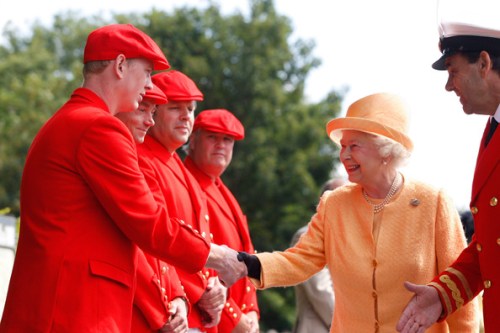
“All swans – unmarked – in open water – belong to the [British] Crown, and have since the Twelfth Century,” says David Barber, Queen Elizabeth’s official swan marker for 16 years. Although, legally, the Queen retains ownership over all unmarked swans in the United Kingdom, the royal British monarch only exercises her rights over a 79-mile stretch of the Thames River. Barber’s job, with the help of a crew in boats, is to annually count the number of unmarked swans in the Thames. This tradition, called “swan-upping,” takes place over a 5-day period the third week in July.
Swan Upping Long Ago – the best way to tag a bird was to sit on it
The ritual [of swan upping] was first documented in the 12th Century, when the bird was a popular dish at medieval feasts. The monarchy laid claim to the birds, which were a valuable food commodity, and doled out ownership charters in exchange for favors. Up to the mid-1800s, swan marking was akin to cow branding: A unique mark, carved into the beak of a newborn cygnet, designated ownership by a specific, chartered family or organization.
Henry VIII reportedly enjoyed swan at his dinner table. Today, swan eating doesn’t go down so well with many Britons, who live in a country that Dr. Perrins describes as “bird oriented.” In 2005, the Master of the Queen’s Music, Sir Maxwell Davies, made headlines when he found a dead swan on his property and made a terrine of it. Mark McGowan, an activist artist, upset Britons when he ate swan in a performance protest against the queen in 2007.
A Swan Upping Boat on the River Thames in England today
This week, Mr. Barber’s crew counted and weighed roughly 120 newborn swans. When they come upon a brood, the rowers yell “All up!” and surround the birds with their skiffs. After deftly bringing the swans aboard, the uppers temporarily tie them up.
“The best way is to sit on the bird,” said Robert Dean, a boat builder and three-year veteran of the royal crew, who stood on the Eton dock Monday morning with a bundle of swan ties holstered in his belt. Once the newborn swans are weighed and tagged with identification rings, they are entered into the log and released into the river.
For the swans, it is a painless affair — and it has helped save their lives. In the 1980s, swan upping records helped alert Dr. Perrins to a sharp decline in the swan population on the Thames caused by lead poisoning from fishing weights. After a successful campaign to ban the implements, the number of mute swans returned to normal — about 35,000 across the country today, Dr. Perrins said.
The identification rings used by the swan uppers also assist local rescuers, who use them to return injured birds to their broods after treatment. Swan Lifeline, a local agency that treats about 1,100 sick swans each year, cures common injuries from fishhooks and dog attacks, as well more exotic wounds, as when swans fly through greenhouses accidentally. Working closely with Swan Lifeline, Mr. Barber coordinates the removal of as many as 100 swans before the Henley Royal Regatta on the Thames.” (1)
For the first time in her 57-year reign, Queen Elizabeth attended the launch party on July 20.
In the following youtube video, the Queen’s swan marker David Barber explains and demonstrates the practice of swan-upping.
(1) “In Her Majesty’s Service, Loyal Minion Courts,” The Wall Street Journal, July 24, 2009.
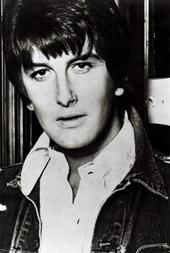
Gordon Waller, half of the rock duo, Peter and Gordon, that was part of the British Invasion of the Sixties, died Friday, July 17, 2009, in Norwich, Connecticut. He was 64 and lived in Ledyard, Connecticut. His death was announced on the official Peter and Gordon website.
Peter and Gordon were part of a wave of British bands that swept the United States following the success of the Beatles. They toured the United States and appeared on network variety shows, including “The Ed Sullivan Show.” In Gordon Waller’s obituary in The New York Times, writer Douglas Martin describes Peter and Gordon’s vocal harmonies as “reminiscent of the Everly Brothers to their own synthesis of folk, blues and rock ‘n’ roll.”
Jane Asher, sister of Peter Asher of Peter and Gordon. Jane Asher dated Sir Paul McCartney for five years until she eventually tired of his rampant infidelity and broke off the relationship.
Although they recorded many successful songs, their most memorable is “A World Without Love” (1964). It was one of several written for them by Sir Paul McCartney. In October, 1963, Peter Asher and Gordon Waller had signed a record contract with EMI. At the time, Peter’s red-haired sister – the lovely Jane Asher – was dating Paul McCartney. Peter (age 19) and Gordon (age 18) asked Paul to give them a song. They knew he was in the middle of writing “A World Without Love” for the Beatles to record. Peter and Gordon asked Paul to finish the tune for them so they could record it. (1)
It was recorded on January 21, 1964, at Abbey Road with an arrangement by Geoff Love and production by Norman Newell. It was completed in 5 takes. The tune became a Top 10 hit in Britain, even displacing the Beatles’ own “Can’t Buy Me Love” on the pop charts. It was then issued in the United States on the Capitol label and became one of the top songs of the year. Two more McCartney songs that year brought Peter and Gordon added success: “Nobody I Know” and “I Don’t Want to See You Again.” Click below to watch the video of Peter and Gordon singing “A World Without Love.” Also visit Peter and Gordon at Peter and Gordon myspace to hear more of their music.
(1) The New York Times, “Gordon Waller, 64, a Partner in the Band Peter and Gordon.” Obituaries, July 21, 2009.
France's First Lady, Carla Bruni, is also a singer, recording star, model, and actress. Her dating resume, prior to her marriage to French President Nicolas Sarkozy, includes rock stars Eric Clapton and Mick Jagger.
From the BBC:
Carla Bruni, the wife of French President Nicolas Sarkozy, has taken part in a New York concert to celebrate the 91st birthday of former South African President Nelson Mandela.
Hosted by Whoopi Goldberg, the event at Radio City Music Hall also featured performances by Aretha Franklin, Wyclef Jean, Stevie Wonder, Alicia Keys and Will.I.Am.
Romeo wears a mask to disguise himself so he may enter his father's enemy's ball. Romeo is played by Leonard Whiting in Franco Zeffirelli's masterpiece film, "Romeo and Juliet," made in 1968 with Olivia Hussey starring as Juliet.
Yesterday, I cut my finger with a knife. My daughter asked me, “Is it bad, Mom?” I thought of the street fight scene from “Romeo and Juliet” when Mercutio gets wounded. Romeo says to Mercutio, “Courage, man. The hurt cannot be much.”
Read today’s post to discover Mercutio’s famous response.
“Romeo and Juliet” by William Shakespeare, 1595
Our story so far: Sixteen-year-old Romeo Montague and his friends – in disguise – boldly crash a masquerade party at the home of Romeo’s father’s enemies, the Capulets. There Romeo meets and falls in love with an enchanting young lady. We know that it is Juliet, the 13-year-old daughter of Lord Capulet.
Romeo, watching Juliet dance, asks a servant her name:
“Who is that lady who gives richness to the hand of that knight by simply holding it?”
Unbeknownst to Romeo, Tybalt, Juliet’s cousin, hears Romeo’s voice and recognizes it as the son of his sworn enemy, Lord Montague. He swears revenge, although the ruler of the city has forbidden any more bloodshed between the two rival families.
Romeo approaches Juliet and they kiss. Romeo does not know that he was seen by Tybalt. Here is that scene from the 1968 Franco Zeffirelli version of “Romeo and Juliet.”
Several scenes later, the two lovers secretly wed.
Act III, Scene I. A public place…
Meanwhile, Romeo’s two best friends, Benvolio, a good-natured guy, and Mercutio, a sassy, hot-headed fellow, are bored, out walking the streets with nothing to do and missing their lovesick friend, Romeo.
Benvolio urges Mercutio to go inside. He senses that the Capulets also might be out, idly about, and up to no good. Neither Benvolio nor Mercutio know that Tybalt saw Romeo at the Capulet ball and has sworn to kill him but the street fighting between the two families has been a long-standing problem. Benvolio pleads with Mercutio:
“I pray thee, good Mercutio, let’s retire. The day is hot, the Capulets abroad, and if we meet, we shall not [e]scape a brawl, for now, these hot days, is the mad blood stirring.”
An arrogant Mercutio laughs at Benvolio’s suggestion that he is a quarrelsome fellow and foolishly ignores his friend’s warning that trouble lies ahead….
Enter Tybalt and others.
Ben: By my head, here come the Capulets.
Mer: By my heel, I care not.
Tyb: [To his men] Follow me close, for I will speak to them. [To Mercutio and Benvolio] Gentlemen, good den. A word with one of you.
Mer: And but one word with one of us? Couple it with something; make it a word and a blow [a slash of your sword].
Tyb: You shall find me apt enough to that, sir, and you will give me occasion [good reason].
Mer: Could you not take some occasion without giving? [I’m sure you could find a reason without having it given to you].
Tyb: Mercutio, thou consortest [play around] with Romeo.
Mer: Consort? What, dost thou make us minstrels [silly musicians]? And thou make minstrels of us, look to hear nothing but discords [angry sounds]. Here’s my fiddlestick [sword]; here’s that shall make you dance. Zounds, consort! [By God’s wounds, Benvolio, do you hear these insults?]
Ben: We talk here in the public haunt of men. Either withdraw unto some private place and reason coldly of your grievances, or else depart. Here all eyes gaze on us.
Mer: Men’s eyes were made to look, and let them gaze. I will not budge for no man’s pleasure, I.
Enter Romeo who has just married Juliet. No one knows yet. He is now married to a Capulet and thus, unknown to Tybalt, his cousin by marriage.
Tyb: Well, peace be with you, sir. Here comes my man [meaning Romeo].
Mer: But I’ll be hanged, sir, if he wear your livery [uniform]. Marry, [Indeed], go before to field [leave town to fight], he’ll be your follower! Your worship in that sense may call him man.
Tyb: Romeo, the love I bear thee can afford no better term than this: thou art a villain. [villain is the nicest name I can call you, I hate you so.]
Rom: [not wanting to fight] Tybalt,the reason that I have to love thee doth much excuse the appertaining rage to such a greeting. Villain am I none. Therefore farewell. I see thou knowst me not. [as your cousin; you haven’t heard the news.]
Tyb: Boy, this shall not excuse the injuries that thou hast done me; therefore turn and draw.
Rom: I do protest I never injured thee, But love thee better than thou canst devise till thou shalt know the reason of my love; And so, good Capulet, which name I tender as dearly as mine own, be satisfied.
Mercutio is incensed that Romeo returns Tybalt’s insults with loving words, so draws his own sword to defend Romeo.
Mer: O calm, dishonorable, vile submission! Alla stoccata [At the thrust] carries it away. Tybalt, you ratcatcher, will you walk?
Tyb: What wouldst thou have with me?
Mer: Good King of Cats, nothing but one of your nine lives….
Tyb: I am for you. [Draws.]
Rom: Gentle Mercutio, put thy rapier up.
Mer: Come, sir, your passado! [a forward thrust of the sword as the foot steps forward]
They fight.
Rom: Draw, Benvolio; beat down their weapons. Gentleman, for shame! Forbear this outrage! Tybalt, Mercutio, the Prince expressly hath forbid this bandying in Verona streets. Hold, Tybalt! Good Mercutio!
Romeo steps between them. Tybalt, under Romeo’s arm, stabs Mercutio. Tybalt runs away.
Mer: I am hurt. A plague o’ both your houses! [Curse the Capulets and Montagues.] I am sped [done for]! Is he gone and hath nothing?
Ben: What, art thou hurt?
Mer: Ay, ay, a scratch, a scratch. Marry, ’tis enough. Where is my page? Go, villain, fetch a surgeon.
The page exits.
Rom:Courage, man. The hurt cannot be much.
Mer:No, ’tis not so deep as a well, nor so wide as a church door; but ’tis enough, ’twill serve.Ask for me tomorrow, and you shall find me a grave man. I am peppered [mortally wounded], I warrant, for this world. A plague o’ both your houses! …Why the devil came you between us? I was hurt under your arm.
Rom: I thought all for the best.
Mer: Help me into some house, Benvolio, or I shall faint. A plague o’ both your houses! They have made worms’ meat of me. I have it, and soundly, too. Your houses!
Exit, supported by Benvolio. Mercutio dies.
Here is the fight scene from Zeffirelli’s 1968 film, “Romeo and Juliet.” The clip opens with a wet-haired Mercutio challenging Tybalt to a duel. Tybalt wears a red cap and orange vestments.
Readers: For more “Talk Like Shakespeare Today” posts, click here.
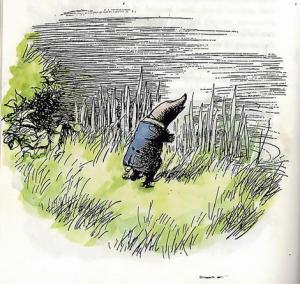
The Mole from The Wind in the Willows by Kenneth Grahame, illustration by E.H. Shepard
The following is an excerpt from the opening scene in the children’s literary classic, The Wind in the Willows. The Rat and the Mole are standing on opposite riverbanks, shouting across the river to one another in greeting. Rat is standing outside his snug riverside dwelling that includes a pier.)
“Hullo, Mole!” said the Water Rat.
“Hullo, Rat,” said the Mole.
“Would you like to come over?” enquired the Rat presently.
The Rat…stooped and unfastened a rope…then lightly stepped onto a little boat which the Mole had not observed. It was painted blue outside and white within, and was just the size for two animals; and the Mole’s whole heart went out to it at once, even though he did not yet fully understand its uses.
The Rat sculled smartly across and…the Mole stepped gingerly down…and …to his surprise and rapture found himself actually seated in the stern of a real boat.
[T]he Rat shoved off and took to the skulls again. “Do you know, I’ve never been in a boat before in my life.” [said the Mole]
“What?” cried the Rat, open-mouthed: “never been in a – you never – well I – what have you been doing, then?”
“Is it so nice as all that? asked the Mole shyly…[as he] felt the boat sway lightly under him.
“Nice? It’s the only thing,” said the Water Rat solemnly, as he leant forward for his stroke. “Believe me, my young friend, there is nothing – absolutely nothing – half so much worth doing as simply messing about in boats. Simply messing,” he went on dreamily: “messing – about – in – boats; messing -“
“Look ahead, Rat!” cried the Mole suddenly.
It was too late.
Published in 1908, The Wind in the Willows, written by Kenneth Grahame, is a timeless tale of animal friends and their adventures along the Thames riverbank, in the Wild Wood, or on the Open Road. The main characters are the laid-back Ratty, the dim but positive Mole, stern yet kindly Badger, and the irrepressible Mr. Toad of Toad Hall. To see more of E.H. Shepard’s drawings for The Wind in the Willows, click here.
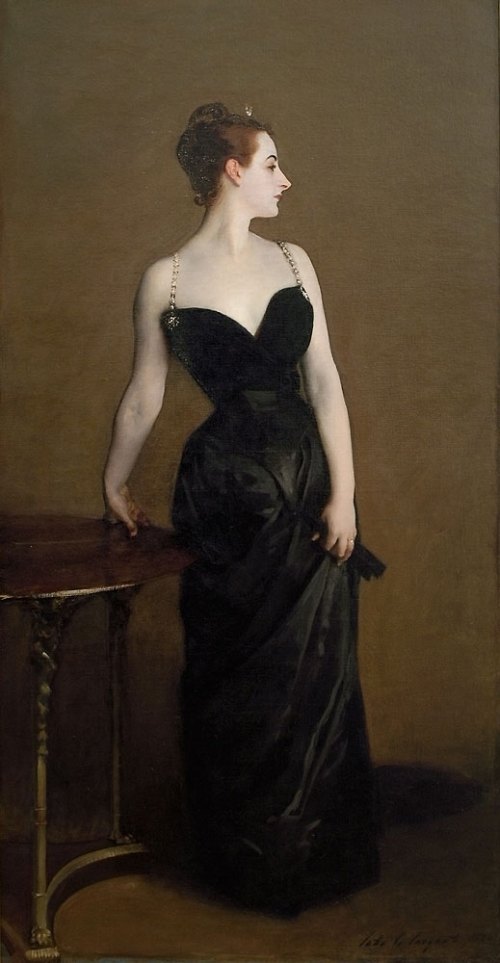
"Madame X" by American portrait painter John Singer Sargent, 1884
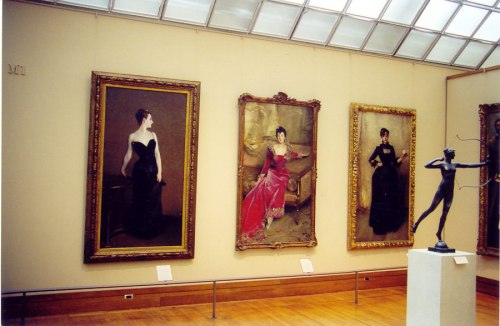
In the Metropolitan Museum of New York hangs a seven-foot tall portrait of a rather pale woman in a black velvet evening dress held up by sparkly straps. “Madame X” was painted by the American society painter John Singer Sargent. The subject of the painting is Madame Virginie Gautreau, a professional beauty, who moved in the top tiers of Paris society and was often mentioned in the scandal sheets for her numerous dangerous indiscretions and passion for self-display. It was 1884 and Madame Gautreau was the Talk of Paris.
It was only a year earlier that John Singer Sargent had met her at a party. Once he laid eyes on her, he knew at once he must paint a portrait of her as an homage to her beauty – and a boost to his lagging career. He felt that if he painted her, all Parisian society women would flock to his studio demanding that he paint their portraits. Sargent sent word to Madame Gautreau that she must sit for a portrait; she consented, realizing that a rising tide lifts all boats. She, too, needed the publicity to maintain her social superiority. Once they agreed, Sargent began to paint, devoting himself to capture the “strange, weird, fantastic, curious beauty of that peacock-woman, Mme. Gautreau,” noted one observer.
Madame Gautreau was rumored to take great pains to be beautiful:
Gautreau achieved her affected, highly artificial look with hennaed hair, heavily penciled brows, rouged ears and powdered skin. She was rumored to mix her powder with mauve tint and to ingest arsenic wafers to make her skin more translucent, giving it even more of a bluish-purple tint.
Not all thought she was lovely to look at. She had her detractors. Some said her white pallor and icy charm made her resemble a cadaver.
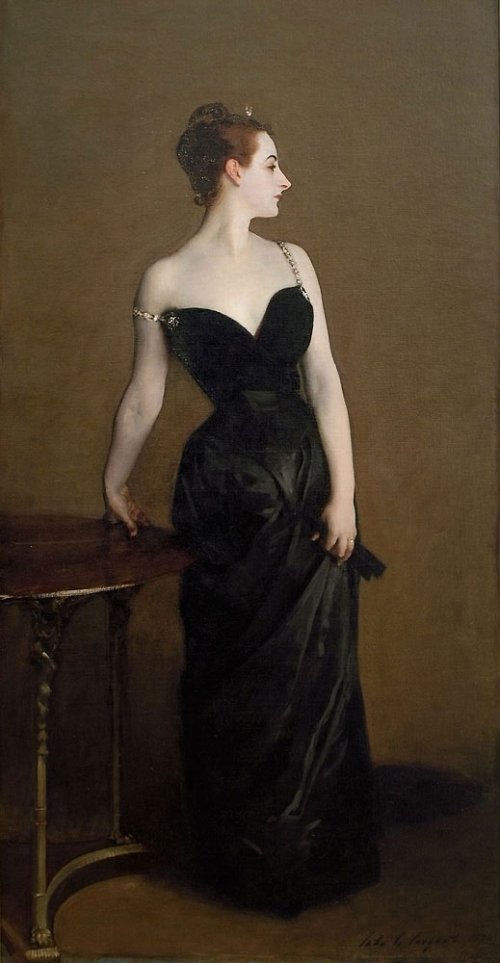
"Madame X" is shown as it must have originally appeared
The painting that hangs in the Met today, “Madame X,” however, is not the same Madame X as the one that Sargent painted in 1884 and exhibited in Paris. That image no longer exists. We can only speculate what it looked like. The painting shown to the right here is what it may have looked like. That original, the one exhibited in Paris in 1884, showed Madame Gautreau’s dress with the right strap suggestively falling off her shoulder. (Compare to the painting at the top, the one at the Met. Her right strap, you’ll notice, sits firmly in place.)
When exhibited in Paris, the painting “with the falling strap” created an instant sensation but not in the way Sargent and Gautreau had hoped:
No sooner had the doors of the Palais de l’Industrie in the Champs-Élysées opened on May 1, 1884, than a crowd gathered in front of ”Madame X.” People hooted and pointed the tips of their umbrellas and canes at the painting. ”Look! She forgot her chemise!*” was heard over and over again. The critics were no kinder. ”Of all the undressed women at the Salon this year, the most interesting is Madame Gautreau . . . because of the indecency of her dress that looks like it is about to fall off,” wrote a critic for L’Artist. (*A chemiseis a woman’s undergarment, a smock, that is worn under clothing and next to the skin. In that day, a French lady always wore a chemise under a dress.)
The painting was considered too provocative; sex pervaded it. Not even an actress, it was remarked, would wear a dress that shockingly low-cut and snug! And that strap! A little imagination conjured up a scene in which a slight struggle with a lover might knock Madame X’s right strap completely off her shoulder leading to… ! Paris was abuzz with the scandal. Madame Gautreau’s mother demanded that Sargent withdraw the painting from the exhibit. He refused.
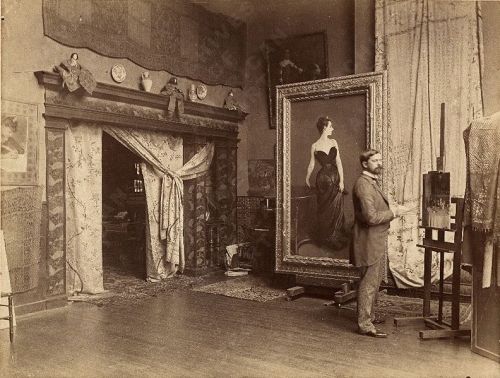
John Singer Sargent in Paris studio 1885 with the revised painting of Madame X
The painting, considered a beloved masterpiece today but pornographic by 1884 Parisian standards of decency, was trashed by the Paris critics so badly that Sargent, having lived in Paris for a decade then, was eventually forced to move to London to continue his profession. Sargent revised the painting to show the gown’s right strap securely in place. It is this retouched painting that hangs in the New York Metropolitan today.
Zip ahead to 1938 and the Upper East Side of Manhattan. Dorothy Hale was wearing her Madame X dress when she jumped to her death from her penthouse apartment. To learn more, read “Frida Kahlo: The Suicide of Dorothy Hale.”
"The Suicide of Dorothy Hale" by Frida Kahlo, 1938/39
one of the neat Michael Jackson shirts available on Epic Love site at Cafe Press. The symbols say: Peace, Love, Michael.
Peace Love Michael
For you Michael Jackson fans, check out the following websites for cool stuff -shirts, buttons, & more in Michael’s memory. They are designed by a clever young lady in Austin, Texas. Check out her site at Epic Love on Cafe Press, here:
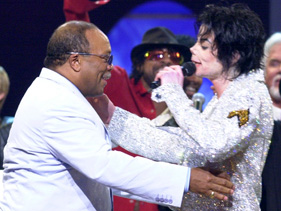
Quincy Jones blasts Michael Jackson’s excuses for turning white
by Lauren Crooks
MICHAEL JACKSON’S mentor has blasted the star’s “bull****” excuses for turning himself white.
Quincy Jones said he never believed Jacko’s claims he was suffering from rare skin condition vitiligo which caused bleaching to his skin.
Jones – who produced some of Jackson’s greatest hits, including Thriller – said the King of Pop had many chemical peels because he was not happy with the way he looked.
He compared the troubled star’s lies to those of a drug addict.
Jones said: “He was the most gorgeous guy but he obviously didn’t want to be black. You see his kids? It’s ridiculous. Chemical peels and all. I don’t understand it.
“He’d come up with, ‘Man, I promise you I have this disease’ and ‘I have a blister on my lungs’. I don’t believe any of that bull****.”
Jones, 76, said while he worked with Jackson they often rowed about his lies and they reminded him of stars who made up excuses about more traditional addictions like alcohol and drugs.
He said: “We talked about it all the time, the chemical peels and stuff. I couldn’t talk him out of it.
“I’ve been around junkies all my life. I’ve heard every excuse.”
The New York Post, quoting a new book, reports that Jackie Kennedy and Bobby Kennedy had a four-year love affair that began shortly after President Kennedy was killed.
Author C. David Heymann says Bobby was Jackie’s “true love” and that the affair was well known among family members. When Bobby was shot after winning the California presidential primary, Jackie — not Bobby’s wife Ethel Kennedy or his brother Ted Kennedy — ordered that he be removed from a respirator, the book says.
The book, Bobby and Jackie: A Love Story, arrives in stores this month. The Post says it “includes recollections of the steamy affair” from Kennedy family intimates, including Pierre Salinger, Arthur Schlesinger, Jack Newfield, Gore Vidal, Truman Capote and Morton Downey Jr. Heymann told the paper he spent nearly two decades researching the book and had access to FBI and Secret Service files. Tapes of his interviews are available at the SUNY Stony Brook library.
The Kennedy family at their home in Hyannisport, Massachusetts on the night after John F Kennedy won the 1960 presidential election. Front row from left: Eunice Shriver, Rose Kennedy , Joseph Kennedy , Jacqueline Kennedy, and Ted Kennedy. Back row, from left: Ethel Kennedy, Stephen Smith, Jean Smith, John F Kennedy, Robert F Kennedy, Pat Lawford , Sargent Shriver, Joan Kennedy, and Peter Lawford
Among the book’s revelations:
— Six months after JFK’s death, during a May 1964 dinner cruise on the presidential yacht the USS Sequoia, Bobby and Jackie “exchanged poignant glances” before disappearing below deck, leaving Ethel upstairs. “When they returned, they looked as chummy and relaxed as a pair of Cheshire cats,” according to Schlesinger.
— At one point, Ethel Kennedy implored family friend Frank Moore to “tell Bobby to stop sleeping with Jackie.” Instead, Moore told her to find a marriage counselor.
— Shipping tycoon Aristotle Onassis — RFK’s rival for Jackie’s attention — once threatened to “bring down” Bobby by going public with details of the affair. “I could bury that sucker,” Onassis said, “although I’d lose Jackie in the process.”
The New York Daily News reports that the book already is generating criticism:
“It’s a new low, and you just wonder how far people are willing to go,” Laurence Learner, author of The Kennedy Men, The Kennedy Women and Sons of Camelot told the paper.
“[Heymann] is just trying to make a buck. Yes, Bobby and Jackie had a relationship as friends, but [the romance] is a total exaggeration. I feel sorry for Heymann,” he said.
Michael Jackson (front row, right) started his career as a member of the family musical group "The Jackson 5." He soon emerged as a star in his own right.
Here’s the joke that’s going around. America the Land of Opportunity. Only in America, can a young black man grow up to be a white woman. Michael Jackson.
Now that he’s passed on, we – who witnessed the bizarre morphing of Michael Jackson from the chubby-cheeked, open-faced little cherub into the mysterious boy man whose facial features became a mosaic of Elizabeth Taylor, Diana Ross, and Kirk Douglas – have a few questions.
Mainly, why did he do it? Why did he surgically alter his adorable face so radically until he looked like one of the ghoulishy-white monsters who danced with him in “Thriller”? Why did Michael Jackson destroy his natural good looks? Was he trying to rub out himself? Was it a form of self-hatred, self-mutilation? Some say he didn’t want to look anything like his savage father and that was his motivation.
Michael was black yet look at his 3 kids. They’re white. We now know he’s not the biological father. So Michael was homosexual. He didn’t want to consummate marriages and become the biological father in that way. Couldn’t he have donated sperm? Or, as some suggest, was Michael incapable of that process? Had he taken hormone treatments or prescription drugs to such a degree as to render him incapable of producing enough sperm? If he wanted children, why didn’t he choose surrogate parents who were black? Why didn’t he want black children? Michael Jackson married two white women. He dated only white girls – Tatum O’Neal, Brooke Shields. He rejected black noses and skin. It’s laughable that black celebrities Jamie Foxx and Spike Lee, activists Jesse Jackson and Al Sharpton are now, upon Michael’s death, claiming the King of Pop as one of their own, when Michael so long ago and so publicly rejected his Afro-American roots.
Have these very public figures – and alleged men of the cloth – forgotten the stain? Michael Jackson was twice investigated, in 1994 and 2005 for sexually assaulting young boys and was brought to trial. True, he was never found guilty but a settlement of $22 million can buy a lot of silence.
A lot of people who knew Michael Jackson know his secrets, but no one is talking negatively about him now that he’s gone. To hear them go on, he was St. Michael. From his bodybuilder to his best friend, all are mum about what was really going in Michael Jackson’s head and private life. We understand that he was not right, that he was a pedophile with warped ideas about how love is legally and morally expressed between adults and children. What we want to know is what caused this transformation from angel into devil? What changed Michael Jackson from the star we loved to the star many hated? Drug addiction plus mental illness? Childhood sexual trauma? Pressures only a superstar could feel? Perhaps all of the above?
We didn’t want Michael Jackson to become a mess; his music and dancing were so much fun. His energy on stage, in videos, on radio was electric, infectious.
We watched him grow into adulthood. We loved him from the first. Then we looked on in bewilderment as he began carving up his face and whitening his skin. Then he moved to Neverland as Peter Pan, set up an amusement park, and invited children to come and see him. Then we learned that he did unspeakable things with those children at Neverland, some of the little ones sick with cancer. Our beloved King of Pop had become somebody dark and revolting – a monster we couldn’t trust.
We are conflicted: we are sad Michael Jackson died. Is it okay we are mourning the death of a once-great entertainer who degenerated into a stranger who abused children and rejected his own race?
***
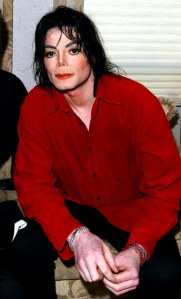
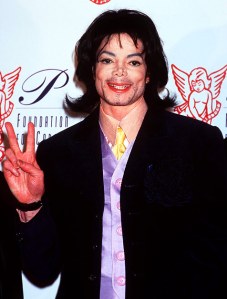
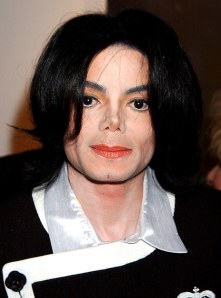
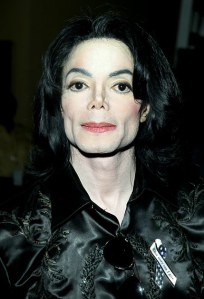
Us Weekly is running these photos today of Michael Jackson’s changing face. One must wonder if Michael’s father’s cruel remarks about his face caused Michael to want to completely alter his looks. Remember that Joe Jackson, besides beating the young Michael with belts and cords and knocking him and his brothers into walls because he wanted them to perform better, subjected Michael to verbal abuse, told his son repeatedly that he had a big nose and made fun of Michael’s skin condition as a teenager (adolescent acne). Michael said that sometimes, when his father walked into a room, he would be so afraid of him that he would vomit.
No doubt as a result of such belittling of his appearance, Michael Jackson, as he grew older, became obsessed with reducing the size of his nose. He further tinkered with his looks. He began making steady rounds to dermatologists to bleach out the black of his African-American skin until he became white. He annihilated his African skin and nose until no visible traces remained.
We were not allowed to see much of his skin so we don’t know how far he took the skin bleaching. As years went by, Michael took pains to keep us from seeing all of him, wearing long sleeves and pants, covering up almost every part of himself in the end, wearing masks, scarves, sunglasses, wigs, and hats, so that we couldn’t know how much plastic surgery and dermatology he had – or how dependent he had become on needle drugs and how badly his body looked beneath the flashy uniforms and spangled gloves.
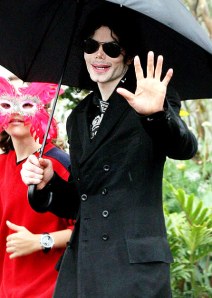
While Michael Jackson changed his face, skin, and hair many times, his fixation on his nose was the most obvious – and the most disturbing. He kept having operations on it – operations that made it look worse. We watched in horror as it became smaller and more pinched, at times looking like it wasn’t even real anymore, just made of Silly Putty. He began to be followed by an umbrella man, whose sole job was to keep the sun off Michael’s face. Was Michael’s nose now so delicate as to melt off in the sun? Did he wear face masks to keep away the germs or to prevent us from seeing what late mutilation he’d subjected his poor nose to?
As the photos that follow will show, Michael Jackson was never satisfied with his nose, having more and more plastic surgery until the nose was whittled down to nothingness. Was it a greedy plastic surgeon who kept pushing Michael for yet one more nose surgery or was it Michael’s body dysmorphia that demanded more, more? After 20 years of surgeries, did Michael still look in the mirror and see a big nose? Was he suffering from a condition akin to anorexia like the 80 pound stick figure girl who looks in the mirror at her figure and still sees herself as a fat pig?
In an odd twist, Michael died with almost no nose left – Joe Jackson couldn’t call him “Big Nose” any longer – and 2 children parented by his skin doctor and nurse.
Michael Jackson 1975
Michael Jackson 1984
Michael Jackson 1984
Michael Jackson 1989
Michael Jackson 1990
Michael Jackson 1990
Michael Jackson face 1995
Michael Jackson 2000
Michael Jackson 2002
Michael Jackson 2003
Michael Jackson 2005
Michael Jackson 2005
Michael Jackson 2009
Michael Jackson 2009
Readers, for more on this blog on Michael Jackson, click here.
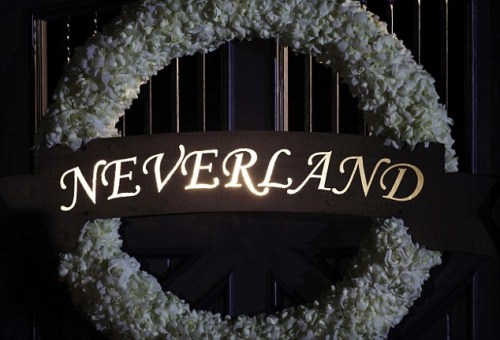
Neverland gate in Los Olivos, California, July 1, 2009
Yesterday, Jermaine Jackson lead Larry King and his television crew on a tour of Michael Jackson’s former fantasy home, Neverland Ranch, empty now. The front gates to Neverland sport a giant wreath of white roses in memorial to the now deceased King of Pop whose passing millions mourn.
The famous Neverland train station with its enormous floral clock
Michael Jackson in a bumper car in the amusement park at his Neverland Ranch, 1994
The singer and ex-wife Lisa Marie Presley welcomed youngsters for World Childrens’s Conference at Neverland in 1995

 I watched that line dance and it took me way back – to the 1970s – to the TV dance show, “Soul Train,” hosted by Don Cornelius. I loved that show. Those kids could dance. I watched “Soul Train” on Saturday mornings when I was in high school and college. It came on right after “American Bandstand.”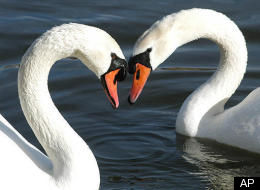



 It was
















 Lisa's History Room