Feeds:
Posts
Comments

Click here to read “Frida Kahlo’s First Bad Accident” before reading this post.

Frida Kahlo and Diego Rivera, their wedding photo, 1929

Frida Kahlo and Diego Rivera, their wedding photo, 1929

Frida Kahlo once said to a friend, “I have suffered two serious accidents in my life, one in which a streetcar ran over me….The other accident is Diego.”

She was referring to her husband, Diego Rivera (1886-1957), the world famous painter and active Communist. He painted large-scale murals in Mexico, New York City, Detroit, and San Francisco. Diego was 21 years older than Frida and their marriage in 1929 offered Frida, a budding artist, to move not only in elite Mexican artistic and intellectual circles, but those in Europe and America as well. But the price Frida paid for marrying a renowned “lady chaser” was high. Their marriage was tempestuous. They divorced once and remarried a year later; they were separated several times.

Many people were surprised by what they considered a strange match. Frida once told a journalist:

When I was seventeen, Diego began to fall in love with me. My father didn’t like him because he was a Communist and because they said he looked like a fat, fat, fat Breughel. They said it was like an elephant marrying a dove. Nevertheless, I arranged everything in the Coyoacán town hall for us to be married on the twenty-first of August, 1929.”

"The Flower Carrier" by Diego Rivera, 1935

"The Flower Carrier" by Diego Rivera, 1935

Frida was 22, Diego, 43. It was Diego’s first legal marriage, although, by then, there had been many women and two long-term relationships. For ten years during the 1910s, he lived in Paris with the Russian artist Angelina Beloff. Together they had a son who died young. Then, in 1922, he married the Mexican Lupe Marín, with whom he had two daughters. Though a serious commitment, Diego and Lupe had not legalized their relationship with a civil ceremony so Diego was free to marry Frida without divorcing Lupe.

Frida’s recollection of her wedding to Diego gives an idea of how difficult a man Diego was to be married to:

I borrowed petticoats, a blouse, and a rebozo from the maid, fixed the special apparatus on my foot so it wouldn’t be noticeable, and we were married. Nobody went to the wedding, only my father, who said to Diego, ‘Now, look, my daughter is a sick person and all her life she’s going to be sick. She’s intelligent but not pretty. Think it over awhile if you like, and if you still wish to marry her, marry her, I give you my permission.'”
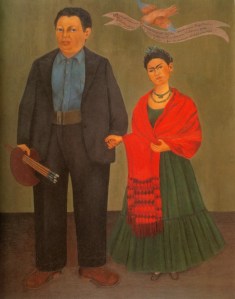
"Frida and Diego Rivera" by Frida Kahlo, 1931

"Frida and Diego Rivera" by Frida Kahlo, 1931

Diego added that her father mentioned that she was un demonio – a devil. Frida continues, describing her wedding reception:

Then they gave us a big party in Roberto Montenegro’s house. Diego got horrendously drunk on tequila, waved his pistol about, broke some man’s little finger, and destroyed some things. Afterward, we got mad at each other; I left crying and went home. A few days went by and Diego came to get me and took me to his house at 104 Reforma.'”

Despite their stormy relationship, Diego and Frida loved and needed each other.

NEXT: Frida Kahlo: A Few, Small Nips
READERS: For more posts on Frida Kahlo, click here.

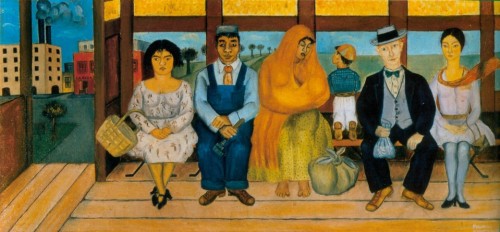
"The Bus," by Frida Kahlo (1929). Frida painted her recollection of the last moments aboard the bus before the terrible accident that robbed her of her health. She is pictured on the far right. Notice that she is not dressed in traditional Mexican costume. She adopted that exotic look later, after her 1929 marriage to flamboyant Mexican muralist Diego Rivera.

“The Bus,” by Frida Kahlo (1929). Frida painted her recollection of the last moments aboard the bus before the terrible accident that robbed her of her health. She is pictured on the far right. Notice that she is not dressed in traditional Mexican costume. She adopts that exotic look later, after her 1929 marriage to flamboyant Mexican muralist Diego Rivera.

Mexican artist Frida Kahlo (1907-1954) once said that she suffered two bad accidents in her life. The first one occurred on September 17, 1925. It would transform her life forever. Frida was only 18.

It was a gray day. A light rain had just fallen. After spending the afternoon wandering among the street stalls of downtown Mexico City, Frida and her boyfriend Alex Gómez Arias caught a bus that would take them home to Coyoacán. The new bus was brightly painted with two benches along the sides. It was nearly full but Alex and Frida found seats together near the back. The bus driver sped off to cross the busy streets on his way out of town.

As the bus driver began to turn onto Calzada de Tlapan, a street trolley approached. The bus driver rashly tried to pass in front of the turning streetcar. He didn’t make it. Alex remembers the point of impact:

The electric train [streetcar] with two cars approached the bus slowly. It hit the bus in the middle. Slowly the train  pushed the bus. The bus had a strange elasticity. It bent more and more, but for a time it did not break. It was a bus with long benches on either side. I remember that at one moment my knees touched the knees of the person sitting opposite me. I was sitting next to Frida. When the bus reached its maximal flexibility it burst into a thousand pieces, and the train kept moving. It ran over many people.

I remained under the train. Not Frida. But among the iron rods of the train, the handrail broke and went through Frida from one side to the other at the level of the pelvis.”

Frida said that the “handrail pierced me the way a sword pierces a bull.” Alex continues:

When I was able to stand up, I got out from under the train. I had no lesions, only contusions. Naturally the first thing that I did was to look for Frida.

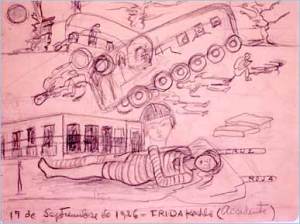
"Accident" by Frida Kahlo (1926)

Something strange had happened. Frida was totally nude. The collision had unfastened her clothes. Someone in the bus, probably a house painter, had been carrying a packet of powdered gold. This package broke, and the gold fell all over the bleeding body of Frida. When people saw her, they cried, ‘La bailarina, la bailarina!’ With the gold on her red, bloody body, they thought she was a dancer.

I picked her up….and then I noticed with horror that Frida had a piece of iron in her body. A man said, ‘We have to take it out!’  He put his knee on Frida’s body and said, ‘Let’s take it out.’ When he pulled it out, Frida screamed so loud that when the ambulance from the Red Cross arrived, her screaming was louder than the siren. Before the ambulance came, I picked up Frida and put her in the display window of a billiard room. I took off my coat and put it over her. I thought she was going to die. Two or three people did die at the scene….others died later.”

"Self-Portrait for Alejandro Gomez Arias," by Frida Kahlo (1926)

Frida’s condition was so grave doctors didn’t believe they could save her. They thought she would die on the operating table. Her spinal column was broken in three places in the lumbar region. Her collarbone was broken and her third and fourth ribs. Her right leg had eleven fractures and her right foot was dislocated and crushed. Her left shoulder was out of joint, her pelvis broken in three places. The steel handrail produced a deep abdominal wound, entering through the left hip and exiting through the genitals. She convalesced for two years though she would never fully recover.

It was while she was confined to bed that Frida began to paint, using a small lap easel her mother bought for her. Frida had a mirror hung overhead in the canopy of her bed so she could use her reflection as a beginning subject for portraits.

Next: Frida Kahlo: The Other Accident

READERS: For even more posts on Frida Kahlo, click here.

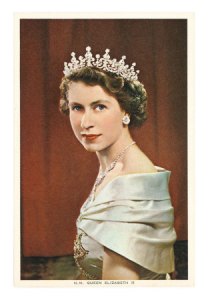
the newly-crowned Queen Elizabeth II

the newly-crowned Queen Elizabeth II

Here is a typical weekday morning for Queen Elizabeth II while in residence at  Buckingham Palace in London:

7:30  The maid enters her bedroom with a tray of  morning tea: 2 silver pots of Earl Grey, milk, and a few biscuits. The cup and saucer are bone china. The linen napkin bears the royal cypher “EIIR” (Elizabeth II Regent). The maid sets down the tray on a bedside table and crosses the room to open the bedroom curtains. She then turns on the radio which is tuned to BBC Radio 4’s Today programme. The Queen listens to the day’s news as she sips her tea. Outside her window the traffic on Constitution Hill is building and people are strolling through Green Park. The maid draws a bath.

While the Queen is bathing, the maid lays out the first of perhaps many outfits the Queen will wear that day, depending upon the royal schedule. Once the Queen is dressed, the Queen’s hairdresser styles her hair.

8:30  The Queen joins her husband Prince Philip for breakfast which is served in the first floor dining room that overlooks the Palace garden. Prince Philip has had a shower and coffee. During their breakfast together, the Prince may place little morsels of food on the bird feeder outside the window. A tail-coated footman brings the breakfast – whole wheat toast with marmalade and more tea and coffee. The Queen reads her papers: The Daily Telegraph and The Racing Post.

9:00  The Piper to the Sovereign – referred to as the “Queen’s Piper” – steps into the Palace garden. He is wearing a kilt of Royal Stewart tartan and two eagle feathers in his headwear.  The Queen and Prince Philip listen as he tunes his bagpipes. For the next fifteen minutes, the Queen’s Piper plays a selection of bagpipe tunes below the dining room window.

9:30  The Queen is seated at her Chippendale desk in her office to begin reviewing her correspondence. A footman comes in with her corgis, who have just had their morning walk in the garden. She works all morning. After lunch, she may take the dogs for a walk herself.

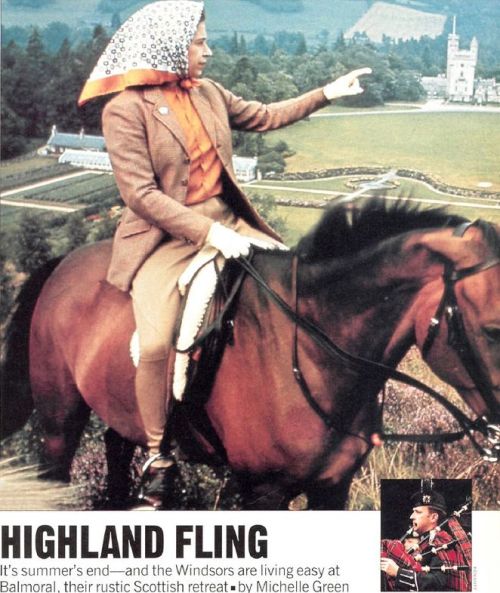
This 1994 People magazine photograph shows Queen Elizabeth II at Balmoral, her Scottish Highland hideaway every August. Whether at Balmoral, Windsor Castle, or Buckingham Palace, the Queen's weekdays start with a fifteen-minute bagpipe serenade. When at Balmoral, the pipers wear the Balmoral tartan.

Above, a 1994 People magazine photograph shows Queen Elizabeth II at Balmoral, her Scottish Highland hideaway she retreats to every August. Whether at Balmoral, Windsor Castle, or Buckingham Palace, the Queen’s weekdays start with a fifteen-minute bagpipe serenade at 9 a.m. When at Balmoral, though, the pipers wear the Balmoral tartan.

For more on Queen Elizabeth II, look in the left column “Categories-People-Queen Elizabeth II.” I’ve written many posts on the Queen; I hope you enjoy them!


Teddy Roosevelt

In the spring of 1903, President Teddy Roosevelt embarked on his much-delayed and much-anticipated rail tour of the American West. He was to travel 14,000 miles over 8 weeks, visiting 25 states and an estimated 150 towns and cities, where he would make over 200 speeches. His “Western trek,” as he called it, included stops at Yellowstone, the Grand Canyon, and Yosemite. He couldn’t wait to get away from the stress of politics in Washington.

On May 3, Teddy attended a church service in the cowtown of Sharon Springs, Kansas. Teddy recounted that day to reporters:

“There were two very nice little girls standing in the aisle beside me. I invited them in and we all three sang out of the same hymn book. They were in their Sunday best and their brown sunburned little arms and faces had been scrubbed till they almost shone.

…When church was over, I shook hands with the three preachers and all the congregation, whose buggies, ranch wagons, and dispirited-looking saddle ponies were tied to everything available in the village. I got a ride myself in the afternoon, and on returning, found that all the population that had not left had gathered solemnly around the train.”

The townspeople of Sharon Springs had never seen anything like Teddy’s train. Six “gleaming private cars” made up the length of it. “First, a baggage car; then the Atlantic, a club car heavy with wood and leather, plus a fully-equipped barbershop; then the Gilsey diner, stocked with champagne and cigars; then the Senegal, a big Pullman carrying reporters, photographers, telegraphers, and Secret Service men; then the Texas, a compartmental sleeper for White House staff, and any guests Roosevelt might ask to ride along.

“Last came the President’s own Elysian, seventy feet of solid mahogany, velvet plush, and sinkingly-deep furniture. It had two sleeping chambers with brass bedsteads, two tiled bathrooms, a private kitchen run by the Pennsylvania Railroad’s star chef, a dining room, a stateroom, with picture windows, and an airy rear platform for whistle-stop speeches.” (1)

Back to Teddy’s recollection:

Among the [crowd gathered on the train platform] was a little girl who asked me if I would like a baby badger which she said her brother Josiah had just caught. I said I would, and an hour or two later, the badger turned up from the little girl’s father’s ranch…The little girl had several other little girls with her, all in clean starched Sunday clothes and ribbon-tied pigtails. One of them was the sheriff’s daughter, and I saw her nudging the sheriff, trying to make some request, which he refused. So I asked what it was and I found that the seven little girls were exceedingly anxious to see the inside of my [train] car, and accordingly I took them all in. The interior arrangements struck them as being literally palatial….”


Teddy Roosevelt's one-legged rooster

Teddy Roosevelt's one-legged rooster

Teddy gave the little girls flowers and a silver-and-gold medal he had been presented in Chicago. (1) He  named the two-week old badger Josiah – “Josh” for short – and installed the animal on the well-ventilated front platform of the Elysian. As the presidential train continued westward, Teddy would hand-feed the badger cut-up potatoes and milk. At train stops, he would show his new prize to schoolchildren, and point out the white stripe that ran down his back. As the journey continued, Josh was joined by two bears, a lizard, a horned toad, and a horse. (1)

When the president returned to the White House, Josh was added to the family’s assortment of pets. But he soon began to hiss like a teakettle and nip at guests’ ankles, so he was donated to the Bronx Zoo.


(1) Morris, Edmund. Theodore Rex. New York: Random House, Inc., 2001.

800px-TheodoreRooseveltFamily Ike Hoover served in the White House for over forty-two years, ultimately becoming Chief Usher in charge of the day-to-day operations of the presidential mansion. His memoirs, published in 1934, provide insight into the White House of Theodore Roosevelt:

“After the McKinley funeral [September 1901], Mr. Roosevelt himself did not appear for several days, but in the meantime Mrs. Roosevelt and her son Teddy arrived. After looking the place over they sent word to the others to join them, and in less than a week all the family were living in their new quarters. Then began the wildest scramble in the history of the White House. The children, hearty and full of spirits, immediately proceeded to cut loose.

The life of the employees who took their responsibilities too seriously was made miserable. The children left no nook or corner unexplored. From the basement to the flagpole on the roof, every channel and cubbyhole was thoroughly investigated.

Places that had not seen a human being for years were now made alive with the howls and laughter of these newcomers. The house became one general playground for them and their associates. Nothing was too sacred to be used for their amusement, and no place too good for a playroom. The children seemed to be encouraged in these ideas by their elders, and it was a brave man indeed who dare say no or suggest putting a stop to these escapades.

One of the favorite stunts of the children was to crawl through the space between ceilings and floors where no living being but rats and ferrets had been for years. They took delight also in roller-skating and bicycle-riding all over the house, especially on the smooth hardwood floors. Practically every member of the family, with the exception of the President and Mrs. Roosevelt, had a pair of wooden stilts, and no stairs were too well carpeted or too steep for their climbing, no tree too high to scramble to the top, no fountain too deep to take a dip, no furniture too good or too high to use for leapfrog and horseplay, no bed was too expensive or chair too elegantly upholstered to be used as a resting place for the various pets in the household.

Algonquin the Pony, ridden by Archie Roosevelt

Algonquin the Pony, ridden by Archie Roosevelt

Giving the pony a ride in the elevator was but one of many stunts. This little fellow, spotted and handsome, had free access to any of the children’s bedrooms. By means of the elevator he would be conveyed to the bedroom floor from the basement, a distance of two complete floors.

…Every member of the family was an expert rider, and the President never seemed so happy as when either Mrs. Roosevelt or one of the children accompanied him on his ride.

Next perhaps might be mentioned his lawn tennis games. It was great sport for him to figure just whom he preferred to play with in the afternoon. Of course none dared refuse the invitation, but it was well known that a poor player was never invited a second time.

…All returned just about in time for lunch. Those famous lunches! Something indeed was wrong when there were not two or more guests for this meal. To prepare properly for a certain number was almost a physical impossibility, for notice was continually coming from the office that someone had been invited at the last minute, and many times the family and guests had to wait until the table was made larger before they could be seated. The place was really a transient boardinghouse, and how every one got enough to eat was the wonder of the household. Lunch being over, the rest of the afternoon was given over to sport – “exercise” as the President used to call it.

…It was more to the liking of the family to spend a quiet evening in the library, either playing cards or reading the current magazines. The whole family were friends when it came to reading. No newspapers. Never a moment was allowed to go to waste; from the oldest to the youngest they always had a book or a magazine before them. The President, in particular, would just devour a book, and it was no uncommon thing for him to go entirely through three or four volumes in the course of an evening. Like-wise we frequently saw one of the children stretched out on the floor flat on his stomach eating a piece of candy and with his face buried deep in a book. The current magazines were entirely too slow coming out, and we were kept busy trying to get them for the different members of the family the moment they appeared.

Hoover, Irwin Hood. Forty-two Years in the White House. Boston: Houghton Mifflin Company, 1934.
Seale, William, The President’s House, vol II. New York: Harry N. Abrams, 1986.

"The Love Embrace of the Universe, the Earth (Mexico), Me, Diego, and Mr. Xolotl," by Frida Kahlo, 1949.

"The Love Embrace of the Universe, the Earth (Mexico), Me, Diego, and Mr. Xolotl," by Frida Kahlo, 1949.

In the lower left of Frida Kahlo‘s painting, “The Love Embrace of the Universe” (above), a little dog is sound asleep in a huge hand. The dog is Frida Kahlo’s favorite pet dog, Mr. Xolotl. Mr. Xolotl (show-low -tul) was a xoloitxcuintli (show-low-eats-queen-tlee) dog. Frida had several of these unusual-looking dogs, a hairless breed with an ancestry that is traceable back 3,000 years to the Aztecs, hence their appeal to Frida, enormously proud of her MesoAmerican heritage. Xolos (show-lows), for short, are related to Mexican hairless chihuahuas. The Aztecs both revered and ate xolos.

"Frida Kahlo and her Itzcuintli Dogs," photo by Lola Alvarez Bravo, 1944

"Frida Kahlo and her Itzcuintli Dogs," photo by Lola Alvarez Bravo, 1944

Nowadays, xolos are prized for the enormous amount of heat their bodies generate, although they do not have a higher-than-average body temperature. As a result, many sufferers of rheumatism and arthritis keep xolos as pets, claiming the dogs relieve their pain by acting as canine heaters.

The xolos are sometimes referred to as Colima dogs. They may range in size from 3 pounds to 60.

READERS: For more posts on Frida Kahlo, click here.

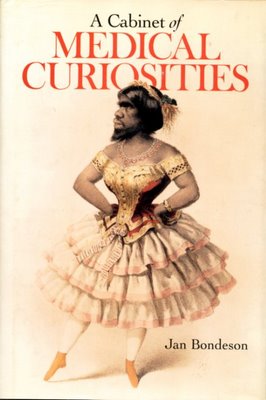
an illustration of Julia Pastrana, a Victorian stage performer who toured Europe, Canada, and the United States billed as the Bearded Lady, the Nondescript, the Ape-Woman.

An illustration of Julia Pastrana, a Victorian stage performer who toured Europe, Canada, and the United States billed as the Bearded or Hairy Lady, the Nondescript, the Ape-Woman, the Marvelous Hybrid or Bear Woman.

Julia Pastrana (1834-1860) was one of the most famous human curiosities of her time, touring Europe, Canada, and the United States in the 1850s as “the Bearded Lady” or the “Ape-Woman.” Born poor in Mexico, she suffered from a rare inherited disorder (hypertrichosis), not understood during the Victorian Age, that caused her entire body to be covered in silky, black hair. Add to that a jutting jaw with huge teeth that made her look positively like a monkey. Yet while grotesque and freakish, she also exuded a feminine grace. She sang Spanish songs sweetly, had slender feet and hands, and displayed a buxom figure at a petite four-and-a-half feet tall. She styled her hair in elaborate coiffures and wore embroidered lace dresses that barely covered her knees. She spoke three languages, cooked, and sewed. In her stage act, she danced a Highland Fling.

When she toured London in 1857 in one of the monster shows popular at the time, she attracted journalists, doctors, and scientific minds. Julia was very popular. It cost 3 shillings to see her in the Regent Gallery, compared to the 6 shillings that a Victorian laborer might earn in a week. Promoted by her avarious manager and new husband, Theodore Lent, Julia was now billed as “The Nondescript,” suggesting that she was a unique species, perhaps “the missing link” between humans and the rest of the animal kingdom. Debate raged in the newspapers as to her origins and her appearance was described at length. She submitted to medical examinations freely and received many distinguished visitors. Charles Darwin mentioned her in his book, The Variation of Animal and Plants under Domestication, writing:

Julia Pastrana, a Spanish dancer, was a remarkably fine woman – she had a thick and masculine beard.”

Julia loved her husband very much and, in 1859 in Moscow, she became pregnant with their first child. Her doctors were worried. Julia’s narrow hips and small frame could mean a difficult childbirth, they warned. On March 20, 1860, Julia gave birth to a hair-covered little boy. He died within 35 hours. Julia died five days later, at age 26.

Theodore Lent was distraught. Julia had been the bank. Now the bank was closed! How was he to live now that his source of income had died? He had a Eureka moment. Why should the bank close? He sent Julia’s corpse and that of his newborn son to Professor Sukolov of Moscow University for embalming. The process took 6 months but the results were amazing. Julia’s mummified remains looked lifelike. He dressed Julia in one of her dancing costumes and his son in a cute sailor suit. He stood them up on a pedestal and took them on a tour, exhibiting them as pickled specimens for 20 years.

Julia Pastrana and son, embalmed, on tour after their deaths

Julia Pastrana and son, embalmed, on tour after their deaths

When touring Sweden, Theodore met another hairy young woman named Zenora who suffered from a condition very similar to Julia. He married her and began touring her as Zenora Pastrana – Julia’s sister. Theodore grew richer and richer. In the 1880s, he and Zenora retired to St. Petersburg where they bought a waxworks museum. Theodore wasn’t able to enjoy his retirement for long because he became ill and was sent to a lunatic asylum where he died.

Over the course of the next 100 years, the mummies changed hands countless times, being sold to German fairs, an Austrian circus, and a Norwegian chamber of horrors. They came out of mothballs in 1970 and went on a short tour of Sweden and Norway. An American tour was aborted due to public outcry over the utter tastlessness of the idea. The mummies were put in storage by Norwegian owner Hans Lund in 1973.

In August of 1976, vandals broke into the storage unit. Julia’s mummified son was mutilated and his remains eaten by mice. Only her body remained. Then in 1979, the storage facility was again broken into and Julia’s body was stolen. It was assumed at the time to be destroyed.

Then, in February of 1990, a Norwegian journalist made a surprise discovery of a mummy in the basement of the Institute of Forensic Medicine in Oslo. It turns out that, back in 1979, the police had responded to a call involving some children who found an arm in a ditch. A search revealed the mummified body of Julia, badly mangled. The police did not know her identity. They took the mummy to the Institute.

It is believed by some, though not confirmed by me at this time, that the remains of Julia Pastrana have rested in a sealed coffin at the Department of Anatomy at Oslo University since 1997. “She is now a buried woman, not an exhibition object. She rests [at peace],” says Professor Gunnar Nicolaysen [translated from Norwegian].

Olivia Hussey and Leonard Whiting in Zeffirelli's 1968 film, "Romeo and Juliet." The scene is at the Capulets' ball, before Romeo and Juliet know each other's identity.

Olivia Hussey and Leonard Whiting in Zeffirelli's 1968 film, "Romeo and Juliet." The scene is at the Capulets' ball, before Romeo and Juliet know each other's identity.

Juliet: O, Romeo, Romeo! Wherefore art thou Romeo?

is probably the most well-known Shakespeare line of all time – and the most misunderstood. The line is from “Romeo and Juliet,” Act II. Scene II.

To give Juliet’s words some context, let’s start at the beginning. Our play takes place in 16th Century Verona in Northern Italy. It’s evening. Young Juliet Capulet’s parents are giving a fancy dress ball where Juliet meets and kisses the dreamiest guy. But the young man mysteriously slips away from her before she can get his name. Quickly, Juliet pulls her nurse (nanny) aside, points toward the fleeing young man, and asks her nurse:

Juliet: What’s he that follows there, that would not dance?

Nurse: I know not.

Juliet: Go ask his name….

Nurse: His name is Romeo, and a Montague, The only son of your great enemy.

Juliet: My only love, sprung from my only hate!

Juliet despairs that she has fallen in love with a Montague, the son of her father’s sworn enemy. Juliet goes upstairs to her bedroom to undress for bed. Then she walks onto the balcony that overlooks the dark orchard to collect her thoughts.

Olivia Hussey as Juliet in the balcony scene from Zeffirelli's 1968 film, "Romeo and Juliet."

Olivia Hussey as Juliet in the balcony scene from Zeffirelli's 1968 film, "Romeo and Juliet."

Juliet is distraught that an age-old feud between her family (the Capulets) and Romeo’s (the Montagues) should keep her from having a relationship with Romeo. She wants to know: Why – for what purpose – is he Romeo???? Why is he not named Jack Sprat – anything! – but the name of my father’s enemy’s son? She is not asking where Romeo is.

Juliet: O Romeo, Romeo! Wherefore [why] art thou Romeo? [Why is your name Romeo, the name of my father’s enemy’s son?]

Deny thy father and refuse thy name!

Or, if thou wilt not, be but sworn my love,

And I’ll no longer be a Capulet.

Meanwhile, unbeknownst to fair Juliet talking to herself up on the balcony, Romeo has leapt over the orchard wall and is hiding amongst the trees, spying on Juliet.

Leonard Whiting in Zeffirelli's "Romeo and Juliet." As Romeo, he is hiding in the Capulet orchard, eavesdropping on Juliet on the balcony.

Leonard Whiting in Zeffirelli's "Romeo and Juliet." As Romeo, he is hiding in the Capulet orchard, eavesdropping on Juliet on the balcony.

Romeo hears what Juliet is saying and whispers to himself:

Romeo: Shall I hear more, or shall I speak at this?

She does not hear him and continues speaking.

Juliet: ‘Tis but thy name that is my enemy.

Thou art thyself, though not a Montague.

What’s Montague? It is nor hand, nor foot,

Nor arm, nor face, nor any other part

Belonging to a man. O, be some other name!

What’s in a name? That which we call a rose

By any other name would smell as sweet.

So Romeo would, were he not Romeo called,

Retain that dear perfection which he owes

Without that title. Romeo, doff thy name;

And for that name, which is no part of thee,

Take all myself.

Romeo: (speaking out from the orchard) I take thee at thy word.

Call me but love, and I’ll be new baptized;

Henceforth I never will be Romeo.


Click below to see the balcony scene from Zeffirelli’s “Romeo and Juliet.” It won Academy Awards for Best Cinematography and Best Costume Design.

http://www.youtube.com/watch?v=c3BfBIzz6vQ&feature=related

Readers: For more “Talk Like Shakespeare Today” posts, click here.

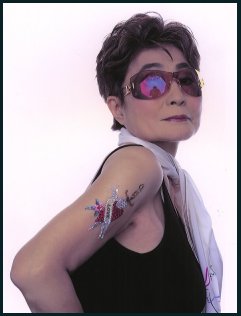
Yoko Ono (b. 1933) photo 2002

Yoko Ono (b. 1933) wearing her trademark wraparound sunglasses and sporting a tattoo. This photo by Mark C. O'Flaherty was taken in London in 2002, the year before Yoko Ono turned 70 and reprised her once-controversial stage show, "Cut Piece," in Paris.

In 2003, when Yoko Ono turned 70, she celebrated her birthday in much the same way the rest of us do. She put on her best outfit (a little black dress, of course), ordered a cake (chocolate), and invited a few friends to come to her party. And, to make it more fun, she hauled out some family photos to remember the old days and tacked them on the wall.

Sounds normal enough, right ? Hardly. The words “Yoko” and “normal” have never appeared in the same sentence before, until now. Yoko, after all, rose to fame first as an avant garde performance artist before she met and wed Beatle John Lennon. True to her fashion, Yoko staged her February 2003 birthday party to be an attention-getting bash. She invited 200 guests to one of New York’s poshest restaurants, Mr. Chow. The partygoers were an eclectic lot,  including creative types like  rockers (Lou Reed, Fred Schneider of the B-52s) and writers (Susan Sontag) as well as recording executives and media moguls. As for the decor:

The room was dominated by a blown-up picture of Ono and John Lennon with their words, “War Is Over If You Want It.” Another wall showed Ono’s “Film No. 4, Autumn,” which features 300 bare butts walking. A portion of the floor was covered with white canvas to create a “painting to be stepped on” of footprints. In another part of the party, Ono’s Bagism, a fabric bag big enough to enclose two people, was available for cavorting guests. Guests received goodie bags that contained Ono’s book “Grapefruit” and her “Box of Smile,” a mirror encased in a box. 

Yoko has been in the jaw-dropping business since 1964 when she first performed “Cut Piece” at the Sogetsu Art Center in Tokyo. At the time she was struggling for recognition as a concept artist. “Cut Piece” was her most provocative piece of that period.

In these first performances [of ‘Cut Piece’] by Ono, the artist sat kneeling on the concert hall stage, wearing her best suit of clothing, with a pair of scissors placed on the floor in front of her. Members of the audience were invited to approach the stage, one at a time, and cut a bit of her clothes off—which they were allowed to keep.” Yoko left the stage completely nude.

Click to see a film of Yoko’s 1965 Tokyo performance of “Cut Piece.” [The music by Yoko Ono was added later.]

“The Japanese audiences’ volative reaction convinced Yoko that she could not stay in Japan if she expected to attract serious attention.” So she took the show on the road – to New York then London for the fateful meeting with Lennon at the Indica Gallery. (1)

Seven months after Yoko held her birthday bash, she decided to reprise “Cut Piece” for a Paris audience, saying that she was doing it for world peace. “Come and cut a piece of my clothing wherever you like the size of less than a postcard,” she offered, “and send it to the one you love.”

Sean Lennon, the son of John Lennon and Yoko Ono, cuts away a piece of his artist mother Yoko Ono's dress as she repeats her 1960s performance "Cut Piece," in Paris.  (AP)

Sean Lennon, the son of John Lennon and Yoko Ono, cuts away a piece of his artist mother Yoko Ono's dress as she repeats her 1960s performance "Cut Piece," in Paris. (AP)

Wearing a layered black silk chiffon skirt (Chanel?) and a black blouse (Gucci?), Yoko sat in a chair onstage as audience members, including son Sean Lennon, came forward and snipped off pieces of her clothing. One woman cut a piece of her own jacket and gave it to Yoko.

“There were a few tense moments. One woman hacked rather brutally with the shears….Early on, one woman cut Yoko’s shoe…but Yoko was obviously not pleased and asked her not to do the shoe, but the damage was already done.”

Stripped down to her matching black bra, panties, and shoes, the show ended and Yoko was escorted off stage in a red kimono.

(1) Spitz, Bob. The Beatles: A Biography. New York: Little, Brown and Company, 2005.

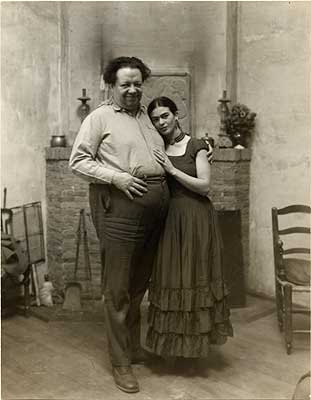
Artists Diego Rivera and Frida Kahlo

Artists Diego Rivera and Frida Kahlo

By the summer of 1938, Frida Kahlo was on her way to being discovered as an artist in her own right, rather than only being referred to as the wife of famed Mexican muralist Diego Rivera. That summer, actor and art collector Edward G. Robinson had traveled to Mexico City just to see her paintings and had paid $200 each for four of them. Frida was thrilled. She had sold only a few of her paintings so far and had been content to just give them away. She later wrote of the Robinson sale:

“For me it was such a surprise that I marveled and said, “This way I am going to be able to be free; I’ll be able to travel and do what I want without asking Diego for money.”

She and Diego had become increasingly estranged because of his many illicit extramarital affairs, including one with Frida’s sister Cristina. Frida was heartsick by Diego’s infidelities and retaliated by having multiple affairs of her own, with both men and women. Despite their discord, they remained deeply in love. Frida and Diego made up one of those married couples who could neither stay together nor apart. By the summer of 1939, they would be divorced – only to remarry a year later.

"Self-Portrait Dedicated to Leon Trotsky (Between the Curtains)" 193

“Self-Portrait Dedicated to Leon Trotsky (Between the Curtains)” by Frida Kahlo, 1937

That November, Frida Kahlo traveled to New York City for her first one-person exhibition of her paintings, held at the Julien Levy Gallery, confident in her new status as celebrated artist. As always, her exotic Zapotec clothing and heavy jewelry created a buzz in the press. Her show was a great success. Time magazine noted that “the flutter of the week in Manhattan was caused by the first exhibition of paintings by famed muralist Diego Rivera’s…wife, Frida Kahlo.” Frida Kahlo’s hand, bedecked with huge rings, adorned a cover of Vogue.

Notables such as artist Georgia O’Keeffe attended the gallery exhibit as did playwright and former editor of the fashion magazine Vanity Fair Clare Boothe Luce.

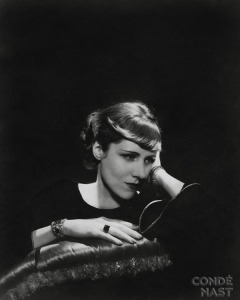
Claire Booth Brokaw (Luce) (1903-1987) as photographed by Cecil Beaton for the August 1934 issue of Vanity Fair

Claire Boothe Brokaw (Luce) (1903-1987) as photographed by Cecil Beaton for the August 1934 issue of Vanity Fair

Luce remembered the occasion well:

“The exhibition was crowded. Frida Kahlo came up to me through the crowd and at once began talking about Dorothy’s suicide [Dorothy Hale was a friend of both Kahlo and Luce’s].…Kahlo wasted no time suggesting that she do a recuerdo of Dorothy. I did not speak enough Spanish to understand what the word recuerdo meant….I thought Kahlo would paint a portrait of Dorothy in the style of her own self-portrait [dedicated to Trotsky][see above], which I bought in Mexico….

Suddenly it came to me that a portrait of Dorothy by a famous painter friend might be something [Dorothy’s] poor mother might like to have. I said so, and Kahlo thought so, too. I asked the price, Kahlo told me, and I said, ‘Go ahead. Send the portrait to me when it is finished. I will then send it on to Dorothy’s mother.’”

Dorothy Hale was a sometime actress, Ziegfeld showgirl, and socialite. Hale’s life had gone downhill seven years earlier after her husband Gardner Hale was killed when his car drove off a 500 foot cliff in Santa Maria, California. Hale’s career as an actress was drying up; she was failing her screen tests. She was in severe financial trouble and living on charity from friends.  On October 20, 1938, Hale assembled her close friends for a party at her New York apartment and announced that she was taking a long trip. The farewell party lasted until the wee hours of the morning. Hale stayed up writing good-bye letters to her friends and drinking the last of the vodka. A little before  6 a.m. on the 21st,  Hale put on her black velvet dress and pinned on it a corsage of small yellow roses sent to her by the sculptor Isamu Noguchi. She then climbed onto the windowsill of her luxury high-rise apartment suite and jumped to her death.

"The Suicide of Dorothy Hale" by Frida Kahlo, 1938/39

“The Suicide of Dorothy Hale” by Frida Kahlo, 1938/39

From the encounter between Luce and Kahlo at the gallery exhibit arose one of Frida Kahlo’s most shocking and controversial paintings, “The Suicide of Dorothy Hale” (1938/39). Kahlo painted Dorothy Hale as she jumped, fell, and landed, dead and bloody, on the concrete walk outside her apartment building. Blood-red lettering at the bottom of the retablo details the tragedy in Spanish:

“In New York City on the 21st of October 1938, at 6:00 in the morning, Dorothy Hale committed suicide by throwing herself from a very high window in the Hampshire House. In her memory, this portrait was executed by Frida Kahlo.”

Luce recalls the horror she felt when the painting was delivered to her home and she first laid eyes on it.

“[W]hen I pulled the painting out of the crate…I felt really physically sick. What was I going to do with this gruesome painting of the smashed corpse of my friend, and her blood dripping down all over the frame? I could not return it – across the top of the painting there was an angel waving an unfurled banner which proclaimed in Spanish that this was ‘The Suicide of Dorothy Hale, painted at the request of Clare Boothe Luce, for the mother of Dorothy’. I would not have requested such a gory picture of my worst enemy, much less of my unfortunate friend.”

Luce wanted to have the painting destroyed, but was dissuaded by friends. Instead, she had sculptor and friend Noguchi paint over the angel with the banner and gave the painting to a friend.

Luce couldn’t have known at the time that Kahlo was in a desperate state of mind as she always was when she was afraid of losing Diego. At the time she painted “The Suicide of Dorothy Hale,” Kahlo herself was having repeated thoughts of committing suicide.

READERS: For more posts on Frida Kahlo, click here.

For more on Dorothy Hale, read my post, “Dorothy Hale and the Dymaxion Car.”

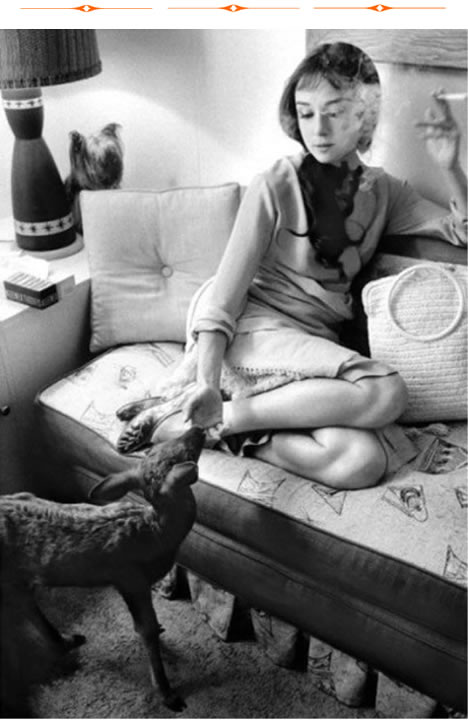
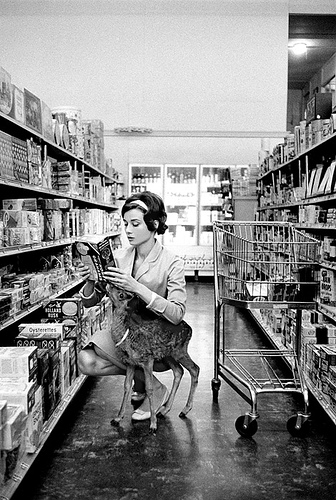
Audrey Hepburn in her dressing room during the filming of "Green Mansions." She is feeding Ip the fawn while her Yorkshire terrier Mr. Famous looks on from the left.

Audrey Hepburn in her dressing room during the filming of “Green Mansions.” She is feeding Ip the fawn while her Yorkshire terrier Mr. Famous looks on from the left.

This is an excerpt from,”Hollywood icon Audrey Hepburn is still full of surprises“:

[The book] Remembering Audrey, features candid portraits by Bob Willoughby, a photographer on the set of many of Hepburn’s films who became close enough to the beauty to literally follow her home. His visual account of Hepburn’s private life and career is peppered with unexpected moments, such as cameos by Pippin, nicknamed Ip, the fawn. When Hepburn was making her 1959 flick “Green Mansions,” directed by then-husband Mel Ferrer, the animal trainer on the set suggested that she take her on-screen sidekick, a baby deer, home with her so that he would learn to follow her. “It was truly amazing to see Audrey with that fawn,” remembers Willoughby in the caption alongside a photo of Pippin cuddling up to Hepburn like a lap dog as she naps on the couch. (Her pet dog, Mr. Famous, is curled in a ball at the other end of the sofa.) “While Audrey’s maid had been told about the little deer, she could not believe her eyes seeing Ip sleeping with Audrey so calmly,” writes Willoughby. “She was shaking her head and just kept smiling.”

Audrey Hepburn shopping in Beverly Hills with her pet deer and costar, Pippin, known as "Ip." (1958)
Audrey Hepburn shopping in Beverly Hills with her pet deer and costar, Pippin, known as “Ip.” (1958)

In another shot, the fawn inspects a box of Honey Grahams, shopping with Hepburn in a Beverly Hills supermarket. “Beverly Hills habitués are fairly blasé about what they see,” writes Willoughby, “but Audrey being followed around town by this lovely creature stopped everyone in their tracks.”

For more on Audrey Hepburn on this site, click here.

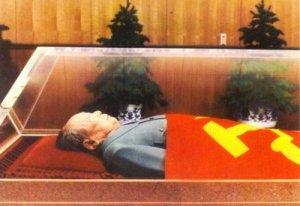
The body of Mao Zedong rests in its crystal coffin.

The body of Mao Zedong rests in its crystal coffin.

In a recent post, “Monster Mao,” I blogged about the Chinese communist leader, Mao Zedong, and his disastrous leadership.

Besides being selfish and cruel, Mao Zedong had some disgusting personal habits. He did not like to bathe. According to his personal physician, Dr. Li, Mao liked young girls and fatty pork. Like many Chinese of his time, Mao Zedong never brushed his teeth. Instead he rinsed with green tea and chewed the leaves. Dr. Li pleaded with his patient to brush but Mao refused, reportedly stating,

“A tiger never brushes his teeth.”

Consequently, Mao’s teeth looked like they were coated with green paint. As he grew older, his teeth fell out and he became toothless.

Mao also loved to chain smoke English cigarettes. Dr. Li begged him to cut down. Mao’s response:

“Smoking is also a form of deep-breathing exercise, don’t you think?”

Monster Mao

Mao Zedong as cult figure in Chinese propaganda poster

Mao Zedong as cult figure in Chinese propaganda poster

Mao Zedong (Tse-Tung) (1893-1976) was a Chinese Communist leader noted for his 1949 establishment of the People’s Republic of China. He led the PRC until his death. Chairman Mao “cast himself as a revolutionary leader but whose conduct and attitudes reminded one of China’s emperors.” Through disastrous economic policies and periodic purges of his political enemies, Mao was responsible for the unnecessary deaths of millions of Chinese citizens.

To shore up his power base of poor peasants, Mao targeted wealthy capitalists as enemies. In 1951, the Chinese government trained tens of thousands of workers to spy upon their fellow citizens. Workers informed on bosses, wives on husbands, and children on parents, mostly in an attempt to protect themselves from government reprisals. The media joined in on the attack, making accusations. Many people were arrested, a few killed, most fined, and some imprisoned. All were terrified and humiliated. There were at least 200 to 300,000 suicides. So many people jumped to their deaths from Shanghai skyscrapers that they got the nickname “parachutes.”

Then, in January 1958, Mao Zedong launched his economic growth plan, “The Great Leap Forward.” Farm workers were organized into people’s communes. All private food production was banned. Livestock and farm implements became property of the commune.

Mao then ordered the implementation of  new agricultural techniques – untested and unscientific. The program was ill-managed and corrupt. Food production began to decline. Then, compounded by drought in some areas and floods in others, the production of wheat dropped dangerously low. The result:  a food shortage so severe that millions of peasants starved to death. Mao acknowledged the deaths by occasionally abstaining from eating meat. (2)

(1) MacFarquhar, Roderick and Schoenhals, Michael. Mao’s Last Revolution. Boston: Harvard University Press, 2006.
(2) Li Zhi-Sui. The Private Life of Chairman Mao. New York: Random House, Inc., 1994.

A photograph of Ronald Reagan as a young child. He is standing between his mother and older brother, Neil. Notice his Dutchboy haircut, from which he got the nickname, "Dutch."

A photograph of Ronald Reagan as a young child. He is standing between his mother and older brother, Neil. Notice his Dutchboy haircut, from which he got the nickname, "Dutch."

This is an excerpt from a CNN.com transcript, “A Look at Reagan’s Early Years,” which aired June 10, 2004, five days after the death of Ronald Reagan, the 40th President of the United States. Reagan died at the age of 93, after suffering from Alzheimer’s Disease for more than a decade:

PHILLIPS (voice-over): Ronald Wilson Reagan (February 6, 1911 – June 5, 2004) was born in an apartment above a bank in this small town. Tampico, Illinois, known for beautiful farm country and great pie. Life here hasn’t changed much.

Ronald was the second son born to Nell and Jack Reagan, the first, Neil, was born two years earlier. Mary Ellen Goldson’s father delivered Ronald in this room.

UNIDENTIFIED FEMALE: Ronald got the name Dutch because when he was born, his father said, he looks just like a Dutchman. He was a big baby, chubby.

PHILLIPS: They would become childhood playmates.

UNIDENTIFIED FEMALE: But it was fun with the ghost stories and the hide & go seek, cops & robbers. That was a lot of fun.

PHILLIPS: Ronald Reagan’s young life was centered on his mother, Nell. He adored her, and she was his moral guide. Dorothy Carlson remembers that bond.

DOROTHY CARLSON, REAGAN’S CHILDHOOD FRIEND: He had good Christian values, had a good Christian upbringing. His mother was a wonderful woman, and he attended Sunday school and church regularly. And living in a small town where everyone is friendly and knows everybody, I think it makes a difference in city living. And you have more of a care and concern for people, and I don’t think he ever forgot it.

KAGAN: Nell also passed to Dutch her love of the dramatic. Reagan would recall [that] he felt [that] performing was his mother’s first love. Nell taught her son [that] God had a plan for him. She taught him how to dream, and to expect those dreams to come true.

Ronald Reagan stands on the diving board in the Little 19 (Illinois private colleges) swim meet held at St. Viator in this March 22, 1930 file photo.

Ronald Reagan stands on the diving board in the Little 19 (Illinois private colleges) swim meet held at St. Viator in this March 22, 1930 file photo.

LOU CANNON, REAGAN BIOGRAPHER: I think that Reagan’s mother was the key to his development, to his maturation, to his successes as an adult human being.

PHILLIPS: Reagan’s paternal ancestors hailed from Tiperary, Ireland. His father, Jack, a shoe salesman, was a staunch Irish- Catholic Democrat, who hated bigotry and racism, supported working people and taught his sons the same. He was also an alcoholic.

CANNON: If you’re the child of an alcoholic, you see things you don’t want to remember, and you certainly don’t want to tell anybody. Its main impact on Reagan was to create a kind of inward part of him that was a very, very important part of his character.

PHILLIPS: But it was Nell Reagan who would teach her son tolerance.

CANNON: The biggest thing that you did was that she taught Reagan and his brother to come to terms with the alcoholism of his father, which was very, very hard on Reagan.

PHILLIPS: Also hard on young Dutch was his nomadic boyhood. The family moved often through several small towns in Illinois before settling in Dixon, a prodominantly working class farm town of 8,000 people.

CANNON: In these first four, five, six years, they moved all the time, and so Reagan didn’t have — form these friendships that you form with other children if you grow up in the same place.

PHILLIPS: Reagan was just nine years old when the family moved to Dixon. He thought Dixon was heaven, and liked to describe his childhood as a rare Huck Finn/Tom Sawyer existence, simple life, simple times.

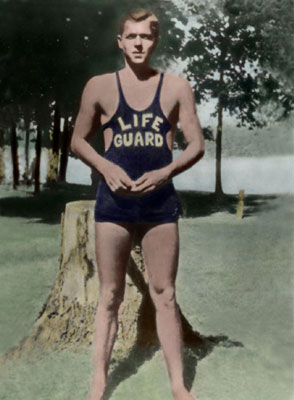
In his seven years as a lifeguard, Ronald Reagan saved 77 lives and a set of false teeth.

In his seven years as a lifeguard, Ronald Reagan saved 77 lives and a set of false teeth. (1931 photo)

Dutch was a short, skinny shy kid who wore thick, horn-rimmed glasses and was only an average student. But as he reached his teens, a summer job would become a defining experience in his life, forever changing his self-image.

(on camera): Ronald Reagan was 15 years old when he became a lifeguard here at Lowell Park on the Rock River. And as the story goes, when his shift was up and swimmers didn’t want to get out, he would toss pebbles from here and yell “River Rat!!!” But that’s not the only way to get swimmers out of the water. In seven summers as a lifeguard, he would go on to save 77 lives [and notched a mark on a wooden log for every life he saved, he said in an interview].

(voice-over): Helen Lotten remembers something else Reagan saved.

UNIDENTIFIED FEMALE: One time while he was a lifeguard, a man came up to him that had been swimming and he said, ‘Will you please dive in? I’ve lost my false teeth.’ He said, ‘I dove in and I can’t find them.’ So Dutch dove in several times, and he got them, he got them and he gave them to him, and the man was so pleased he gave him $10. And he [Reagan] said, ‘That was the first time I was ever paid for doing anything.’

PHILLIPS: Ronald Reagan loved being a lifeguard. He would recall his days on Rock River with great pride.

Biographer Edmund Morris said in an interview that being a lifeguard left Reagan with a lifelong desire to save people.

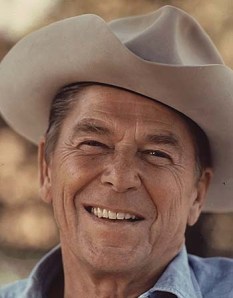
Ronald Reagan in a cowboy hat, circa 1976

Ronald Reagan in a cowboy hat, circa 1976

In the last years of his life, Ronald Reagan, while suffering from the debilitating mental effects of Alzheimer’s, had the same “slow, unstoppable energy” of his youth. He remained active in these post-presidency years, taking walks through parks near his California home and on beaches, playing golf regularly, riding horses, and visiting his office in nearby Century City. (1) At his home, he would tirelessly rake leaves from the pool for hours, not knowing that the leaves were secretly being replenished by the Secret Service men. (2)

(1) Wikipedia. Ronald Reagan.

(2) Morris, Edmund. Dutch: A Memoir of Ronald Reagan. New York: Random House, Inc., 1999.

For background information, read my previous post, “Eva Peron’s Restless Corpse.”

Here is part 5 0f 5 of the 1996 A & E “Biography” series on Eva Peron, “Evita: The Woman Behind the Myth.”  Halfway through the tape, you will get an eyeful of Evita.