Feeds:
Posts
Comments
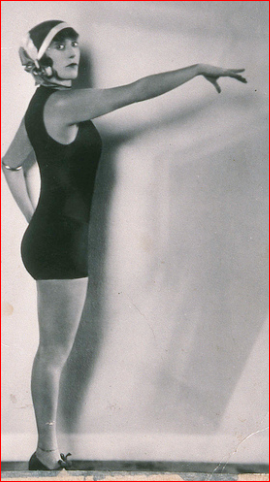
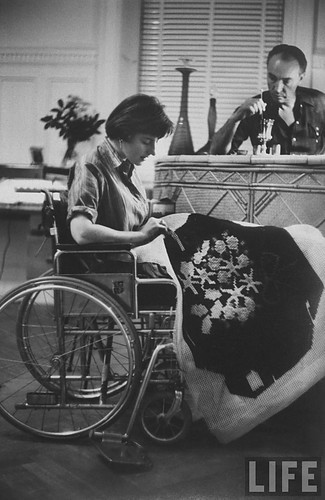
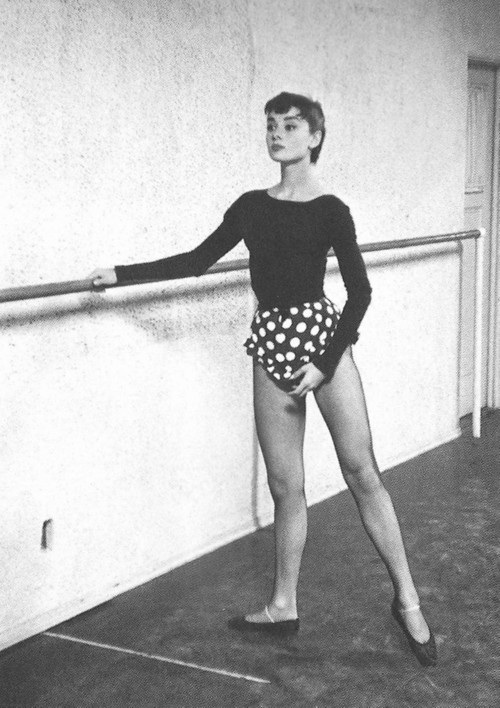
Tanaquil Le Clercz, born in Paris to a French father and an American mother, studied dance in NYC. undated photo

Tanaquil Le Clercq, born in Paris to a French father and an American mother, studied dance in NYC. Tanaquil was the name of an Etruscan queen with prophetic powers. Undated photo

In 1944, when fifteen-year-old Tanaquil Le Clercq (1929-2000) was one of ballet master George Balanchine‘s star pupils, she danced the role of a girl stricken with polio in his short piece “Resurgence.” The performance was a March of Dimes benefit held at the Waldorf Astoria in New York City. The music was Mozarts String Quintet in G minor, and at the close of the plangent adagio [slow part]…

Balanchine, as the Threat of Polio, came onstage wearing a large black cape and enveloped her [Tanaquil]; she sank to the floor [stricken ill with polio]. In the final movement – a sunny allegro – she reappeared in a wheelchair, children tossed dimes, and she rose and danced again.”1

In 1944, few diseases frightened people more than polio. At that time, there was no cure. Polio struck in the warm summer months, sweeping through towns in epidemics every few years. It was known that polio was highly contagious. What was not known – and was particularly terrifying – was how the virus was transmitted. People did everything they had done in the past to avoid infection but these tactics never worked. They avoided crowds. They stopped going to theatres, swimming pools. Schools closed for weeks at a time.

Though most people recovered quickly from polio, some suffered temporary or permanent paralysis and even death. Many polio survivors were disabled for life. Charities like the March of Dimes raised money to help families deal with their stricken loved ones and to search for a cure. Finally, in 1955, a vaccine became available.

Tanaquil Le Clercq and Nicholas Magallanes in "Jones Beach," 1950

Tanaquil Le Clercq and Nicholas Magallanes in “Jones Beach,” 1950

For the next twelve years, Tanaquil Le Clercq /tan-uh-kill luh-clair/would continue to dazzle audiences of the New York City Ballet with her “perky young vivacity” and “crisp and tangy style.” With her long and limber flamingo legs, Tanaquil Le Clercq – “Tanny” to her friends – defined the Balanchine Ballerina style. Allegra Kent, a young dancer at the time, recalls those limber legs. Once she arrived at ballet class to discover Tanny with a bandage on her nose. Tanny explained her injury, saying that

she had just kicked her leg too high but that she was going to be fine.”2

Tanaquil Le Clercq in her long-limbed beauty, 1953

1954 ad for George Balanchine's smash hit, The Nutcracker

1954 ad for George Balanchine’s smash hit, The Nutcracker

New York City Ballet, front row, George Balanchine seated next to his muse on the right, prima ballerina Tanaquil Le Clercq, 1952

On New Year’s Eve 1952, Tanny became George Balanchine’s fourth official wife. Every dancer knew she was Balanchine’s favorite, his inspiration to create, his muse. And now she was his wife. She was 23; he was 48.

To understand Tanny’s broad appeal, here is a video clip from one of her 1956 Paris performances. In “Western Symphony,” a satire on the American Wild West, Tanny plays a dance hall girl strutting around a saloon with a cowboy.  She has wit:

The Paris performance of “Western Symphony” was part of a 10-week European tour, begun in August 1956, that encompassed Salzburg, Vienna, Zurich, Venice, Berlin, Munich, Frankfurt, Brussels, Antwerp, Paris, Cologne, Copenhagen, and Stockholm. It was an ambitious schedule, brutal and exhausting, especially when prima ballerina Maria Tallchief (Balanchine’s third wife) unexpectedly departed mid-tour and Tanny had to fill in for her. Although most of the dancers had been given the polio vaccine before the trip, Le Clercq decided at the last minute to wait.

Coughing, thin, and tired, Tanny collapsed in Copenhagen. On November 1, she was rushed to the hospital. She fell into a coma and could not breathe on her own. They placed her in an iron lung. Tanny had contracted polio. She was 27.

The iron lung ward at Rancho Los Amigos Hospital in Downey, CA, ca 1953. (Photo: PBS)

The iron lung ward at Rancho Los Amigos Hospital in Downey, CA, ca 1953. (Photo: PBS)

It made international news. “Tanaquil Le Clercq Stricken With Polio,” reported the New York Times on November 2, 1956. The dance world was shocked.

Tanny remained in the Blegdamshospitalet (Copenhagen Polio Hospital) for four and a half months before returning home. Although she survived the disease, she was permanently paralyzed from the waist down. The most beautiful dancer of the New York City Ballet would never walk again. Tanny, who had danced ballet since the age of 7, would never again dance. Her career was over.

But not her marriage. Balanchine took a year off to take care of Tanny himself. Deeply mystical, he could not shake the feeling that he had somehow played an evil part in her fate. He recalled that March of Dimes performance twelve years before when he had played the part of the Threat of Polio. He had reached out his foul hand and laid it on Tanny, afflicting her in what then seemed then but an innocent little play.

‘It was an omen,’ he would later say. ‘It foretold the future.'” 3

However, in the March of Dimes play, after the shower of dimes was bestowed on the wheelchair-bound Tanny, she retrieved her ballet slippers, put them on, and danced joyfully across then off the stage.

‘It was, alas, a balletic finale.’ Balanchine reflected. ‘Nothing like that ending will happen in Tanny’s real life.'” 3


Tanaquil Le Clercq and husband George Balanchine in an undated photo. They would divorce.


1 “Dancing Around the Truth” by Holly Brubach. The New York Times, February 15, 1012.

2 “Tanaquil Le Clercq.” Ballet Encyclopedia online.

3 Taper, Bernard. Balanchine: a Biography. University of California Press, 1996.

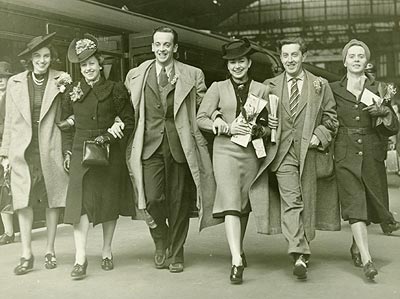
Members of the Sadler's Wells Ballet Company leave Victoria Station, London, for a tour of Holland, May 1940

Members of the Sadler’s Wells Ballet Company leave Victoria Station, London, for a tour of Holland, May 1940. Director Ninette de Valois is on the far right.

When the Germans invaded Holland on May 10, 1940, Ninette de Valois found herself trapped in The Hague. She was the director of the Sadler’s Wells Ballet Company from England. She and her 42 dancers had been on a Dutch tour. On the day of the invasion, de Valois had been sitting at a sidewalk café with two members of the dance company. It was noon. Suddenly, a stray bullet ricocheted from the pavement, passed between their heads, and crashed through the café’s plate glass window behind them. The bullet had been fired from a German plane swooping over the city square. The diners were rushed inside to safety.

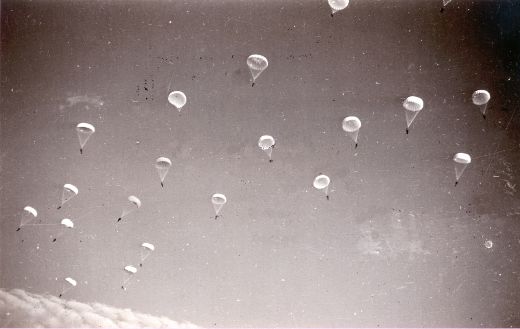
That morning, some of the dancers had flocked to the rooftop of their hotel to watch German parachutists float down and land in the area around the Hague, where Queen Wilhelmina resided.  Thousands of leaflets also fluttered down from the enemy aircraft, some landing on the rooftop, that proclaimed:

Strong German troop units have surrounded the city. Resistance is of no use. Germany does not fight your country but Great Britain. In order to continue this battle the German Army has been forced to penetrate your country. The German Army protects the life and goods of every peace-loving citizen. However, the German troops will punish every deed of violence committed by the population with a death sentence.” 1

For five days, the Dutch army fought bravely, but it was no match for the German war machine. The Netherlands had a policy of neutrality and had had no recent experience of resisting outside invading forces. Queen Wilhelmina and the Dutch Royal Family from the Royal House of Orange-Nassau refused to accept the Nazi offer of protection and sailed to England on the HMS Hereford sent by King George VI.

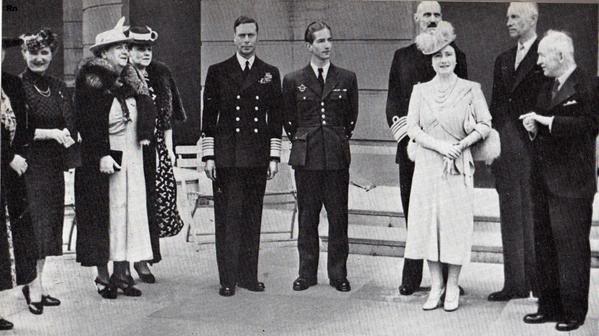
The Exiled Royals with the King and Queen of England, WWII (photo undated). From left to right: Queen Marie of Yugoslavia,Miss Benesj,Queen Wilhelmina of the Netherlands,Miss Raczkiewicz,King George VI of England,King Peter of Yugoslavia,King Haakon of Norway, Queen Elizabeth (The Queen mother) of England, the President of Poland, M. Raczkiewicz and Dr. Benesj, President of Tsjecho- Slovakia.

The Exiled Royals with the King and Queen of England, WWII (photo undated). From left to right: Queen Marie of Yugoslavia,Miss Benesj,Queen Wilhelmina of the Netherlands,Miss Raczkiewicz,King George VI of England,King Peter of Yugoslavia,King Haakon of Norway, Queen Elizabeth (The Queen mother) of England, the President of Poland, M. Raczkiewicz and Dr. Benesj, President of Tsjecho- Slovakia.

The Netherlands surrendered on May 15.

For the next seven weeks, the citizens of Holland did not resist the German occupation. They buried their dead and mourned their losses. They were shocked and demoralized. They felt abandoned by their queen.

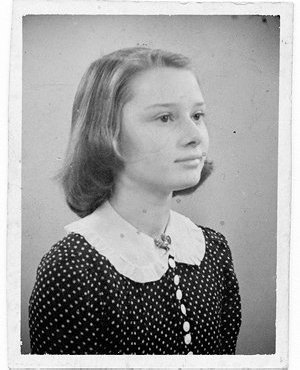
Audrey Hepburn-Ruston, ca. 1941 (age 12)

Audrey Hepburn-Ruston, ca. 1941 (age 12)

Audrey Hepburn was eleven years old when the Germans took over her town of Arnhem, Holland:

“The first few months we didn’t quite know what had happened.”

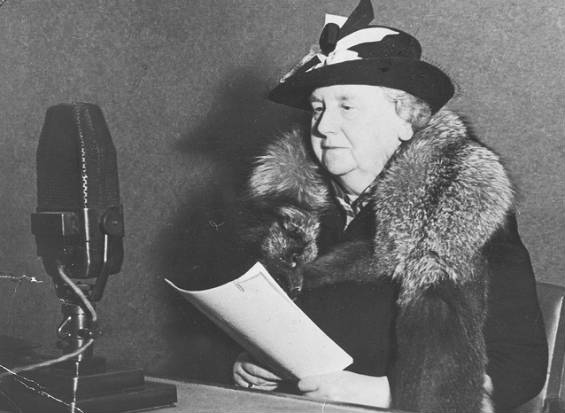
But Queen Wilhelmina reached out to her subjects across the North Sea via newsreels and BBC radio broadcasts, revitalizing Dutch hope for Allied liberation, and condemning German aggression. She urged them to resist the moffen (German Huns). For the next five years, the radio voice of the Queen would be the main source of inspiration for the Dutch Resistance Movement.

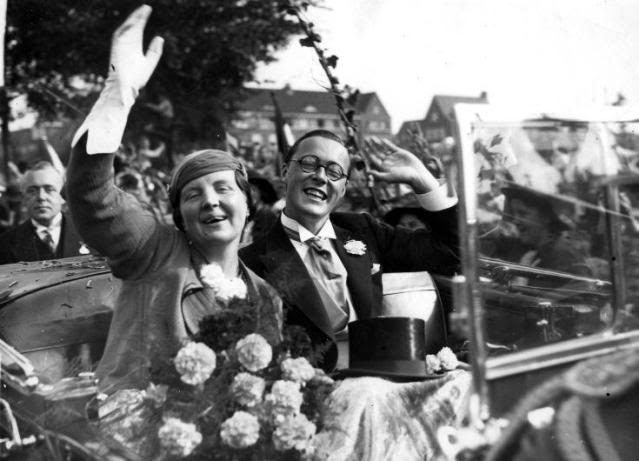
Princess Juliana and Prince Bernhard celebrate their engagement 1936. Note the white carnation in the Prince's lapel.

Princess Juliana and Prince Bernhard celebrate their engagement 1936. Note the white carnation in the Prince’s lapel.

An opportunity for the Dutch citizens to protest the German occupation arrived on June 29. It was the birthday of Prince Bernhard, the Queen’s son-in-law. Since he had been a student, the Prince had worn a trademark white carnation in his lapel.

So, on June 29, the Dutch people demonstrated their loyalty to Queen and country and their defiance of Nazi rule. People participated all across the country, but the activity was strongest in Amsterdam and The Hague.

People displayed vases full of carnations in the windows of homes and stores. Women and girls wore orange skirts, orange being the national color, symbolic of the Royal House of Orange. The Dutch flag was flown. Men pinned white carnations in the buttonhole of their coats, in imitation of Prince Bernhard, a German who was anti-Nazi.  Some people rode bicycles around town all dressed in orange.

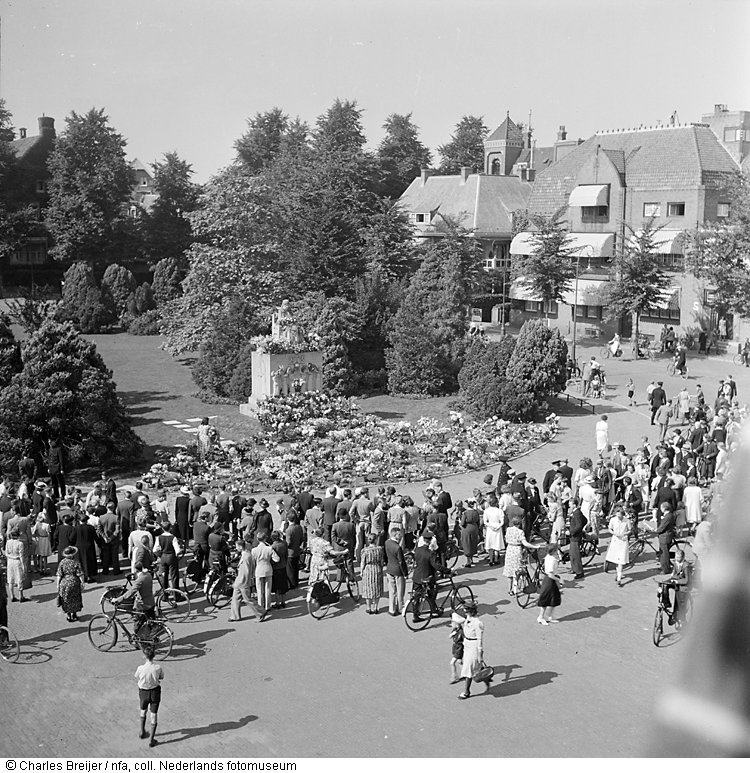
Crowds gathered at the statue of Queen Emma, Wilhelmina’s mother, in Amsterdam to lay flowers.

The Queen Emma monument is festooned with flowers on Carnation Day, 1940

The Queen Emma monument is festooned with flowers on Carnation Day, 1940

At first, only single flowers were placed on the statue’s lap. Then others arrived carrying great pots of flowers. Soon the area at the base of the statue was covered in flowers. On the nearby lawn, the letter B was formed with a clever flower arrangement. People brought cut-out pictures of the royal family and laid these beside the flowers.

A street organ began to play the national anthem. Softly at first, people began to sing. Shortly, though, more people lifted their voices in patriotic song. Emotion was running high.

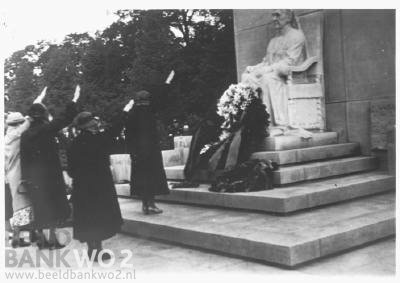
Men belonging to the WA, the military arm of the Dutch Nazi organization (NSB), shoved into crowds and started fights. The WA goons wore black shirts. Many people were injured.

NSB members (Dutch Nazis or collaborators) show up at a statue of Queen Emma on Carnation Day, giving the straight arm salute.

NSB members (Dutch Nazis or collaborators) show up at a statue of Queen Emma on Carnation Day, giving the straight arm salute.

People gathered at the Queen’s residence in the Hague, the Noordeinde Palace, to lay flowers on the balcony and to sign the birthday register.  The German commander of the Wehrmacht feared a riot. He ordered German fighter planes to fly above the city, diving now and then, but not to shoot, to get the crowd to disperse.

This day became known as Anjerdag, “Carnation Day.”

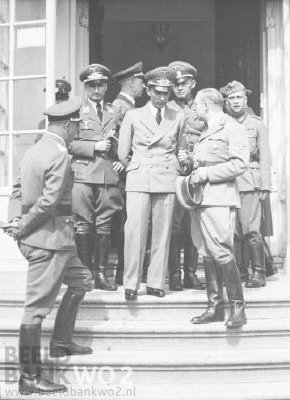
German propaganda minister Joseph Goebbels is shown at the entrance to Queen Wilhelmina's residence, the Noordeinde Palace in The Hague on Carnation Day. The nonviolent protest demonstration by the Dutch citizens greatly alarmed their German occupiers. Hitler was informed and the Nazis began their crackdown on Dutch life, liberty, and the pursuit of happiness.

German propaganda minister Joseph Goebbels (center) is shown at the entrance to Queen Wilhelmina’s residence, the Noordeinde Palace, in The Hague on Carnation Day. The nonviolent protest demonstrations by the Dutch citizens greatly alarmed their German occupiers. Hitler was informed and the Nazis began their crackdown on Dutch life, liberty, and the pursuit of happiness.

The Germans were furious with this civil act of disobedience. They ordered images of the Dutch Royal Family to be removed from all public places. Street names were renamed. The Prince Bernhard Square, for example, became “Gooiplein.” The Royal Library was soon referred to as the National Library. On the first of August, the top Nazi in Holland, Reichskommissar Seyss-Inquart, announced that it was forbidden to celebrate a birthday of a member of the Dutch Royal family.

Postnote:  In early 1941, a baby girl was born to a Mr. and Mrs. Niehot of The Hague. They wanted to name their newborn baby Nelia after their midwife, Nelia Epker, but she suggested they give their child an ‘Orange‘ name. The result was announced in the newspaper in a birth advertisement: Irene Beatrix Juliana Wilhelmina Niehot.

This announcement was met with great joy. Irene and Beatrix were the young daughters of Crown Princess Juliana.

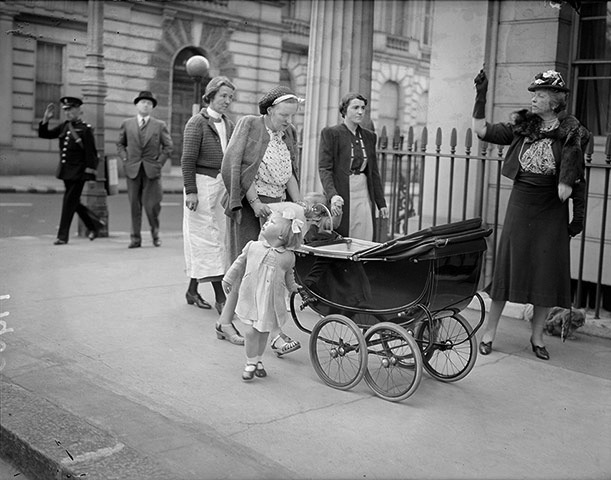
May 1940, London. Elizabeth Van Swinderen, wife of the former Dutch minister to Great Britain, points out London barrage balloons to Princess Juliana of the Netherlands. Juliana is with her children, Beatrix by her side and Irene in the baby carriage.

May 1940, London. Elizabeth Van Swinderen, wife of the former Dutch minister to Great Britain, points out London barrage balloons to Princess Juliana of the Netherlands, who is pushing the stroller. Juliana is with her children, Beatrix is by her side and Irene is in the baby carriage.

Perfect strangers sent cards, flowers, cakes and even money to the Niehot family. When the midwife Nelia Epker placed a thank-you advertisement in March 1941, listing the baby’s royal names once again, Nelia was arrested. She would not return to the Netherlands until August 1945, a survivor of Camp Ravensbrück. 2

1 Gottlief, Robert, ed. Reading Dance: A Gathering of Memoirs, Reportage, Criticism, Profiles, Interviews, and Some Uncategorizable Extras. New York: Pantheon Books, 2008.

2 Dutch Resistance Museum


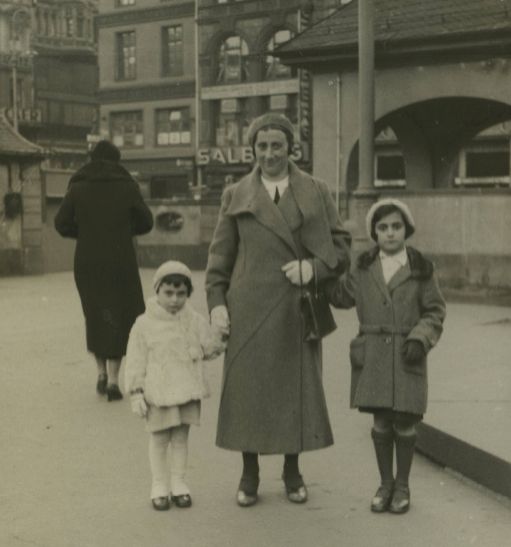
March 1933, the last picture taken of Anne, Edith, and Margot in Germany, prior to emigrating to Holland. Anne is 3 years old. They are standing in the Hauptwache square in the center of Frankfurt am Main

March 1933, the last picture taken of Anne, Edith, and Margot Frank in Germany, prior to emigrating to Holland. Anne is 3 years, 9 months old. They are standing in the Hauptwache square in the center of Frankfurt am Main.

I have just finished rereading Anne Frank: The Diary of a Young Girl. I was surprised to read that Anne had not been born in Amsterdam, where she hid from the Germans during World War II, but in Frankfort, Germany:

I will start by sketching in brief the story of my life. My father was 36 when he married my mother, who was then 25. My sister Margot was born in 1926 in Frankfort-on-Main, I followed on June 12, 1929, and, as we are Jewish, we emigrated to Holland in 1933….

The rest of our family, however, felt the full impact of Hitler’s anti-Jewish laws, so life was filled with anxiety.”1

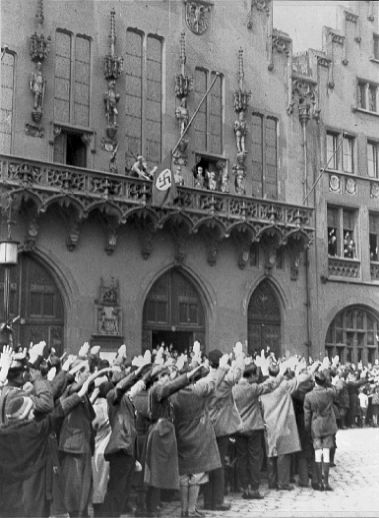
Following Hitler's appointment as Chancellor, a Nazi flag is hoisted at the town hall in Frankfort, the Franks' hometown in Germany. February 1933

Following Hitler’s appointment as Chancellor, a Nazi flag is hoisted at the town hall in Frankfort, the Franks’ hometown in Germany. ca. January 31, 1933

Once Hitler was appointed Chancellor on January 30, 1933, Nazi Germany became too dangerous for the Franks, simply because they were Jewish.

The Nazis believed that Jews were subhuman and were bent on driving them out of Germany. The Nazi propaganda machine went full bore, inciting the German people to violence against the Jews, their neighbors and fellow citizens. At the helm were Joseph Goebbels, the Nazis’ main propagandist, and Julius Streicher.

Julius Streicher’s Nazi Party card was Number 2; Hitler’s was Number 7. Throughout the 1920s, Streicher had been a loyal agitator for Hitler. He published the rabid anti-Jewish newspaper Der Stürmer (“The Attacker”). He was believed to be a sexual pervert. In May 1933, Hitler made him chief of the Central Committee of the Defence against Jewish Atrocity and Boycott Agitation. That July, Streicher:

…had some Jews arrested and taken to a meadow to tear out grass with their teeth….A small squat man, his head shaven, he had a predilection for swaggering in public. He carried a whip, and used it.” 2

May 1934 issue of Der Stürmer, a weekly Nazi propaganda newspaper owned by Julius Streicher. This specific cover issue is notorious as an example of the anti-Semitic propaganda style of Der Stürmer. It invokes the infamous "blood libel against the Jews", specifically the allegation that Jews were killing German Christian children and using their blood in religious rituals. The banner across the bottom of the page, "Die Juden sind unser Ungluck,' means "The Jews are our misfortune."

May 1934 issue of Der Stürmer, a weekly Nazi propaganda newspaper owned by Julius Streicher. This specific cover issue is notorious as an example of the anti-Semitic propaganda style of Der Stürmer. It invokes the infamous “blood libel against the Jews”, specifically the allegation that Jews were killing German Christian children and using their blood in religious rituals. The banner across the bottom of the page, “Die Juden sind unser Ungluck,’ means “The Jews are our misfortune.”

Goebbels and Streicher fomented lies about the Jews, making them the scapegoat for Germany’s poor economy and its humiliating defeat in World War I. They told the German people that the Jews were their enemies and not rightful citizens of Germany.

1933 Germany. Germans read issues of anti-Semitic propaganda newspaper, Der Stürmer, published by Nazi agitator Julius Streicher

1933 Germany. Germans read issues of anti-Semitic propaganda newspaper, Der Stürmer, published by Nazi agitator Julius Streicher

In the first few weeks of his chancellorship, Hitler gained complete control of the police force, stripping regular uniformed police of the power to defend law-abiding citizens against unreasonable search, seizure, and arrest. He expanded the notoriously brutal Gestapo, his state secret police, and unleashed them and his other thugs with full power to seek out any suspected enemies to his leadership and detain them, without trial.

February 1, 1933. One day after Hitler becomes Chancellor, the Sturmabteilung (SA), the Nazi paramilitary group known as "the brownshirts" round up suspected Communists.

February 1, 1933. One day after Hitler becomes Chancellor, the Sturmabteilung (SA), the Nazi paramilitary group known as “the brownshirts” round up suspected Communists.

Organized attacks on Jews broke out across Germany. Since the local police had no power, the Jews had no one to turn to. Then, on April 1, 1933, the first officially-sanctioned national attack on German Jewry was held. Organized by Streicher, it called for a boycott of all Jewish businesses. Armed Nazi guards were posted in front of every Jewish business, intent upon blocking all clients from entering. The businesses were marked with yellow Stars of David, and trucks drove through the streets sporting anti-Jewish signs. Windows were shattered, business owners attacked, and stores plundered.

Hitler needed a place to stash his “enemies.” Two months into his chancellorship, he built Dachau outside of Munich, the first of many concentration camps.

Anne’s father, Otto Frank, began looking for other places for his family to live. Frank said many years later:

Because so many of my German countryman were turning into hordes of nationalistic, cruel, anti-Semitic criminals, I had to face the consequences, and though this did hurt me deeply, I realized that Germany was not the world and I left my country forever.”

Through his brother-in-law, Frank was able to set up a business in Holland. By the end of 1933, his wife Edith and daughters, Anne and Margot would join him there.

1934, Amsterdam. Margot, Anne, and their mother Edith Frank on the beach with Mrs. Schneider (back)

1934, Amsterdam. Margot, Anne, and their mother Edith Frank on the beach with Mrs. Schneider (back)

They were running from Hitler, but he would catch up with them later. He was not satisfied in just driving the Franks and all Jews out of Germany. He wanted to completely annihilate them. He would hunt them down across Europe and kill them until, in April 1945, the madness finally stopped.

Between 1933 and 1939, more than half of the 550,000 Jews living in Germany had fled.

Between 1933 and 1939, more than half of the 550,000 Jews living in Germany had fled.

1. Frank, Anne. Anne Frank: The Diary of a Young Girl. New York: Doubleday, 1952.

2. Pryce-Jones. Unity Mitford: A Quest. London: Weidenfeld and Nicolson, 1976.

Corrie’s father turned on the old table radio to warm it up. Corrie felt that the small, portable one would have worked just fine, but her father insisted on using this old one. It was to be a major broadcast, he said, and the old radio had an elaborate speaker. The prime minister of the Netherlands was to address the Dutch nation.

It was 9:15 on a Thursday night, an hour when Corrie, Father, and Corrie’s sister Betsie normally would be heading upstairs to bed. As was their custom, they had already said their prayers and read a passage from the Bible. But, this evening, they would stay up a little later.

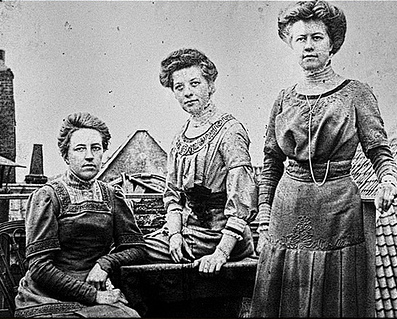
Corrie, Betsie, and Nollie Ten Boom

Corrie, Betsie, and Nollie Ten Boom

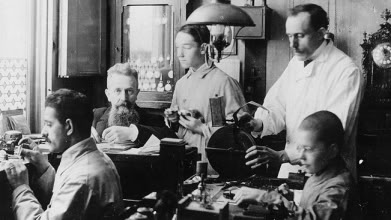
The Ten Boom family lived above their watch shop in Haarlem in the Netherlands (Holland).

Casper Ten Boom in watch shop

Casper Ten Boom in watch shop

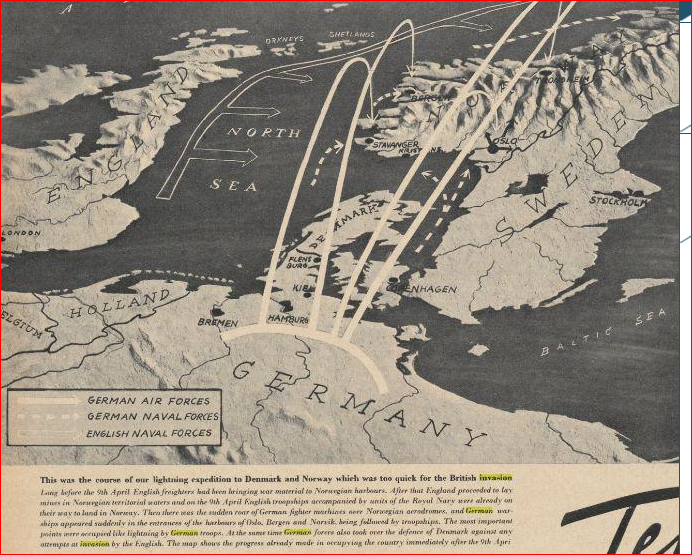
It was May 9, 1940. World War II was raging in Europe. The aggressive German army had invaded and occupied Poland, Norway, and Denmark. As a result, England and France had declared war on Germany. The Netherlands, however, did not and would not enter the conflict. They had declared their neutrality, the same as they had done in the first world war. Germany had respected their neutrality then and would do so again, they expected.

But every day fresh rumors reached their ears of an impending German invasion. Would Holland be drawn into the war? To calm these fears, the German Nazis repeatedly pledged goodwill to the people of the Netherlands. Many times Corrie had heard Hitler himself on the radio, promising the Dutch people that he would not invade their country.

Finally, it was 9:30, and time for the prime minister’s speech. The Ten Booms pulled their wooden, high-backed chairs closer to the radio, leaning in to listen, tense.

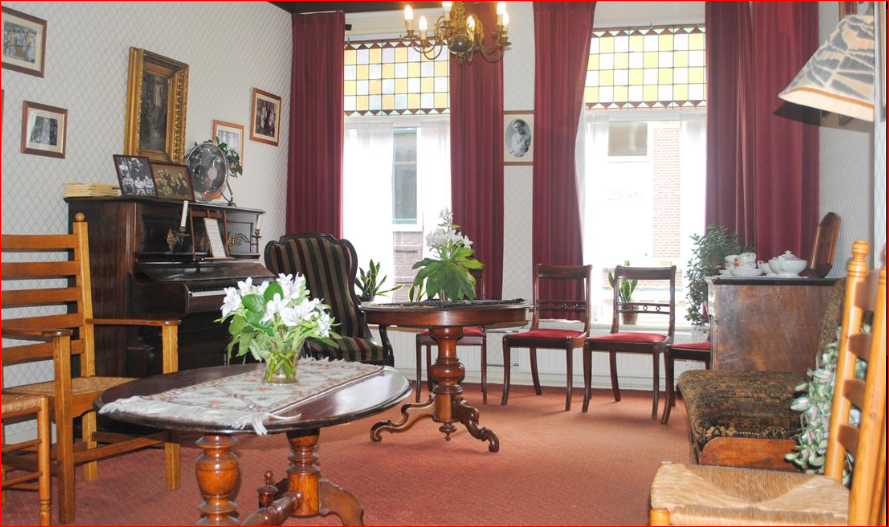
The parlor of the Ten Boom house in Haarlem, the Netherlands

The parlor of the Ten Boom house in Haarlem, the Netherlands

The prime minister’s voice filtered over the air waves. Tonight, it was pleasant and soothing. He told the Dutch people that there was no reason to worry. There would be no war. He knew it for a fact. He had spoken to people in high places.

In spite of the prime minister’s encouraging words, The Ten Booms were not comforted. The broadcast ended. They went upstairs to bed.

Five hours later and 37 miles south down the coast, 19 year old Diet (Deet) Eman woke up to noise outside her bedroom window. It was about 3 in the morning. It sounded as if someone was beating a rug. It was a steady, staccato sound – “pop-pop-pop” – only much faster. Deet lived in The Hague, Netherlands, where Queen Wilhelmina and her government were established.

Diet Eman was 19 years old when the Germans invaded the Netherlands.

Diet Eman was 19 years old when the Germans invaded the Netherlands

“This is crazy!” She thought. “Some idiot is beating rugs right now, and it’s pitch dark outside.” It’s true it was Friday morning and Friday was the day of the week that Dutch women typically beat rugs. But who would beat rugs at three in the morning?

What Diet heard was the first sound of the war. The Germans had invaded the Netherlands. The skies were filled with German parachutists falling. German Stukas dive-bombed the airfield, wiping out the Dutch biplanes. Diet’s sister’s fiancé, part of the weak Dutch army, was killed that day in the German bombing.

German parachutists attack the Netherlands May 10-14, 1940

German parachutists attack the Netherlands May 10-14, 1940

The Dutch people had been caught off guard. So many times they had readied for invasion only to discover it was a false alarm. Over time, they had grown complacent, caught in the net of Nazi lies and deception.

Some of the invading German soldiers crossed the border and parachuted from planes in disguise. They wore Dutch, French, and Belgian military uniforms and carried machine guns. Their disguises allowed them to roam freely behind the Dutch lines. It was Hitler’s idea to deceive and infiltrate the enemy; the Dutch army would be confused and not know who to shoot, the French and the Belgians being their allies. Dutch Nazis met them upon arrival and aided their sabotage activities. Other German soldiers dressed up as nuns, bicyclists, priests, peasants, and schoolboys in order to move undetected among the Dutch population. They seized key strongholds like water controls and bridges to pave the way for the German infantry.

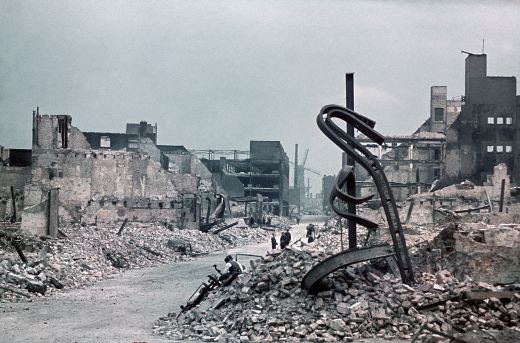
Peace talks were underway when the Germans went ahead and ruthlessly bombed Rotterdam, the Netherlands. This was the message: If the Netherlands doesn't surrender, we will do what we did to Rotterdam to every one of the Dutch cities until you surrender.

Peace talks were underway when the Germans went ahead and ruthlessly bombed Rotterdam, the Netherlands. This was the message: If the Netherlands doesn’t surrender, we will do what we did to Rotterdam to every one of the Dutch cities until you surrender.

The German blitzkrieg crushed the Dutch defenses in five days, allowing the Germans to turn their attention then to invading France. On May 14, 1940, the Netherlands surrendered and the German occupation began in earnest. Germans moved swiftly to prepare Dutch airbases to send missiles to destroy England.

With the May 1940 occupation of Holland, Germany is poised to attack England.

With the May 1940 occupation of Holland, Germany is poised to attack England.

Queen Wilhelmina broadcasts over the BBC to her people in the Netherlands during WWII.
However, Queen Wilhelmina had foiled the Nazi plot to kidnap her and escaped, by boat, to England, where she set up a government in exile. Thanks to the BBC radio network, she was able to speak to her people for the next five years over the radio, urging them to resist the Germans.

It was revealed that the Nazis who had been trained to capture her – but had failed – had taken lessons in how to correctly address royalty. After capturing her, the plan went, a German general would come calling, a bouquet of flowers in hand, and attempt to persuade her to call off all resistance activity.

Audrey Hepburn (ca. 1935-37, perhaps in Brussels, age 6-8)

Audrey Hepburn (ca. 1935-37, perhaps in Brussels, age 6-8)

It was May 9, 1940, and Audrey Kathleen Hepburn (Ruston) had just turned eleven years old. She was living in Holland with her mother, her two older brothers, and other relatives. Her father lived in London. Her parents were divorced.

To celebrate Audrey’s birthday, her mother, Dutch Baroness Ella van Heemstra Ruston, had bought tickets for her and Audrey to see a performance by the great English dance troupe, The Sadler’s Wells Ballet. The company was touring Holland, France, and Belgium. Audrey’s town of Arnhem was to be one of their stops.

Audrey (1929-1993) had been living in Holland for only nine months. Previously, she had been in boarding school in England. But, in September 1939, Hitler invaded Poland. All at once, England was no longer a safe place for a little girl, as it had declared war on Germany. At her mother’s request, Audrey’s father scooped up Audrey from her school and put her on a big orange plane to Holland (also known as the Netherlands), where her mother’s family lived. Holland intended to stay neutral in the war with Germany and was considered a safe place for riding out the conflict.

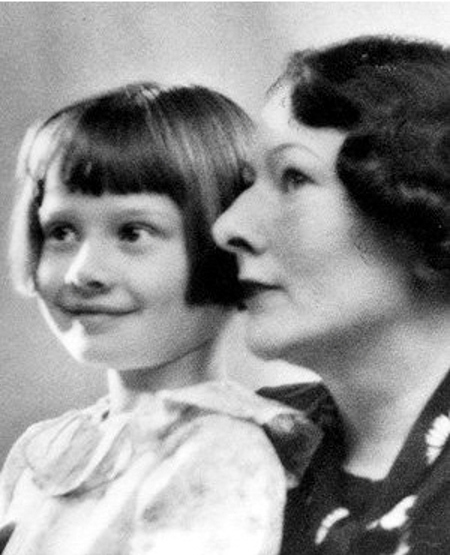
Audrey Hepburn and her mother Ella, Baroness van Heemstra Hepburn-Ruston, ca. 1936.

Audrey Hepburn and her mother Ella, Baroness van Heemstra Hepburn-Ruston, ca. 1936.

Audrey had not seen her dad since that day at the airport. She missed him so! Her parents’ divorce had left an aching hole in her heart. But on this particular May day, Audrey was not sad. She was looking forward to the ballet! Her mother had given her more than one reason to smile:

My mother had our little dressmaker make me a long taffeta dress. It went all the way to the ground, and it rustled. There was a little round collar, a little bow here, and a little button in front. The reason she got me this, at great expense, was that I was to present a bouquet of flowers at the end of the performance to…the director of the company.”

The evening finally arrived. Audrey wore her beautiful new long dress and got to see the famous Margot Fonteyn dance in “Horoscope” and “Façade” by choreographer Frederick Ashton. It was marvelous.

Margot Fonteyn in the Polka from Ashton's Facade, 1940. Fonteyn was the principal dancer of the Royal Ballet Company for 20 years.

Margot Fonteyn as the Polka from Ashton’s Facade, 1940. Fonteyn was the principal dancer of the Royal Ballet Company (originally the Sadler’s Wells) for 20 years.

Afterwards, Audrey’s mother took the stage and gave a formal thanks to the troupe first in Dutch, then in English. Next was Audrey’s big moment. To her surprise, her bouquet of tulips and roses was hurriedly accepted. A quick supper followed, as the dancers hustled about afterward, gathering up their props and costumes, to get on their bus to leave Arnhem that very evening. According to the British consul, there was suspicious German military activity nearby. The dancers didn’t want to get stuck in Holland if the Germans did attack and closed off the borders.

As Audrey’s head lay on the pillow that night, the Germans invaded Holland, Belgium, and Luxembourg. The Dutch were totally shocked. They never dreamed Hitler would attack them, his “Dutch cousins”! Just the night before, matter of fact, Hitler had made a radio broadcast, promising to all who listened that he had no plans whatsoever of attacking Holland. For five days, the Germans came down on the Dutch with the force of Hell. They never bothered issuing a formal declaration of war either.

 German parachutists invading the Netherlands, May 10-15, 1940

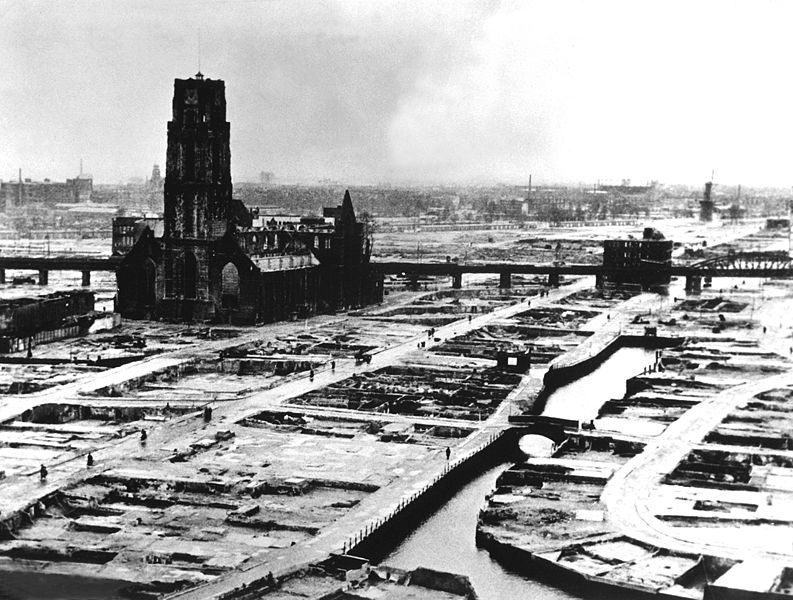
This is the city center of Rotterdam, Holland, following the German Blitz of May 14, 1940. A ceasefire was already in progress but the Nazis bombed anyway.

They blasted the city of Rotterdam with an air attack that killed 1,000 Dutch civilians and left 85,000 homeless (accounts vary as to the exact number).

Incendiary bombs were dropped on the Hague. Nazi troops tore through Audrey’s town of Arnhem, looting and despoiling as they pleased. The Germans threatened to bomb every Dutch city until they were demolished until Holland surrendered. The Dutch military, though terribly outnumbered, fought back anyway, but they were no match for the conquering horde, and were forced to surrender. After five days, Holland capitulated. It would be occupied by the Nazis for five very long years. The Germans wanted to take over the world and destroy the Jewish population.

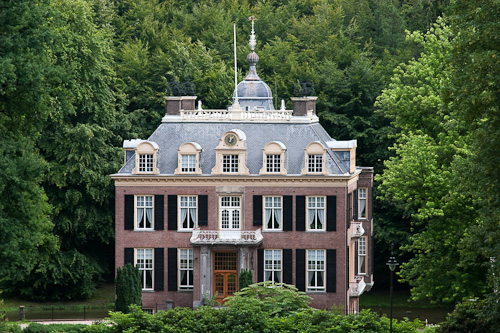
At first, Audrey’s family was allowed to remain at their regal ancestral home, Castle Zypendaal (or Zijpendaal). Audrey Hepburn’s mother’s family was of Dutch nobility.

Audrey Hepburn's mother's family was of Dutch nobility. This is one of their homes, the Castle Zypendaal in Arnhem.

Audrey Hepburn’s mother’s family was of Dutch nobility. This is one of their homes, the Castle Zypendaal in Arnhem.

Over the next ten months, the van Heemstra bank accounts, securities, and jewelry would be confiscated by the Nazis. Rations were imposed on food and fuel which were soon in short supply for the suffering Dutch people. Food became completely nonexistent during the Hunger Winter of 1944 as the Germans cut off all imports of foods to punish the Dutch Resistance (secret group that fought back against the Nazis from inside Holland). During that time, Audrey confessed to eating bread made from flour from tulip bulbs and grass to keep from starving to death like 20,000 other Dutch citizens did that winter.

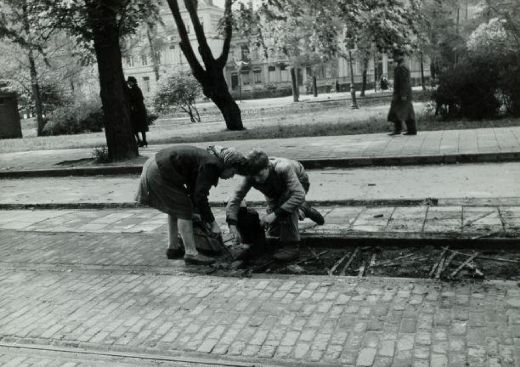
The Hunger Winter, 1944-45. Wood is taken from the tram rail in Holland to burn as fuel.

The Hunger Winter, 1944-45. Wood is taken from the tram rail in Holland to burn as fuel.

The German occupiers spread anti-English sentiment, banning the import of British jams and biscuits and outlawing the Girl and Boy Scouts. The Germans hoped they could whip the Dutch into a hatred for the English and recruit them in the battle against Britain.

Audrey Hepburn-Ruston was an English name and Audrey spoke English. She carried a British passport. With the Nazis cracking down on the English, the Baroness was worried. Quickly, Audrey’s mother gave Audrey a new identity as a little Dutch girl. For the war years, the Baroness changed her daughter’s name to Edda van Heemstra. Audrey – now Edda – took Dutch language lessons so she could pass as Dutch and not be arrested for being English. Audrey did not risk speaking English for the rest of the war.

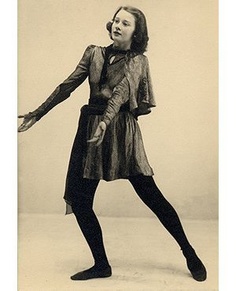
Audrey Hepburn at a dance recital, 1944, Arnhem Conservatory, Holland (age 15)

Audrey Hepburn at a dance recital, 1944, Arnhem Conservatory, Holland (age 15)

Audrey was keen to be a famous ballet dancer and her mother was the quintessential stage mom. In 1941, Ella sent Audrey to the Arnhem Conservatory to study dance. It was then that Audrey decided that she wanted to grow up to become a ballerina. Her dream was to

“wear a tutu and dance at Covent Garden.”

Her mother made her ballet slippers from scraps of felt, as materials became scarcer and scarcer, since the Nazis took the best for themselves, always.

As a child of war, Audrey learned to cope with hunger, fear, and deprivation through art, music, and dance. Soon, though, she and some other dancers began staging private, secret dance shows to raise money for the Dutch Resistance.

I designed the dances myself. I had a friend that played the piano, and my mother made the costumes. They were very amateurish attempt – but…it amused people.”

The recitals were given in houses with windows and doors closed, and no one outside knew what was going on. Afterward, money was collected and turned over to the Dutch Resistance. To keep from being discovered, the audiences did not clap.

“The best audience I ever had made not a single sound at the end of my performance.”

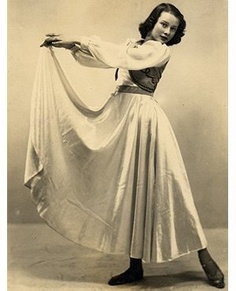
Audrey Hepburn during a dance recital in Arnhem, Holland, 1944

Audrey Hepburn during a dance recital in Arnhem, Holland, 1944

Sometimes at these “black performances,” resistance workers attended. They gave the young performers money and folded messages to be stuffed into the children’s shoes and transported the next day to resistance workers. The children risked death to save the lives of resistance workers and Audrey was one of these children.

One winter day, Audrey was walking along a city street when three truckloads full of German soldiers toting rifles stopped suddenly. The soldiers ordered all the girls in their sight to line up and get in the trucks. Audrey did as she was told. As the trucks drove off, Audrey kept saying the Lord’s Prayer to herself in Dutch. Then the convoy stopped unexpectedly. Some soldiers jumped out and began abusing some Jews. Audrey said:

“I remember hearing the dull sound of a rifle butt hitting a man’s face. And I jumped down, dropped to my knees, and rolled under the truck. I then skittered out, hoping the driver would not notice me – and he didn’t.”

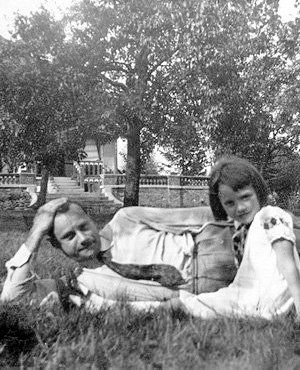
Audrey with father, preNazi Occupation, ca. 1934-35, age 5-6

Audrey with father, preNazi Occupation, ca. 1934-35, age 5-6

And where was Audrey’s father all this time? He was arrested in England and accused of peddling Nazi propaganda for the notorious leader of the British Union of Fascists, Sir Oswald Mosley. He remained under house arrest for the duration of the war on the Isle of Man with other suspected Nazi sympathizers.

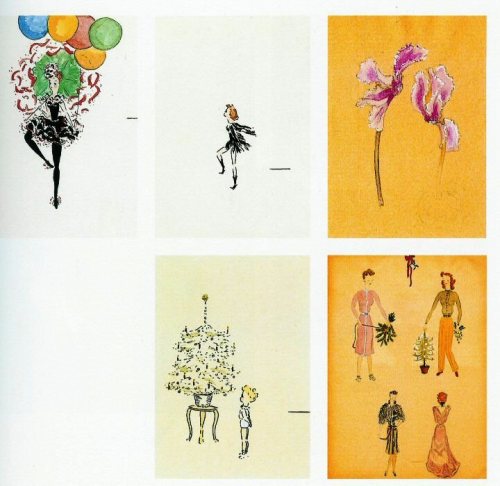
Below are some beautiful drawings Audrey made during the war.

Audrey Hepburn's childhood artwork

Audrey Hepburn’s childhood artwork

About a month before doctors amputated her right leg at the knee, Frida Kahlo drew a picture of her severed feet on a pedestal. It is one of many diary entries in which she expresses her anguish at the impending operation. In public, though, she acted lighthearted, saying playfully to friends, "Did you know they are going to cut off my paw?"

From Frida Kahlo’s diary, “Why do I need feet if I have wings to fly.”

About a month before doctors amputated her right leg at the knee, Mexican artist Frida Kahlo drew a picture of her severed feet on a pedestal. Instead of healthy veins protruding from the amputated feet, dead, thorny vines snake out. The flesh is yellow, anemic, and the page is stained with her blood.

This is one of many diary entries in which Frida explores her anguish over the impending operation. She knew that she had no other choice but to cut off her leg. In truth, her right leg was skinny, crippled, shriveled, and lame. It hung from her body as if it were broken. Two toes were missing from the foot. The leg was infected with gangrene. It hurt her terribly.

Her husband Mexican muralist Diego Rivera urged her to accept her fate and submit to yet another operation. Maybe she would be able to get a good prosthetic leg, he urged, and walk a little.

For Diego’s sake, she said to the doctors,

“Prepare me for the operation!”

Then, putting on a brave face for her friends, she asked them, 

“Did you know they are going to cut off my paw?”

For more on Frida Kahlo on this blog, click here.

Herrera, Hayden. Frida: A Biography of Frida Kahlo. New York: HarperCollins Publishers, Inc., 1983.
The Diary of Frida Kahlo: An Intimate Self-Portrait. Introduction by Carlos Fuentes. Essays by Sarah M. Lowe. New York: Abradale, 1995.

From ABC News/Univision

Frida Kahlo’s Closet is Opened After 58 Years

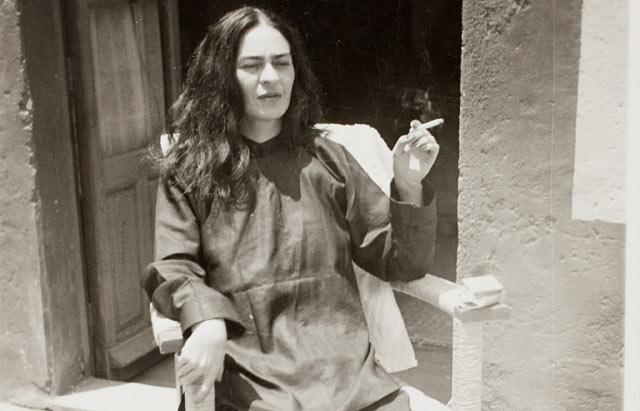
Frida Kahlo is seen smoking after a 1946 operation.

Frida Kahlo, wearing Chinese pajamas, is seen smoking after a 1946 operation.

“Imagine being in Frida Kahlo‘s childhood home and opening up a closet that has been locked for decades. Inside are hundreds of personal items – personal photographs, love letters, medications, jewelry, shoes, and clothing that still hold the smell of perfume and the last cigarette she smoked.

That is exactly what happened when Hilda Trujillo Soto, the director of the Frida Kahlo Museum opened the closets that had been locked since the Mexican artist’s death in 1954. Inside were over 300 items belonging to Frida Kahlo, and now, a wide array of what was found is on display at the Casa Azul, the Frida Kahlo Museum in the Coyoacán neighborhood of Mexico City.

The exterior of Frida Kahlo's home called Casa Azul outside Mexico City, 1952.

The exterior of Frida Kahlo’s home called Casa Azul outside Mexico City, 1952.

The exhibit, Appearances Can Be Deceiving: The Dresses of Frida Kahlo, a collaboration between the museum and Vogue Mexico, brings to an end an elaborate 50 year scheme to keep private the intimate details of Kahlo’s life. It started when she died in 1954, as a distraught Diego Rivera, the famous Mexican muralist and Frida Kahlo’s husband, locked the doors to her closet and never let anyone enter for fear that the contents would be mishandled and ruined.”

Kahlo contracted polio when she was six, leaving her right leg shorter and thinner than her left. Then, when she was 18, a metal tube pierced  through Frida’s abdomen during a bus crash, subjecting her to painful operations and  long periods of bed rest throughout her life.

In keeping with her flamboyance and ebullient spirit, Frida wore long, flowing tehuana skirts, lacy and colorful, that hid this affliction and celebrated her Mexican heritage.

frida-kahlo-dresses-on-display-exhibition-in-mexico-city

Frida Kahlo’s dresses in the Tehuantepec style are on exhibit in Mexico City at the Casa Azul, January 2013.

Frida Kahlo Self-Portrait, 1848, shows her dressed in traditional Tehuantepec costume.

Frida Kahlo Self-Portrait, 1848, shows her dressed in traditional Tehuantepec costume.

Later in life, Frida’s right leg had to be amputated. Included in the exhibit is a ornate red boot with the prosthetic leg Kahlo wore after the amputation.

Mexico Frida Fashion

A prostetic leg belonging to Mexican artist Frida Kahlo is on exhibit at the Casa Azul in Mexico City (Jan. 2013). Frida’s fashion sense combined both form and function – a red boot attached to an artificial leg. Frida Kahlo’s right leg was amputated in 1953 due to gangrene.

Also on view are three ornate corsets, one styled by Jean-Paul Gaultier in memory of Frida after her death. Frida had to wear plaster corsets to alleviate her excrutiating spine pain.

Frida Kahlo, 1941, displays her Communist sympathies with her therapeutic plaster chest cast

Frida Kahlo, 1941, displays her Communist sympathies with her therapeutic plaster chest cast

For more on Frida Kahlo on this blog, click here.

Natalie Wood (1938-1981) January 2013 autopsy report says death may not have been solely accidental

Natalie Wood (1938-1981) January 2013 autopsy report says death may not have been solely accidental

From the Daily Beast:

FOUL PLAY? Wood Autopsy Hints at Assault

“A year after the LAPD reopened the 1981 drowning case of Natalie Wood, a new autopsy report suggests the late actress may have been assaulted before she plunged into the Pacific Ocean. The coroner has amended Wood’s cause of death from accidental drowning to “drowning and other undetermined factors,” detailing bruises on her body that “appeared fresh” along with scratches down her legs. It remains unclear whether the abrasions resulted from falling off the dinghy, attempting to climb back on, or something potentially darker. There were also conflicting statements as to when Wood went missing and whether or not she had a confrontation with her husband, Robert Wagner.”

Read more from the Los Angeles Times.

For more on Natalie Wood on this blog, click here.
George VI (Albert Frederick Arthur George; 14 December 1895 – 6 February 1952) was King of the United Kingdom and the Dominions of the British Commonwealth from 11 December 1936 until his death. He was the last Emperor of India, and the first Head of the Commonwealth.

George VI (Albert Frederick Arthur George; 14 December 1895 – 6 February 1952) was King of the United Kingdom and the Dominions of the British Commonwealth from 11 December 1936 until his death. He was the last Emperor of India, and the first Head of the Commonwealth.

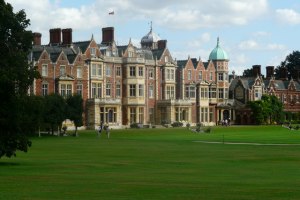
It was Christmas, 1939, and Great Britain was at war with Nazi Germany. Like his father before him, King George VI would continue the holiday tradition of addressing the British Empire in a live radio message. That year, he would broadcast from the royal country house at Sandringham, where he and his family would spend Christmas.

The Royal Residence at Sandringham, England

The Royal Residence at Sandringham, England

King George VI and his family leave Buckingham Palace, 1939, to spend Christmas at their country house at Sandringham. Pictured are the King and his wife Queen Elizabeth, daughters Princesses Elizabeth and Margaret Rose. Princess Elizabeth would become Queen Elizabeth upon the death of her father in 1952.

King George VI and his family leave Buckingham Palace, 1939, to spend Christmas at their country house at Sandringham. Pictured are the King and his wife Queen Elizabeth, daughters Princesses Elizabeth and Margaret Rose. Princess Elizabeth would become Queen Elizabeth upon the death of her father in 1952.

You will remember that King George VI was not a man comfortable with public speaking. His struggle to overcome a debilitating speech impediment – a stutter – was immortalized in the 2011 American Academy Award-winning film for Best Picture, “The King’s Speech.” A shy, nervous man, a heavy smoker and drinker (it would kill him at 56), King George VI would have preferred to have remained the Duke of York, living a quiet, out-of-the-public eye life with his sturdy wife and two rosy-cheeked daughters.

British Royal Princesses Elizabeth (l.) and Margaret Rose. February 1939, 7 months before the outbreak of WWII

British Royal Princesses Elizabeth (l.) and Margaret Rose. This photo was taken in February 1939, seven months before the outbreak of WWII.

King George VI – born Albert, called Bertie – never wanted to be king. He wasn’t supposed to be king. He was only king because his brother David had abdicated the throne in 1936 and he, Bertie, was next in line. Nevertheless, unwillingness aside, this unlikely monarch would rise to the occasion and be the very king the British people so sorely needed in a time of great trouble.

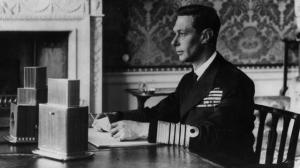
It was December 25, 1939, the day of the broadcast. Dressed in the uniform of the Admiral of the Fleet, the tall and too thin sovereign approached the table where two radio microphones were set up, taking his seat.

King George VI addresses his people on September 19, 1939, at the outbreak of WWII.

King George VI addresses his people on September 19, 1939, at the outbreak of WWII.

Taking a few deep breaths, he began to speak, slowly yet solidly. Measuring his words carefully, he spoke from the heart:

“A new year is at hand. We cannot tell what it will bring. If it brings peace, how thankful we shall all be. If it brings us continued struggle we shall remain undaunted.”

Toward the end of his nine-minute broadcast, he said:

“I feel that we may all find a message of encouragement in the lines which, in my closing words, I would like to say to you:”

He then read from a poem given to him by his 13-year-old daughter, Princess Elizabeth,

I said to the man who stood at the Gate of the Year,
‘Give me a light that I may tread safely into the unknown.’
And he replied, ‘Go out into the darkness, and put your hand into the Hand of God.
That shall be better than light, and safer than a known way.’”*

He finished by saying,

“May that Almighty Hand guide and uphold us all.”

For a king not known for compelling speeches, this one would be a landmark. It united King and Country in common cause and inspired the people to hold fast. After all, at this point in history, no one knew that the Allies would triumph. Britain was to face five more years of war and brutal bombing by Hitler before the day of liberation would arrive. The end of 1939 was a shaky time and great leadership by King, Queen, and Prime Minister Winston Churchill would hold Britain steady against the Nazi aggressors.

Queen Elizabeth and King George VI of Great Britain stop at Vallence Road, Stepney, in the East End, London, to examine the debris following an air raid in the Second World War. October 4, 1945

Queen Elizabeth and King George VI of Great Britain stop at Vallence Road, Stepney, in the East End, London, to examine the debris following an air raid in the Second World War. October 4, 1945

King George VI pins a Distinguished Service Medal on Chief Petty Officer C.L.Baldwin in December 1939.

King George VI pins a Distinguished Service Medal on Chief Petty Officer C.L.Baldwin in December 1939.

Listen to the last four minutes of the King’s Christmas 1939 message here:

For more about the British Royal Family on this blog, click here.

Click here for the full text of the King’s 1939 Christmas Message plus The REAL austerity Christmas: How a nation gripped by fear kept calm and carried  on three months after outbreak of war in 1939

*“The Gate of the Year,” by Minnie Haskins (1908)

Whitney Houston talking to the audience before proceeding to perform "Saving All My Love for You" during the HBO-televised concert "Welcome Home Heroes with Whitney Houston" honoring the troops, who took part in Operation Desert Storm, their families, and military and government dignitaries, 1991.

from TMZ:

Whitney Houston‘s family was told by L.A. County Coroner officials … the singer did not die from drowning, but rather from what appears to be a combination of Xanax and other prescription drugs mixed with alcohol … this according to family sources.

We’re told Coroner’s officials informed the family there was not enough water in Whitney’s lungs to lead to the conclusion that she drowned.

Our sources say the family was told Whitney may well have died before her head became submerged.

And family sources tell us … it was actually Whitney’s aunt, Mary Jones, who discovered Whitney’s body in the bathtub. Mary had laid out Whitney’s dress for the evening on the bed and then left for about a half hour. When Whitney didn’t come out of the bathroom, Mary entered, pulled Whitney out of the tub and began administering CPR.

And we’re told … Whitney’s mom has arranged to have the singer’s body flown back to Atlanta, as early as tomorrow. The family was told the Coroner has no problem releasing the body because there is no evidence of foul play — and unless cops put a hold on the body, it can be flown back East.

Readers: For more on Whitney Houston here on Lisa’s History Room, click here.
An emergency medical team removes Whitney Houston's lifeless body from her 4th floor room at the Beverly Hilton Hotel, L.A., on February 11, 2012.

TMZ reports that Whitney Houston may have drowned. Her body was initially found face down in the bathtub but had been removed by her bodyguards and staff before medical personnel arrived. Various pill bottles were found in her room at the Beverly Hilton Hotel. An autopsy will be performed to discover whether Ms. Houston died from an overdose, drowning, or another cause.

A bathroom at the Beverly Hilton Hotel much like the one in which Whitney Houston died.

Family members said Houston had been taking Xanax, prescribed for anxiety. TMZ reported that, the night before she died, Whitney Houston had been drinking alcohol heavily. Had she mixed the two drugs, it would have had a strong sedative effect, perhaps causing her to fall asleep in the bathtub and drown.

Paparazzi swarm around a coroner's van transporting Whitney Houston's body from the Beverly Hilton Hotel to the L.A. County morque for an autopsy.

Readers: For more on Whitney Houston here on Lisa’s History Room, click here.
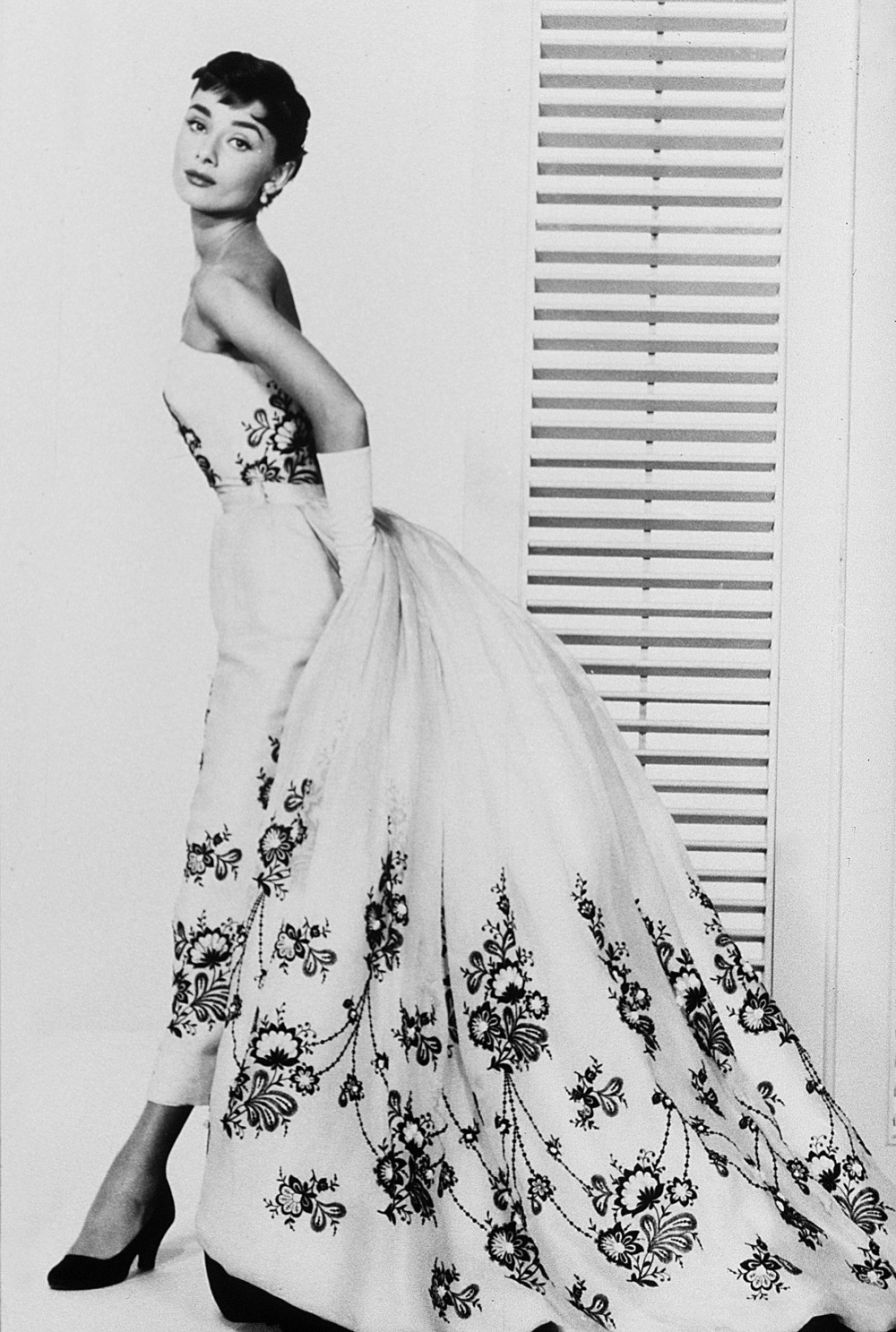
Before Whitney Houston signed a contract with Artista Records in 1983, she was a much sought-after teenage model. She was one of the first African-American women to appear on the cover of Seventeen magazine.

Whitney Houston (r.) enjoys an ice cream treat with an unidentified model in this 1981 issue of Seventeen magazine. Whitney was 18 years old.

Readers: For more on Whitney Houston here on Lisa’s History Room, click here.
 

Peace Love Whitney

This Peace Love Whitney Jr. Hoodie honors the life of Whitney Houston with a peace sign, a heart, and a graceful treble clef to symbolize Whitney's musical gifts. This is one of the many offerings at CafePress.

More tasteful gifts from Cafe Press, these to memorialize the passing of the great American rhythm and blues singer Whitney Houston, with “Peace Love Whitney” t-shirts and gifts. Visit Cafe Press to see the cool designs for yourself.

Readers: For more on Whitney Houston here on Lisa’s History Room, click here.

Whitney Houston (1963-2012) The legendary singer, actress, and producer won six Grammy awards, two Emmy awards, 30 Billboard Music Awards across her extensive career. She was probably best known for her megahit “I Will Always Love You,” written by Dolly Parton.

Gifted singer Whitney Elizabeth Houston (1963-2012) died today yet her voice lives on and has the power to move us.

This video features Houston singing the American National Anthem at the 1991 SuperBowl when the U.S.A. was involved in the Gulf War.

Readers: For more on Whitney Houston here on Lisa’s History Room, click here.

Mariah Carey (l.) and Whitney Houston perform a duet at the 1999 Oscars ceremony. The two pop stars were good friends.

Zimbio is posting what Hollywood stars such as Mariah Carey are saying about Whitney Houston’s death. Check it out. Also Toofab is showing tweets from stars.

Readers: For more on Whitney Houston here on Lisa’s History Room, click here.