Feeds:
Posts
Comments

Posts Tagged ‘biographies of royalty’

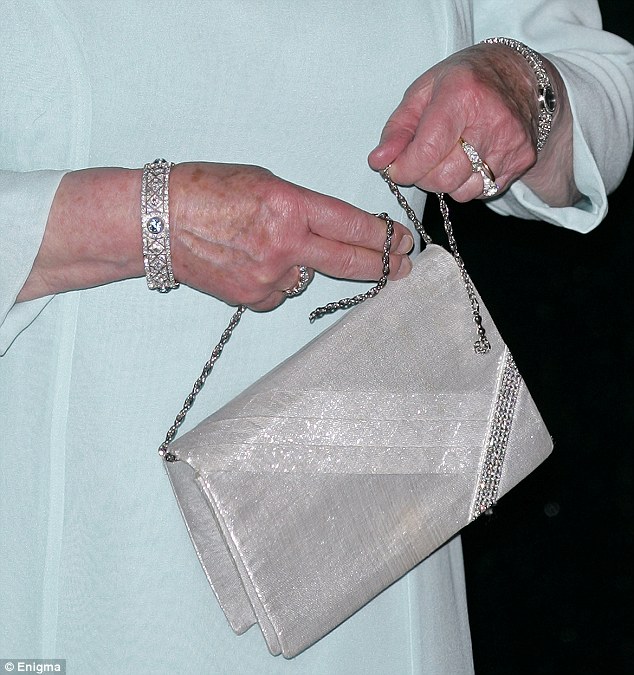
Queen Elizabeth II of England suffered two wardrobe malfunctions at a private party in London for her cousin King Constantine of Greece. A fellow guest spilled something on her beautiful blue gown, leaving huge stains running down the right side, then the chain link strap on her silver handbag broke. (June 3, 2010)

Two nights ago, Queen Elizabeth II of Great Britain helped King Constantine of Greece celebrate his 70th birthday and, at the party, had not one but two fashion mishaps. Someone – a fellow guest, possibly, or a waiter maybe – spilled what is purported to be coffee on the 84-year-old British monarch’s pale blue floor length gown, staining it permanently. Then, on top of that, the metal strap on the Queen’s ever-present handbag broke in half.

Queen Elizabeth clutches the broken strap of her evening handbag at King Constantine's 70th birthday party in a private London home.

Poor Queen! Where were all those ladies-in-waiting when she needed them most? Couldn’t someone have thrown a cloak over the Queen’s dress to hide the stains or stood in front of her to block her from the paparazzi’s unrelenting snaps?

If the Queen was ruffled by being uncharacteristically messy, she didn’t show it. Her Majesty – who is always neat, clean, and fastidiously turned-out – held high the royal chin throughout the terrible, horrible, no-good, very bad night and had a very good time, thank you, in spite of her multiple fashion faux-pas. Jolly brave, Elizabeth partied for hours alongside fellow royals — including son Prince Andrew, daughter Princess Anne, Queen Sofia of Spain, and Crown Prince Pavlos of Greece, who hosted the bash at his London home.

King Constantine of Greece escorts his cousin Queen Elizabeth down the steps at the end of his 70th birthday party. Despite the obvious food stains running down the Queen's dress and the broken strap of her glittery evening bag, the Queen maintained her always noble demeanor.

Read Full Post »

Sarah Ferguson watches polo at Windsor with Princess Diana, in 1985, the year before she married into the British Royal Family and became the Duchess of York

Sarah Ferguson –  “Fergie” –  and Princess Diana (1961-1997) knew each other for six years before Fergie married Prince Andrew in 1986 and became a member of the Royal Family. The two women had first met on the polo circuit, as Diana’s husband Prince Charles was an avid player and Fergie’s father, Sir Ronald Ferguson, was the Prince’s polo manager.

Soon after meeting, Diana and Fergie (b. 1959) became fast friends. The timid and reserved Diana was intoxicated by Fergie’s loud and breezy energy:

“The two girls would burn up the telephone wires trading gossip and irreverent royal tidbits they could share with no one else.” (1)

Since Diana’s 1981 wedding to Charles, she had been starved of fun. Diana thought about how lovely it would be to have Fergie as a mate in the Royal Family. In June of 1985, Diana decided to play royal matchmaker and make it happen. She wangled an invitation for Fergie to not only attend the Queen’s Ascot Week house party at Windsor Castle , but managed also to get the boisterous redhead seated next to the Queen’s second son, the 25-year-old Prince Andrew, a very eligible bachelor and second in line for the throne.

Sarah, the Duchess of York ("Fergie") and Diana, Princess of Wales, 1987

Within an hour of meeting Fergie, Andrew was “chatting her up” and “flirtatiously coaxing a merry-eyed Ms. Ferguson to eat every one of the chocolate profiteroles [cream puffs] on her plate.” (1) A year later, Fergie and Andrew were married at Westminster Abbey as the Duke and Duchess of York. Di had gotten her ally in the family.

This commemorative stamp was issued in Great Britain in 1986 to commemorate the Royal Wedding of Prince Andrew to Miss Sarah Ferguson. They became the Duke and Duchess of York.

 
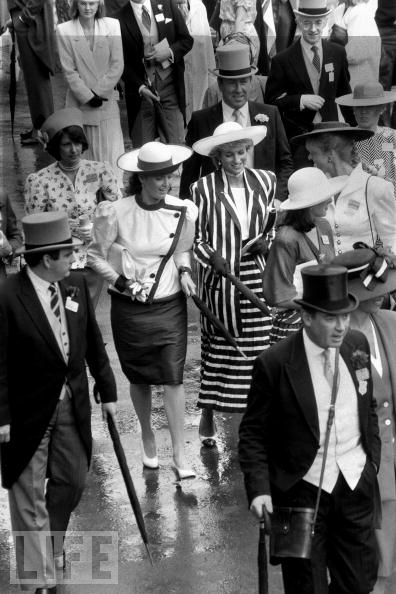
Encouraged by Fergie’s wildness, Diana began to loosen up publicly. She became a bit of a royal daredevil. Memorably, in June 1987, she and Fergie were photographed at Royal Ascot poking Fergie’s old school friend Lulu in the behind with their umbrellas, called “brollies” in England.  (2) 

Sarah Ferguson, the Duchess of York (l), and Princess Diana (r) attend the Royal Ascot, June 1987.

The Ascot Umbrella Caper – dubbed “the Brolly Folly” – drew public scorn. Woodrow Wyatt recorded in his memoirs that his wife saw Diana at Ascot

fooling about in the most childish manner, pulling people’s hair and tweaking them.”

The Sun reported the incident, referring to Fergie and Diana caustically as “silly, simpering girls.” It was the first of many desperate attempts Diana and Fergie made to “unstiffen” royal protocol. 

Over time, the fallout from the bad press would affect Diana and Fergie differently. Diana would weather the public criticism better than Fergie. With Diana’s tragic death, charity work, and sad marriage, the public has been more forgiving of her wild days. The late Princess Diana is lovingly remembered today as the People’s Princess.

Fergie, however, at age 50, continues to court disaster with her impetuous ways and money woes. Matter of fact, with the latest bribery scandal and “Oprah” TV appearance, the Duchess of York is being referred to in the press as the Duchess of Disaster. 


An image made from video shows the Duchess of York apparently selling access to ex-husband Prince Andrew for 500,000 British pounds to an undercover reporter from the UK tabloid, "News of the World." (foxnews.com_May 24, 2010)

(1) Brown, Tina. The Diana Chronicles. New York: Doubleday, 2007.

(2) “Births, Deaths, & Marriages.” Thirty Years of Majesty. Vol. 31, No. 5.

Read Full Post »

quoted from 

The Duchess of York’s Toe Scandal

Sarah Ferguson and Prince Andrew wave to the crowds following their 1986 wedding at Westminster Abbey, London.

“By 1992, the marriage between [British] Prince Andrew and Sarah Ferguson [Fergie] (the Duke and Duchess of York) was faltering. The Duchess was with various men including Texan multimillionaire Steve Wyatt, while her husband was away on royal duties. They agreed to separate in January 1992, but in August 1992, surreptitiously taken photographs of John Bryan, an American financial manager — apparently in the act of sucking on the toes of a topless Sarah in Southern France — were published in the British tabloid The Daily Mirror.

John Bryan sucks the toes of a topless Duchess of York, August, 1992, the Daily Mirror.

“The Duchess was at Balmoral [Scotland] with the rest of the Royal Family when the story broke. Prince Philip handed her a copy of the paper and quipped “there but for the grace of God go I.” (Notoriously picky Duke of Edinburgh liked Sarah as much as he detested Diana). The Queen was less amused; the Queen’s private secretary told the Duchess that she might feel better if she left immediately to London, effectively banishing her from the royal household. She would never be reinvited back to Balmoral until 2008. The only feeble defense both Fergie and John Bryan could muster up was that he hadn’t been sucking her toes, he was simply kissing the instep of her foot.”

Read Full Post »

Diana, Princess of Wales

The late Diana, Princess of Wales (1961-1997), once remarked that, in marrying Prince Charles and having two sons with him, she had genetically given the British Royal family “chins.” She felt that she had a very prominent chin and that the Royal Windsors were lacking in this facial feature. Her sons, Princes William (b. 1982) and Henry (b. 1984), known as “the Heir and the Spare,” are in line for the British throne.

Queen Elizabeth II is shown wearing a lime green suit in this 1960s era photo with husband Prince Philip, the Duke of Edinburgh, and their four children, l to r: Andrew, Edward, Charles, and Anne.

Tragically, Diana didn’t live to see her boys grown into tall, strapping fellows setting new records not for chins but for height. This genetic trait was likely passed down to them through Diana’s Spencer family and their grandfather Prince Philip, the Duke of Edinburgh, who was 6′ at his prime. Princess Diana, at 5’10” & 3/4″, was almost 2  inches taller than her former husband.


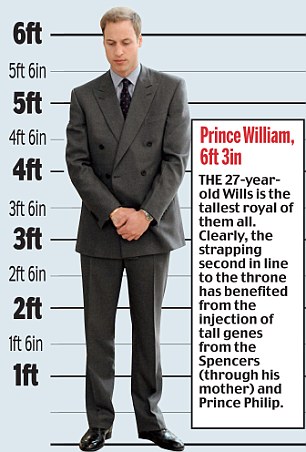
At 6’3″, Prince William of Wales, second in line for the British throne, is set to become the tallest monarch in history. His brother, Prince Henry of Wales (known as Prince Harry), is right up there with him, measuring in at 6’2″.

The Great Seal of Edward I who served as the British monarch from 1272-1307

The record for the tallest British monarch has been held by Edward I, 6’2″, known as “Longshanks” for his long legs. An expert horseman, he took the throne in 1272.

More modernly, though, the British monarchs have erred on the short side. Queen Elizabeth II, who took the throne in 1953, is only 5’4″. Her great grandmother Queen Victoria, who reigned from 1837-1901, was even more petite. She was only 5 feet tall and very stocky. At her death in 1901, Queen Victoria boasted a 50″ waist.

Queen Victoria was quite stout. With her afternoon "cuppa" tea, she fancied a sponge cake slathered with jam and whipped cream. This classic (high-calorie) British cake is known as the "Victoria Sponge."

Should Prince William decide to marry his long-time girlfriend, the 5’10” Kate Middleton, their children likely would be taller than the average royal.

Kate Middleton (black hat) is shown with Prince Harry of Wales and Camilla, Duchess of Cornwall (white hat), at the June 16, 2008 installation of Kate's boyfriend Prince William of Wales in the Order of the Garter.

Here’s how the current royals and their significant others measure up:

Men ———————————– Ladies
Prince William (6ft 3in) ——– Kate Middleton (5ft 10in)
Prince Harry (6th 2in) ——— Chelsy Davy (5ft 8in)
Prince Philip = (5ft 11in) ——– The Queen (5ft 4in)
Prince Charles = (5ft 9in) ——- Camilla, the Duchess of Cornwall (5ft 8in), Diana (5ft, 10 & 3/4 in)

Source: Article Daily Mail

Read Full Post »

Britain's Princess Diana and Prince Charles wave to the cameras and onlookers following their fairytale wedding in July 1981 at St. Paul's Cathedral, London. To everyone, the smiling royals in the glass coach seemed like a dream couple.

Princess Diana‘s wedding tiara gave her a “cracking headache” said her brother, Charles Spencer, in an interview on the American program, “Entertainment Tonight.” 

Charles, the 9th Earl Spencer, described how he was able to spend some time with Diana, Princess of Wales, after her marriage to Britain’s Prince Charles on July 29, 1981. The royal wedding at St. Paul’s Cathedral in London was watched by an estimated global TV audience of 750 million. Spencer recalled being with his sister that memorable day: 

”In the evening we all went to a sort of semi-private party and she was there and she seemed incredibly relaxed and happy and I just remember she had a cracking headache too, because she wasn’t used to wearing a tiara all morning,” said the aristocrat during the interview posted on the U.S. show’s website. 

Diana’s wedding tiara – which is known now as the “Spencer Tiara” – is a Spencer family piece with an elaborate design of stylized flowers decorated with diamonds in silver settings. Princess Diana (1961-1997) wore this and other tiaras (or coronets) many times during her lifetime. 

Princess Diana wears the Spencer tiara at a 1983 dinner banquet in New Zealand.

Earl Spencer added that he still has a piece of his sister’s wedding cake with her name on it. 

Readers: You might also enjoy “Waity Katie and ‘The Ring.'” 

For more posts on the British Royal Monarchy, scroll down the right sidebar to “Categories”/”Royalty.”

Jewelry Lovers, you might try “Queen Victoria’s Tiny Crown” and “Queen Alexandra’s Royal Bosom.”

Read Full Post »

British royal Prince William of Wales and his girlfriend Kate Middleton at the 2009 Audi Polo Match

Is Prince William of Wales finally going to propose to his girlfriend of nine years, Kate Middleton? Tina Brown, Editor-in-Chief of The Daily Beast, says so. She predicts the engagement will be announced by Buckingham Palace on June 3 or 4 of this year.

Kate Middleton – known as “Waity Katie”  in the British press – has dated Prince William since they met in 2001 at the University of St. Andrew’s in Scotland. They have been together almost continuously, even living together. (1)

Woolworth's High Street Store in Great Britain anticipated a 2007 royal wedding between Kate Middleton and Prince William of Wales. They were so sure a ceremony was imminent that they unveiled designs for mugs, thimbles, mouse mats, and even sweets bearing a picture of the Prince and his sweetheart in 2006. Unfortunately, Kate and William broke up shortly after this announcement and Woolworth's was forced to scrap this line of merchandise. It is unlikely the product line will be revived as William no longer resembles the 2006 photo. He no longer sports a boyish look as his hairline has receded considerably since then.

Tina Brown’s column has caused a surge in speculation, Brown, the famous ex-Vanity Fair and ex-New Yorker editor and best-selling biographer of William’s mother, Princess Diana, is known to have excellent sources in Buckingham Palace, although the Palace has denied her prediction. Nevertheless, British tabloids like The Daily Mail went nuts thinking about a royal wedding in the future with headlines like,

“She’ll Wear Diana’s Tiara!”

Diana, Princess of Wales (1961-1997), wears her Cambridge Love Knot Tiara

Americans got feverishly excited, too. People magazine put William and Kate on the cover last month under the headline, “The Next Princess!” Inside, was a report that William was overheard calling Kate’s father “Dad” while they were all on a ski holiday in the French Alps in March 2010. (2)

(2) “A Date for William & Kate?” USA TODAY, May 13, 2010.

Readers: You might also enjoy “Princess Diana’s Wedding Tiara.”  For more posts on the British Royal Monarchy, scroll down the right sidebar to “Categories”/”Royalty.”

Read Full Post »

American actress Grace Kelly looks over her shoulder in Hollywood, California, March 1954. In April 1956, Kelly married Rainier III, Prince of Monaco, and became Her Serene Highness the Princess of Monaco. (“Grace Kelly: Floating on Chiffon,” Lisa’s History Room)

I was so excited to read in Vanity Fair that London’s Victoria & Albert Museum was featuring an exhibition of Grace Kelly‘s clothes. What a treat! I thought. Imagine all those beautiful 1950s dresses designed for actress Grace Kelly (1929-1982) together in one place. Of course I couldn’t get to London, I knew; I was recovering from spine surgery and we were building an addition to our house.

But what did that matter? I had my computer. With a few keystrokes and mouse clicks, I could cyber fashion stroll. I just assumed the V & A Museum would put the collection online as they had done with Queen Victoria and Prince Albert‘s jewelry collection. (See “Victoria & Albert: Art & Love & Teeth”)

I jumped to the museum website and found the exhibition: “Grace Kelly: Style Icon.” I got even happier after I read the promising blurb:

“Featuring dresses from her films including ‘High Society’ and ‘Rear Window,’ as well as the gown she wore to accept her Oscar in 1955, the display will examine Grace Kelly’s glamorous Hollywood image and enduring appeal.

It will also explore the evolution of her style as Princess Grace of Monaco, from the outfit she wore to her first meeting with Prince Rainier in 1955 to her haute couture gowns of the 1960s and ’70s by her favourite couturiers Dior, Balenciaga, Givenchy and Yves St Laurent.”

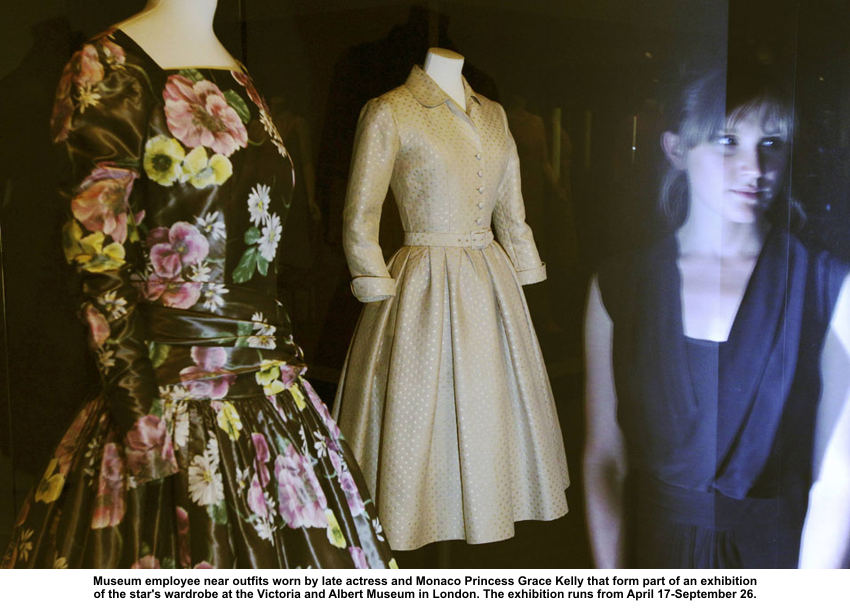
But much to my chagrin, I discovered that the exhibit is not posted online at the V & A. I was, at first, incredibly disappointed. In a mad haste, I scoured the Internet for images of the fashion display on newssites and blogs. I found a lot of articles but precious few images of the actual exhibit. But what I did find told a lot. To illustrate a point, here are two of those V & A showcase windows:  

A mannequin displays the dress Grace Kelly wore in “The Swan.” (1956) The exhibit, “Grace Kelly: Style Icon,” is at the Victoria & Albert Museum in London from April 17- September 26, 2010

The exhibition at the Victoria & Albert Museum in London, “Grace Kelly: Style Icon,” includes dresses worn by Grace Kelly after she became Princess Grace of Monaco in 1956.

Yawn. Pretty dry stuff, huh? Dresses on mannequins have no sparkle. What they needed was Grace Kelly.

Grace Kelly as Lisa Fremont in Alfred Hitchcock’s 1954 thriller, “Rear Window.” (“Grace Kelly: Floating on Chiffon,” Lisa’s History Room)

So instead of trying to catalog for you all the dresses in the V & A, I have picked my personal favorite and shown it as worn by the eternally beautiful Grace Kelly. It is the Paris dress she wore as sophisticate Lisa Carol Fremont in the 1954 Alfred Hitchcock classic, “Rear Window.”

The dress with a fitted black bodice and deep V-cut bustline was designed for Kelly by Paramount Picture’s chief costume designer Edith Head. The full skirt falls to mid-calf, gathered and layered in white chiffon and tulle. From the nipped-in waist, a spray branch pattern falls playfully over the hip. Grace accessorized her high-fashion gown with white silk gloves, pearls, and a chiffon shoulder wrap.

To read the “Rear Window” script excerpt wherein “Lisa-Carol- Fremont” enters Jimmy Stewart‘s apartment wearing this outfit, click here.

Grace Kelly sits on steps in her “Paris” dress she wore in Alfred Hitchcock’s 1954 “Rear Window.” The gown had a light & airy quality with a slender waist and a beautiful skirt made from yards and yards of tulle and chiffon. The black and white confection was created by Paramount Pictures costume designer Edith Head. (“Grace Kelly: Floating on Chiffon,” Lisa’s History Room)

For more on Grace Kelly, click here.

Read Full Post »

Queen Victoria at her Golden Jubilee, 1887. Note the tiny crown atop her mourning veil.

In my previous post, “Queen Alexandra’s Royal Bosom,” I mention that Queen Victoria refused to wear a crown to the Thanksgiving service at Westminster Abbey that was part of her Golden Jubilee celebration in June, 1887. She did, however, consent to wear a crown for her official Jubilee photograph (shown here), which we may assume she wore to the banquet celebrating her 50 years on the British throne. Fifty European Kings and princes and the American author Samuel Clemens (AKA Mark Twain) attended.

After her husband Prince Albert’s death in 1861, the Queen had largely disappeared from public view. She had vowed to publicly mourn her husband until her death and wear nothing but black widow’s weeds and her white lace mourning veil. In 1870, under government pressure, Victoria began to appear in public again. But she refused to wear her Imperial State Crown again, for several reasons. Chiefly, it was too big and heavy and was impossible to wear with her mourning veil.

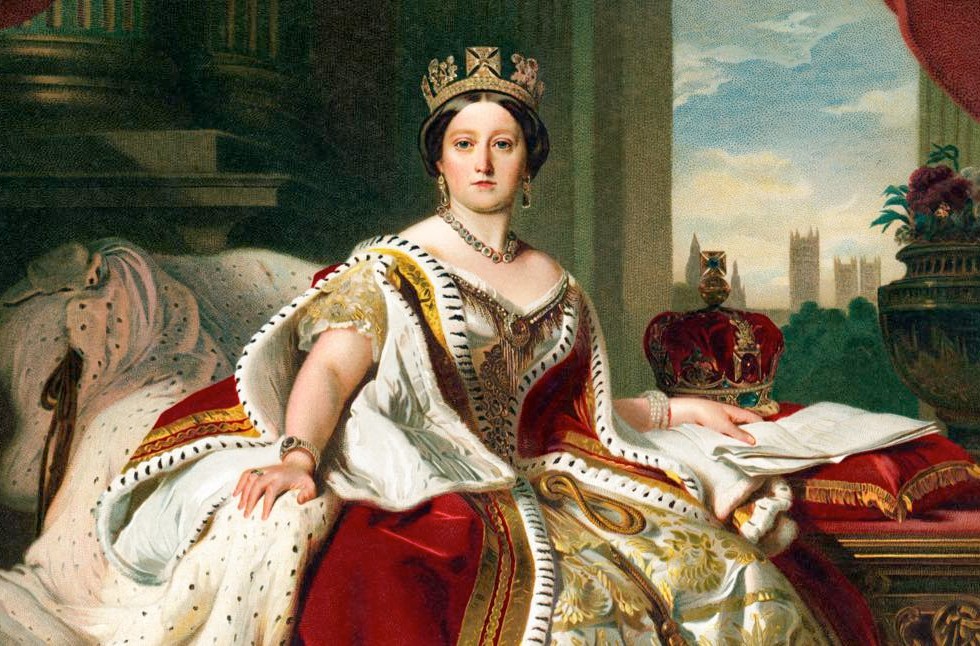
The Imperial State Crown of Great Britain worn by Queen Victoria at her coronation. It includes a base of four crosses pattée alternating with four fleurs-de-lis, above which are four half-arches surmounted by a cross. Inside is a velvet cap with an ermine border. The Imperial State Crown includes several precious gems, including: 2,868 diamonds, 273 pearls, 17 sapphires, 11 emeralds, and 5 rubies.

Queen Victoria shown wearing the Imperial State Crown at her Coronation, 1837

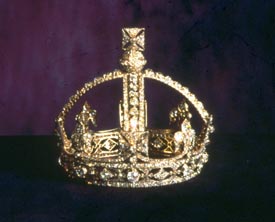
Consequently, a new crown, a small one, was designed for the Queen. It sat atop her mourning veil. The Queen was satisfied and so was the government. Wearing the tiny crown atop her veil allowed her to look like both a widow and a queen.

“The crown followed standard design for British crowns. It was made up of four half-arches, which met at a monde, on which sat a cross. Each half-arch ran from the monde down to a cross pattee along the band at the bottom. Between each cross pattee was a fleur-de-lis. However, because of its small size (9 centimeters across and 10 centimeters high) Victoria’s small diamond crown possesses no internal cloth cap. The crown was manufactured by R & S Garrard & Company.”
 

Queen Victoria's Small Diamond Crown created in 1870 measures 3.7 inches (9.9 cm) high and 3.4 inches (9 cm) in diameter. It was worn atop a widow's cap. The silver crown was made in 1870, using some 1,300 diamonds from a large necklace and other jewelry in the Queen's personal collection. Queen Victoria's Small Diamond Crown remains on show in the Jewel House in the Tower of London.

Read Full Post »

"The Landing of H.R.H. the Princess Alexandra at Gravesend, March 7, 1863," by Henry Nelson O'Neil, 1864.

When Princess Alexandra of Denmark arrived on English soil in 1863 to marry the Prince of Wales, the heir of Queen Victoria, she was the very picture of modesty. No jewelry was visible and she wore a handmade bonnet. Alexandra may have been Danish royalty, but she wasn’t rich. Matter of fact, her family had lived on handouts to get by. She was shy, kind, and very beautiful. Everyone loved her immediately.

Queen Victoria, 1873

Queen Victoria of Great Britain, 1873

When Alexandra joined the British royal family, over two years had passed since Queen Victoria‘s husband, Prince Albert, had died.  Yet Victoria was still plunged into deep mourning. Victoria had wished she had died with her beloved Albert. Upon his death, she had renounced all pleasures and vowed to wear dreary black crape dresses the rest of her life as a token of mourning. She spent many of her waking hours kneeling in Albert’s carefully-preserved bedroom, crying and pleading with God to help her. (See “Queen Victoria in the Blue Room with a Bust.”)

Alexandra discovered that Victoria had amassed an enormous jewelry collection.  But, after Albert’s death, the Queen had became convinced that excessive display of jewels awakened anti-monarchial feelings in the English people. Princess Alexandra tried to convince her to wear her pretty, glittering things but to no avail. Famously, Victoria refused to wear a crown to the Thanksgiving service honoring her 1887 Golden Jubilee. The Queen of Great Britain arrived at the state ceremony wearing a bonnet.

Whereas Victoria had renounced all pleasures, Princess Alexandra had just begun to live. She had grown up poor and now she was rich and the future Queen of England! She was not about to be sucked into Victorian mourning dress. Although her husband, “Bertie,” was a serial adulterer, Alexandra accepted his infidelity and got on with her life, moving with him from party to party with the artsy crowd. Dressing herself in fine jewels and frivolous clothes became her passion – and she indulged herself completely.

Queen Alexandra at her Coronation, 1902

Initially, Princess (later Queen) Alexandra adopted dog collar chokers, called a ‘collier de chien’ to cover a small scar on her neck. For state and formal occasions, though, she plastered herself from head to waist in necklaces, tiaras, ribbons, sashes, and brooches of pearls, diamonds, and other jewels. Her long strings of pearls became her signature look. Alexandra became quite popular and women copied her style and bearing. American tycoon Cornelius Vanderbilt, Jr., remarked that:

Queen Alexandra “possessed the world’s most perfect shoulders and bosom for the display of jewels.”
 

Readers: “Queen Victoria’s Tiny Crown” follows this post.

Read Full Post »

Queen Victoria and Prince Albert, 1854. They had been married 14 years and are both about 34 years old. This is the first time Victoria had been photographed. Queen Victoria reigned as Queen Regnant of the United Kingdom of Great Britain and Ireland from 1837-1901 and as the first Empress of India of the British Raj from 1876 -1901. Her reign as the Queen lasted 63 years and 7 months, longer than that of any other British monarch before or since, and her reign is the longest of any female monarch in history. The time of her reign is known as the Victorian Era, a period of industrial, cultural, political, scientific, and military progress within the United Kingdom.

Throughout their 21-year marriage, Prince Albert and Queen Victoria delighted in showering each other with gifts of art. A new major exhibition of the Royal Collection (March 19-October 31, 2010) at the Queen’s Gallery, Buckingham Palace, is the first ever to focus on the royal couple’s shared enthusiasm for art. “Victoria & Albert: Art & Love” showcases over 400 paintings, drawings, photographs, jewelry, and sculpture from the years of their courtship (1836-1839) and marriage (1840) until Albert’s untimely death of typhoid (1861).

Gold, enamel, and tooth brooch belonging to Queen Victoria (1847, probably commissioned by Prince Albert)

Many trinkets exchanged between the royal couple were sentimental in nature, marking special occasions in the royal household, such as this gold and enamel brooch, seen for the first time ever. This unusual and tiny brooch in the form of a thistle has, as its flower, the first milk tooth lost by the firstborn of their nine children, Princess Victoria (1840-1901). An inscription on the reverse states the tooth was pulled by Prince Albert at Ardverikie (Loch Laggan), on September 13, 1847. (To see more of Victoria’s jewelry made with teeth, click here.)

Princess Victoria was the subject of many art commissions; her parents were overjoyed at her birth because she almost wasn’t born. When the Queen was four months pregnant, she had been the target of a failed assassination attempt. Edward Oxford fired two shots at her as she and Prince Albert rode up Constitution Hill in a carriage in June of 1840. Fortunately, neither the queen, prince, or the unborn Princess Royal was harmed.

An attempt is made to assassinate Queen Victoria by Edward Oxford, June 10. 1840, as the Queen rides up Constitution Hill with Prince Albert. Oxford was arrested for high treason, tried, and acquitted by reason of insanity.

Prince Albert was a man of many talents. He designed many of Queen Victoria’s jewels, including this 1842 brooch featuring a miniature of Princess Victoria as a bejewelled angel.

Queen Victoria's enamel, gold, and jewel brooch, 1842, with a miniature of Princess Victoria as an angel, Prince Albert, designer; William Essex, after William Ross, miniaturist

The queen appreciated Albert’s talent in jewelry design. She wrote:

“Albert has such taste & arranges everything for me about my jewels.”

In addition to designing the queen’s personal jewelry, Prince Albert designed many pieces of her state jewelry. He designed most of her tiaras, including the Oriental Circlet, also a part of this year’s special exhibition.

Queen Victoria's State Jewelry: "The Oriental Circlet," 1853. Diamonds, rubies, gold. The inspiration for the design of this tiara, which includes ‘Moghul’ arches framing lotus flowers, came from Prince Albert who had been greatly impressed by the Indian jewels presented to the Queen by the East India Company.

Readers, you might also enjoy: “Queen Victoria in the Blue Room with a Bust.”

Read Full Post »

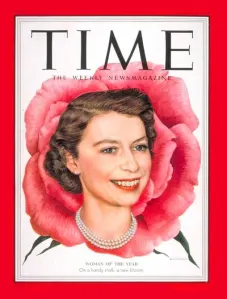
TIME magazine's 1952 Woman of the Year: Queen Elizabeth II of England (Jan. 5, 1953 cover)

TIME magazine's 1952 Woman of the Year: Queen Elizabeth II of England (Jan. 5, 1953 cover)

In February 1952, Princess Elizabeth was touring Kenya with her husband Prince Philip, the Duke of Edinburgh when she received the bad news that her father, King George VI of Great Britain, had passed away. Thus, at the tender age of 25, Elizabeth ascended the throne to become Queen of the United Kingdom, Canada, Australia, New Zealand, South Africa, Pakistan, and Ceylon. She took the title Queen Elizabeth II although she was not a descendant of Queen Elizabeth I (1533-1603), who was the last Tudor queen. Queen Elizabeth II belongs to the Royal House of Windsor, formerly known as Saxe-Coburg and Gotha.

During the Queen’s reign, there have been 11 U.S. presidents. Queen Elizabeth II has met every one of them except Lyndon B. Johnson. She met Harry Truman before she became queen and Herbert Hoover when he was a former president.

Here is a photo gallery of Queen Elizabeth II and 12 U.S. Presidents:

The Queen with President Barack Obama in 2009

The Queen with President Barack Obama in 2009

The Queen with President George W. Bush in 2003

The Queen with President George W. Bush in 2003

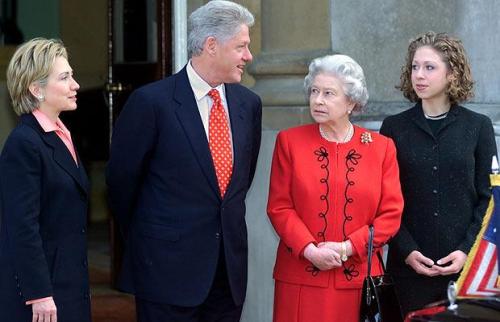
The Queen with President Bill Clinton in 2000

The Queen with President Bill Clinton in 2000

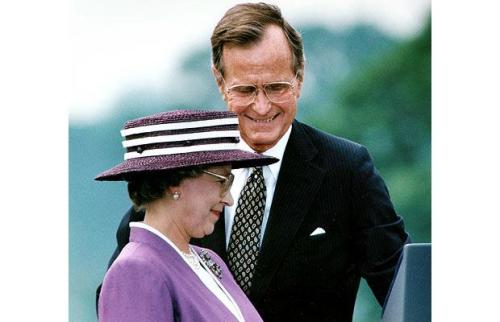
The Queen with President George H. Bush in 1991

The Queen with President George H. Bush in 1991

The Queen with President Ronald Reagan in 1982

The Queen with President Ronald Reagan in 1982

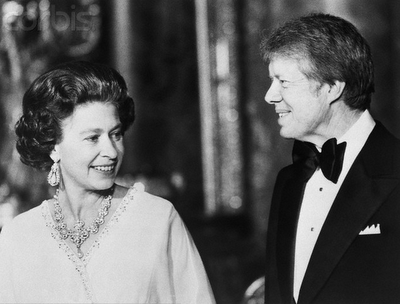
The Queen with President Jimmy Carter in 1977

The Queen with President Jimmy Carter in 1977

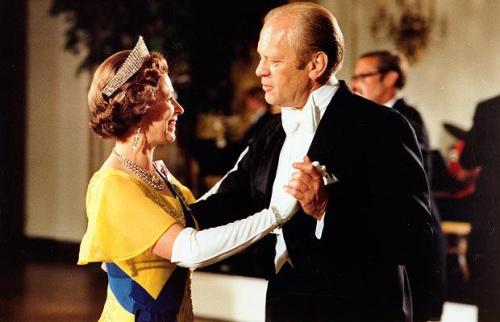
The Queen with President Gerald Ford in 1976

The Queen with President Gerald Ford in 1976

The Queen with President Nixon 1970

The Queen with President Richard Nixon in 1970

The Queen and Prince Philip with President John and Jackie Kennedy (early 1960s)

The Queen with President John F. Kennedy in 1961

The Queen with former President Herbert Hoover in 1957

The Queen with former President Herbert Hoover in 1957

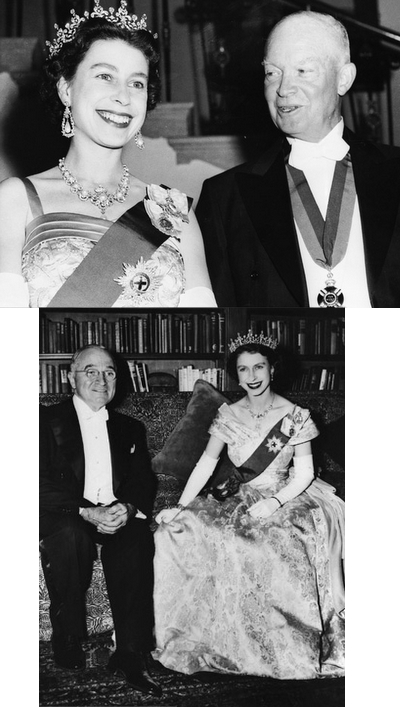
The Queen with Presidents Dwight Eisenhower (top) and Harry Truman (1950s)

The Queen with Presidents Dwight D. Eisenhower (top) in 1957 and Harry Truman (bottom) in 1951

Readers, for more on the Queen, scroll down the right sidebar to “Categories” – “People” – “Queen Elizabeth II”

Read Full Post »

Self-Portrait by Richard Avedon

Self-Portrait by Richard Avedon (1923-2004)

Photographer Annie Leibovitz doesn’t talk to her subjects when photographing them. “I certainly can’t talk to people and take pictures at the same time. For one thing, I look through a viewfinder when I work.” (1)

But famed photographer Richard Avedon had a different style. Leibovitz observed that Avedon “seduced his subjects with conversation. He had a Rolleiflex that he would look down at and then up from. It was never in front of his face” but next to him while he talked. (1)


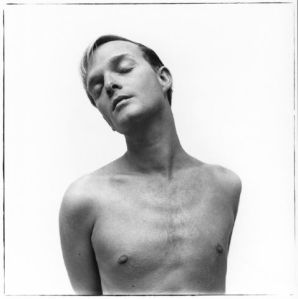
Truman Capote, author of "In Cold Blood" and "Breakfast at Tiffany's" photographed by Richard Avedon in New York City, 1955.

Truman Capote, author of "In Cold Blood" and "Breakfast at Tiffany's" photographed by Richard Avedon in New York City, 1955.

In this way, Avedon got what he wanted from his sitter. According to writer Truman Capote, Avedon was interested in “the mere condition of a face.”

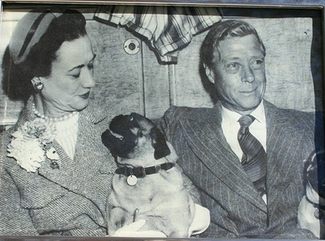
The Duchess and Duke of Windsor with one of their beloved pugs.

The Duchess and Duke of Windsor with one of their beloved pugs.


Some, though, felt that Avedon’s impulses had a cruel edge, showing the face in a harsh light. Here’s a case in point: In 1957, Richard Avedon scheduled a New York City appointment to photograph the Duke and Duchess of Windsor, formerly King Edward VIII of the United Kingdom and Wallis Warfield Simpson of Baltimore. The Windsors were very practiced at putting on happy, regal faces for the camera and Avedon anticipated that. As a royal pair, they were endlessly photographed since they had nothing better to do with themselves since the Duke abdicated the British throne in 1936, giving up crown and kingdom, and moving to France with Wallis.

But Avedon didn’t want that kind of stock photo of the royal pair. According to another fellow photographer, Diane Arbus, Avedon knew that the Windsors were avid dog lovers and would use this knowledge to cruel advantage.

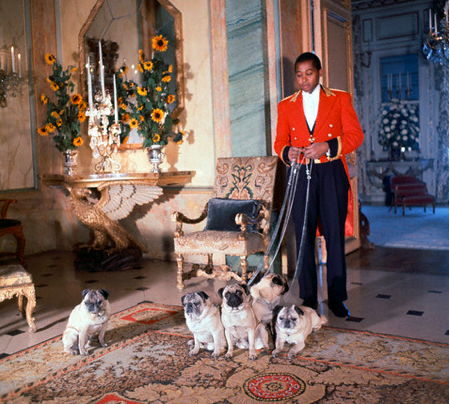
Valet in livery of the Bois de Bologne, Paris, home of the Duke and Duchess of Windsor with pugs Mr. Disraeli, Mr. Chu, Trooper, Imp, and Davy Crockett

Valet in livery of the Bois de Bologne, Paris home of the Duke and Duchess of Windsor with pugs Mr. Disraeli, Mr. Chu, Trooper, Imp, and Davy Crockett


In 1997, Sotheby's auctioned off the contents of the Paris home of the Duke and Duchess of Windsor. Included in their possessions were these pug pillows arranged at the foot of the Duchess' bed. Although Wallis, the Duchess, was fastidious about cleanliness, she allowed the pugs to sleep in the bed with her. "“Paper money for the Duchess was either ordered new and crisp from a bank or wash cleaned and ironed by the housemaids; coins were always washed. Each evening, just before dinner was served, two maids could be found carrying bedsheets through the halls by their corners; the bed linens, having just been ironed, were destined for the rooms of the Duke and Duchess. Wallis could not stand wrinkles in her bed….Once the bed was made, a plastic sheet was spred atop the satin eiderdown so that the pugs could climb onto the bed with Wallis; there she would feed them the hand-baked dog biscuits prepared fresh each day by her chef. Usually the pugs slept on the bed with her, although the Duke’s favorite might disappear through the boudoir to his own spot at the foot of his master’s bed.” The Duchess of Windsor: The Uncommon Life of Wallis Simpson by Greg King

In 1997, Sotheby's auctioned off the contents of the Paris home of the Duke and Duchess of Windsor. Included in their possessions were these pug pillows arranged at the foot of the Duchess' bed. Although Wallis, the Duchess, was fastidious about cleanliness, she allowed the pugs to sleep in the bed with her. "“Paper money for the Duchess was either ordered new and crisp from a bank or wash cleaned and ironed by the housemaids; coins were always washed. Each evening, just before dinner was served, two maids could be found carrying bedsheets through the halls by their corners; the bed linens, having just been ironed, were destined for the rooms of the Duke and Duchess. Wallis could not stand wrinkles in her bed….Once the bed was made, a plastic sheet was spread atop the satin eiderdown so that the pugs could climb onto the bed with Wallis; there she would feed them the hand-baked dog biscuits prepared fresh each day by her chef. Usually the pugs slept on the bed with her, although the Duke’s favorite might disappear through the boudoir to his own spot at the foot of his master’s bed.” The Duchess of Windsor: The Uncommon Life of Wallis Simpson by Greg King

This is what he did: When Avedon arrived at the appointment to photograph the Windsors, he got them seated just as he wanted them then told them a lie. He explained how, on his way to meet them, his taxi had accidentally run over a dog in the street and killed it. As the Windsors flinched with sympathetic horror, Avedon clicked the shutter – and caught their expression. Here is that photo.

The Duchess and Duke of Windsor, New York, 1957. Photograph by Richard Avedon

The Duchess and Duke of Windsor, New York, 1957. Photograph by Richard Avedon

The photograph caused an international sensation. Some said it made the Duchess look like a toad. British Royalists were outraged at the unflattering portrait. But Avedon defended lying to the couple to conceive the portrait, arguing that his photographs tended to show what people were really like.

If that was indeed true, the Windsors appeared to be two very dreadful people, a suspicion already aroused by their most ungracious familiarity with Adolf Hitler and his Nazi cronies in the pre WWII years. While living in an elegant Paris home provided by the French government on a lavish income bestowed on them by the  British government, the Windsors regularly made pro-fascist remarks to the press as well as disparaging comments about their lack of loyalty to either of  their host countries, France and Britain. They palled around with British traitors like Oswald Mosley and wife Diana Mitford in the French countryside until the Duke’s brother, the reigning King George VI of the United Kingdom got wise to the danger and shipped them off to the Bahamas for the duration of the war.

Avedon once remarked that the Windsors loved dogs more than they loved Jews.

(1) Leibovitz, Annie. Annie Leibovitz at Work. New York: Random House, 2008.

Readers: For more posts on this site on Annie Leibovitz or the Duke and Duchess of Windsor, scroll down the right sidebar: Categories: People.

Read Full Post »

1936 The Year of Three British Kings: George V, Edward VIII, George VI

1936 The Year of Three British Kings: dad George V and his 2 sons - George VI & Edward VIII

The year 1936 brought many changes within the British monarchy. In January of that year, the first monarch of the House of Windsor, King George V, died and his son, Edward VIII ascended the throne. King Edward VIII though was not destined to rule long. He had a married American mistress – Wallis Warfield Simpson – who was in the process of divorcing her second husband. The King’s choice of sweetheart would soon bring him tumbling down.

Wallis Warfield Simpson, Duchess of Windsor (1896-1986). Wallis' second husband Ernest Simpson couldn't keep her happy. She was accustomed to a grander style of living than he was capable of providing. She found that way of life with the then Prince of Wales, who ascended to the British throne in 1936 as King Edward VIII. The King was obsessed with Wallis, showering with jewels and clothes and taking her on expensive cruises - while she was still married to Mr. Simpson. Wallis had cast her spell.

Wallis Warfield Simpson, Duchess of Windsor (1896-1986). Wallis' second husband Ernest Simpson couldn't keep her happy. She was accustomed to a grander style of living than he was capable of providing. They were living well beyond their means and having to fire servants when, in 1931, she was introduced to the playboy Prince of Wales, who ascended to the British throne in 1936 as King Edward VIII. The King - called "David" by his friends and family - dropped all his other married girlfriends and became obsessed with Wallis, showering her with jewels and clothes and taking her on expensive ocean cruises - while she was still Mrs. Married Simpson.

The King shocked the nation – already reeling from the King’s scandalous behavior of appearing in the society pages with Mrs. Simpson – by announcing that he planned to marry Mrs. Simpson.

The British people and the government would never have accepted Mrs. Simpson as their queen. Divorced people were not accepted at court, especially ones with two living ex-husbands. Although the King was not forbidden to marry Mrs. Simpson, Prime Minister Stanley Baldwin advised him, on religious and political grounds, that he must make a choice between the throne and marrying Mrs. Simpson – or the government would resign.

By December 1936, King Edward had made his decision. He used his power to expedite Wallis’ divorce from Ernest Simpson [divorces took years back then] then, declared to his kingdom – the United Kingdom, Canada, and India – that it was impossible to carry out his duties “without the help and support of the woman I love,” and gave up the throne. Edward became the only monarch in the history of Great Britain to voluntarily abdicate. Edward’s younger brother, King George VI, then ascended the throne. Edward did marry Wallis and they became the Duke and Duchess of Windsor, settling in France until World War II began.


Elizabeth Bowes-Lyon [pictured] was Wallis’ sister-in-law. She was married to King George VI, the Duke of Windsor’s younger brother who ascended the throne following his  1936 abdication. Elizabeth was known as “The Queen Mum” in later years, after King George VI died in 1952 and their daughter, “Lilibet,” became Queen Elizabeth II. Queen Elizabeth II’s mother – also called Queen Elizabeth when she was queen – died in 2002 at the age of 101.  The Queen Mum hated Wallis, the Duchess of Windsor, and was determined that Wallis would never reenter British society after causing the abdication crisis. She also blamed the Duke and Wallis for the premature death of her husband George VI in 1952 upon the stress of his reign as king – again, because of her brother-in-law’s abdication to marry Wallis. Wallis wasn’t so happy with the Queen herself and returned her hostile sentiments, ridiculing the Queen’s fussy style of confectionary dress by nicknaming her “Cake.” Wallis had never forgotten the snub that King George VI gave her – at his wife Queen Elizabeth’s insistence – of refusing to allow Wallis to be referred to as “Her Royal Highness.”"The Queen Mum" in later years. Queen Elizabeth II's mother died in 2002 at the age of 101. She hated the Duchess of Windsor and the Duchess of Windsor returned her sentiments, calling her the dowdy duchess [when the Queen Mum was the Duchess of York] and "Cake" for her confectionary style of dressing.

The abdication and the subsequent exile to France of the newly titled Duke and Duchess of Windsor turned out to be a gigantic blessing for the UK, because, by September of 1939, Great Britain would declare war on Nazi Germany. It was a good thing King Edward VIII had been replaced with the level-headed King George VI and his queen, Queen Elizabeth (known later as the Queen Mum). They had the good sense to see the threat a Nazi Germany presented and the courage to lead the British people through the terrible bombings of Great Britain by the Nazis. King George VI began his reign as a reluctant king. He was a nervous man with a pronounced stutter who never wanted to rule. But, with Queen Elizabeth by his side, they were able to summon the strength from God and selves to help the British people endure the war and oppose the Nazi regime.

“When war broke out in 1939, George VI and his wife resolved to stay in London and not flee to Canada, as had been suggested. The King and Queen officially stayed in Buckingham Palace throughout the war, although they usually spent nights at Windsor Castle to avoid bombing raids. George VI and Queen Elizabeth narrowly avoided death when two German bombs exploded in a courtyard at Buckingham Palace while they were there.”

So, as history would have it, Great Britain owes an enormous debt to Wallis, the Duchess of Windsor, for spiriting the Duke away before he could do any real harm. At the time, it seemed a great sadness for the Duke to have to give up the throne because convention wouldn’t allow for him to be married to the Duchess. But now we know that it would have been a disaster for him to be King during World War II. Because, as it turned out, both he and the Duchess were  Nazi sympathizers. They held their wedding ceremony at the Chateau de Cande in Mont, France, the home of Nazi collaborator Charles Bedaux.

Within months, Bedaux had arranged for them to travel to Germany to dine with Adolf Hitler. It was widely believed that Hitler planned to install the Duke back on the British throne after the Germans had conquered England. The Duke was desperate for a kingdom and made no secret of his fondness for fascism. Fortunately,the Duke’s brother, the King, got wind of his brother’s nefarious activities and schemes and, at the start of the War, whisked him and the Duchess off to a British island [the Bahamas] far out in the Caribbean. Had  Edward been the British monarch during WWII, not George VI, we might today to looking at a frighteningly different world order.

King George V, the Duke of Windsor’s father, never thought much of his son David. He was disgusted by his son’s playboy ways and inability to grow up and settle down.

The King [George V] was reluctant to see Edward inherit the Crown, and was quoted as saying of Edward [the Duke of Windsor]:”After I am dead, the boy will ruin himself in 12 months.”

George V knew his son well. King Edward VIII…or “David,” the Prince of Wales,  the Duke of Windsor, – he had so many names, it can be so confusing – was self-indulgent to the point of self-destruction. King Edward VIII’s reign as monarch was one of the shortest in British history, lasting  only 325 days, or about 11 months, one month less than his father had so sagely predicted. Edward never did have a coronation ceremony. He was never crowned king.

Readers, for more on the Duke and Duchess of Windsor on this blog:

See “Wallis, the Duchess of Windsor” and “Coco Chanel, Nazi Lovers, and the Windsor Set.”

Read Full Post »

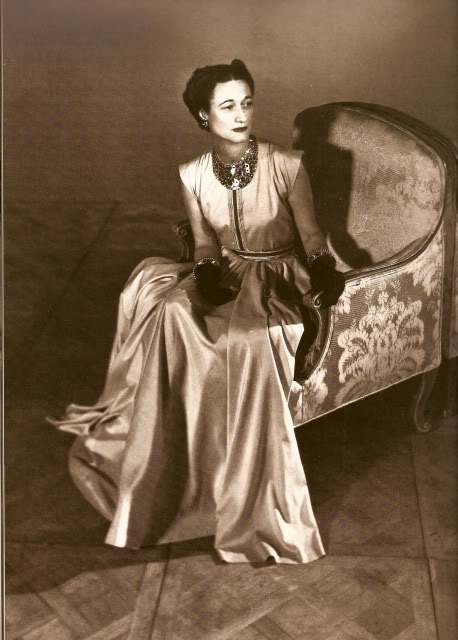
The Duchess of Windsor filled her empty life by buying expensive clothes and getting the Duke to buy her costly jewels. She was always immaculately dressed and never casual. In 1935, she made the Paris Couture best-dressed list and remained there for 40 years.

Wallis, the Duchess of Windsor (1896-1986), is remembered for her stylishness. She filled her empty life by buying expensive clothes from the big Paris fashion houses like Chanel and getting the Duke to buy her costly jewels from Cartier. The Duchess of Windsor was always immaculately dressed and never casual. In 1935, she made the Paris Couture best-dressed list and remained there for 40 years.

In my previous post, “Coco Chanel, Nazi Lovers, and the Windsor Set,” I described the wave of attention the Duke and Duchess of Windsor received when they settled in Paris in the late thirties. A glamorous social set of fashion designers, Nazi sympathizers, American heiresses, British ex-pats, and assorted other idle rich people welcomed the Windsors and became a sort of parallel court for the displaced royals. This French upper-crust group was dubbed “the Windsor Set.” The press buzzed about them like bees around a hive. All  their comings and goings, designer clothes, fancy homes, and elegant soirees were endlessly photographed and reported in the society columns of the day.

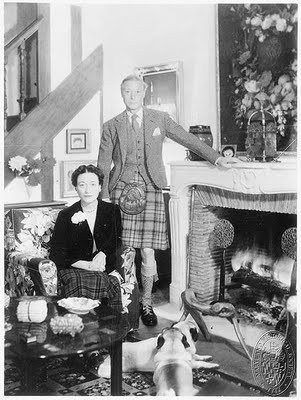
The Duchess and Duke of Windsor at hone

The Duchess and Duke of Windsor at home

At the center of this new social whirl was the Duchess of Windsor. She had never gotten over being snubbed by the British Royal Family and being barred from getting the attention she felt she and the Duke deserved.

Wallis had always been obsessed with her appearance. She knew she wasn’t a great beauty, having once said,

” Nobody ever called me beautiful, or even pretty.”

What she lacked in looks, she made up for in other ways. She selected simple, well-tailored clothes that accented her slim, almost boyish figure. Against this plain backdrop, she dripped with sometimes enormous jewels, sometimes mixing real gems with costume pieces, the real things being given to her by the Duke. Her taste ran to big colorful stones and yellow gold. She amassed a huge collection of jewelry which was sold at auction in 1987 for a record-shattering $50 million. “An 18-karat-gold cigarette case from Cartier—engraved with a map of Europe and set with 37 gems to mark the couple’s premarital holidays—sold for more than $290,000; Elizabeth Taylor phoned in a bid of $623,000 and snagged a diamond brooch.”

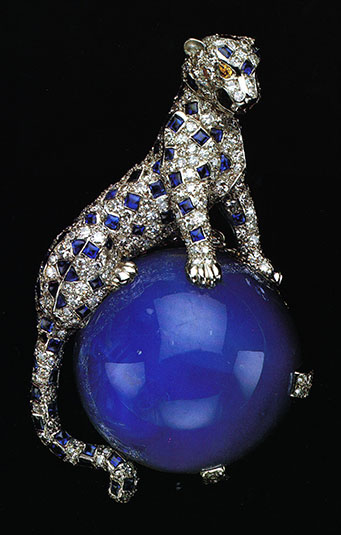
In 1949, the Duchess of Windsor acquired this diamond and sapphire panther pin from Cartier. The panther is crouched in a life like pose on a large perfect round cabochon star sapphire weighing 152.35 carats. This panther pin was one of the Duchess' favorite pieces which she frequently wore. It created an envy among other jewelry collectors and a demand for Cartier to produce more panther pieces. Today, the panther is a Cartier icon. The Duchess of Windsor's animal pieces became her signature.

In 1949, the Duchess of Windsor acquired this diamond and sapphire panther pin from Cartier. The panther is crouched in a life like pose on a large perfect round cabochon star sapphire weighing 152.35 carats. This panther pin was one of the Duchess' favorite pieces which she frequently wore. It created an envy among other jewelry collectors and a demand for Cartier to produce more panther pieces. Today, the panther is a Cartier icon. The Duchess of Windsor's animal pieces became her signature.

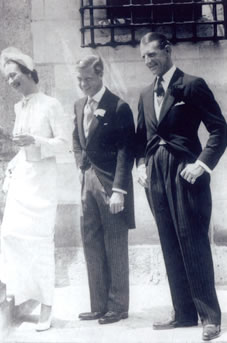
Wallis and Edward with best man Edward "Fruity" Metcalf at their royal wedding, June 3, 1937, at the Chateau de Cande, Mont, France

Wallis and Edward with best man Edward "Fruity" Metcalfe at their royal wedding, June 3, 1937, at the Chateau de Candé, Mont, France

Necklaces, bracelets, lapel pins – she had them all. The only gap in her jewelry collection was rings. The Duchess hated her hands. She thought they were big and ugly. (Notice the black gloves in the first photo above). Acclaimed British photographer Cecil Beaton photographed the Windsors many times. He took their wedding photos at the Chateau de Candé. Beaton remembered of that session that Wallis

“twisted and twirled her rugged hands. She laughed a square laugh, protruded her lower lip. Her eyes were excessively bright, slightly froglike, also wistful.”


Read Full Post »

The third week in July is set aside for the annual swan count along the Thames.

The third week in July is set aside for the annual swan count along the Thames.

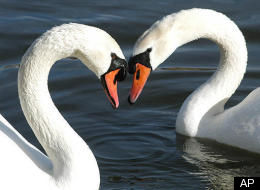
“All swans – unmarked – in open water – belong to the [British] Crown, and have since the Twelfth Century,” says David Barber, Queen Elizabeth’s official swan marker for 16 years. Although, legally, the Queen retains ownership over all unmarked swans in the United Kingdom, the royal British monarch only exercises her rights over a 79-mile stretch of the Thames River. Barber’s job, with the help of a crew in boats, is to annually count the number of unmarked swans in the Thames. This tradition, called “swan-upping,” takes place over a 5-day period the third week in July.

Swan Upping Long Ago - the best way to tag a bird was to sit on it

Swan Upping Long Ago – the best way to tag a bird was to sit on it


The ritual [of swan upping] was first documented in the 12th Century, when the bird was a popular dish at medieval feasts. The monarchy laid claim to the birds, which were a valuable food commodity, and doled out ownership charters in exchange for favors. Up to the mid-1800s, swan marking was akin to cow branding: A unique mark, carved into the beak of a newborn cygnet, designated ownership by a specific, chartered family or organization.

Henry VIII reportedly enjoyed swan at his dinner table. Today, swan eating doesn’t go down so well with many Britons, who live in a country that Dr. Perrins describes as “bird oriented.” In 2005, the Master of the Queen’s Music, Sir Maxwell Davies, made headlines when he found a dead swan on his property and made a terrine of it. Mark McGowan, an activist artist, upset Britons when he ate swan in a performance protest against the queen in 2007.

A Swan Upping Boat on the River Thames in England

A Swan Upping Boat on the River Thames in England today

This week, Mr. Barber’s crew counted and weighed roughly 120 newborn swans. When they come upon a brood, the rowers yell “All up!” and surround the birds with their skiffs. After deftly bringing the swans aboard, the uppers temporarily tie them up.

“The best way is to sit on the bird,” said Robert Dean, a boat builder and three-year veteran of the royal crew, who stood on the Eton dock Monday morning with a bundle of swan ties holstered in his belt. Once the newborn swans are weighed and tagged with identification rings, they are entered into the log and released into the river.

For the swans, it is a painless affair — and it has helped save their lives. In the 1980s, swan upping records helped alert Dr. Perrins to a sharp decline in the swan population on the Thames caused by lead poisoning from fishing weights. After a successful campaign to ban the implements, the number of mute swans returned to normal — about 35,000 across the country today, Dr. Perrins said.

The identification rings used by the swan uppers also assist local rescuers, who use them to return injured birds to their broods after treatment. Swan Lifeline, a local agency that treats about 1,100 sick swans each year, cures common injuries from fishhooks and dog attacks, as well more exotic wounds, as when swans fly through greenhouses accidentally. Working closely with Swan Lifeline, Mr. Barber coordinates the removal of as many as 100 swans before the Henley Royal Regatta on the Thames.” (1)

Queen+Elizabeth+II+Attends+Annual+Swan+Upping+_XgDImnk-EXl

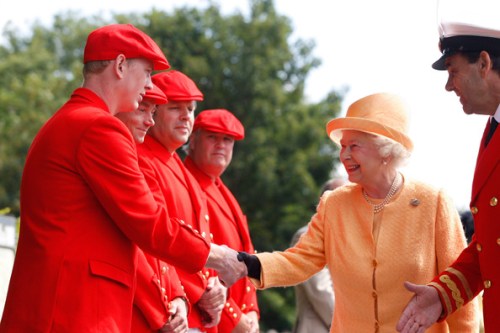
For the first time in her 57-year reign, Queen Elizabeth attended the launch party on July 20.

In the following youtube video, the Queen’s swan marker David Barber explains and demonstrates the practice of swan-upping.

(1) “In Her Majesty’s Service, Loyal Minion Courts,” The Wall Street Journal, July 24, 2009.


Read Full Post »

« Newer Posts - Older Posts »