Feeds:
Posts
Comments

Archive for the ‘British Royal Family/Nobles’ Category

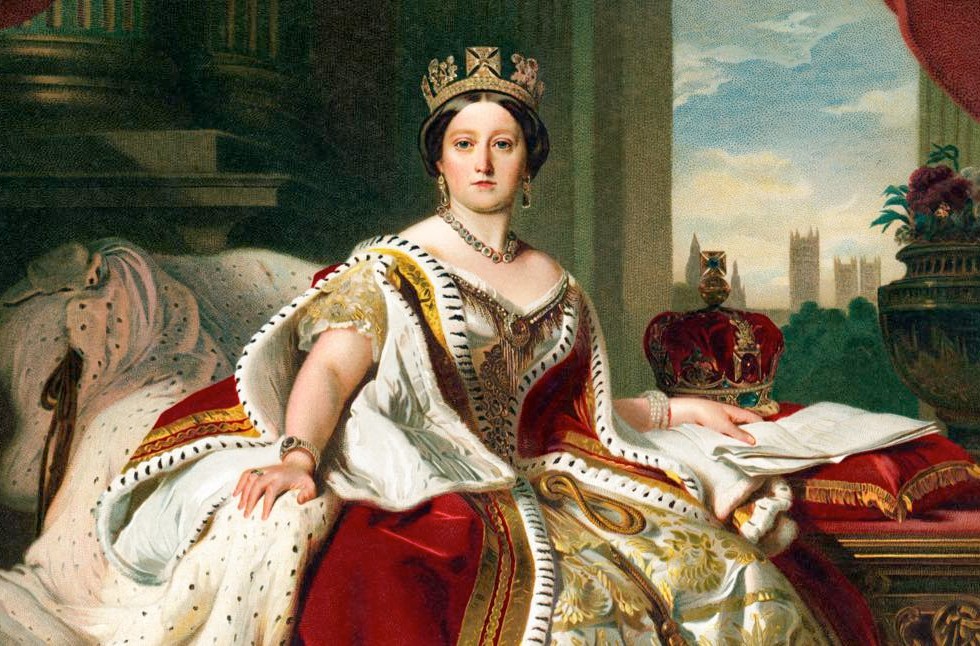
Queen Victoria and Prince Albert, 1854. They had been married 14 years and are both about 34 years old. This is the first time Victoria had been photographed. Queen Victoria reigned as Queen Regnant of the United Kingdom of Great Britain and Ireland from 1837-1901 and as the first Empress of India of the British Raj from 1876 -1901. Her reign as the Queen lasted 63 years and 7 months, longer than that of any other British monarch before or since, and her reign is the longest of any female monarch in history. The time of her reign is known as the Victorian Era, a period of industrial, cultural, political, scientific, and military progress within the United Kingdom.

Throughout their 21-year marriage, Prince Albert and Queen Victoria delighted in showering each other with gifts of art. A new major exhibition of the Royal Collection (March 19-October 31, 2010) at the Queen’s Gallery, Buckingham Palace, is the first ever to focus on the royal couple’s shared enthusiasm for art. “Victoria & Albert: Art & Love” showcases over 400 paintings, drawings, photographs, jewelry, and sculpture from the years of their courtship (1836-1839) and marriage (1840) until Albert’s untimely death of typhoid (1861).

Gold, enamel, and tooth brooch belonging to Queen Victoria (1847, probably commissioned by Prince Albert)

Many trinkets exchanged between the royal couple were sentimental in nature, marking special occasions in the royal household, such as this gold and enamel brooch, seen for the first time ever. This unusual and tiny brooch in the form of a thistle has, as its flower, the first milk tooth lost by the firstborn of their nine children, Princess Victoria (1840-1901). An inscription on the reverse states the tooth was pulled by Prince Albert at Ardverikie (Loch Laggan), on September 13, 1847. (To see more of Victoria’s jewelry made with teeth, click here.)

Princess Victoria was the subject of many art commissions; her parents were overjoyed at her birth because she almost wasn’t born. When the Queen was four months pregnant, she had been the target of a failed assassination attempt. Edward Oxford fired two shots at her as she and Prince Albert rode up Constitution Hill in a carriage in June of 1840. Fortunately, neither the queen, prince, or the unborn Princess Royal was harmed.

An attempt is made to assassinate Queen Victoria by Edward Oxford, June 10. 1840, as the Queen rides up Constitution Hill with Prince Albert. Oxford was arrested for high treason, tried, and acquitted by reason of insanity.

Prince Albert was a man of many talents. He designed many of Queen Victoria’s jewels, including this 1842 brooch featuring a miniature of Princess Victoria as a bejewelled angel.

Queen Victoria's enamel, gold, and jewel brooch, 1842, with a miniature of Princess Victoria as an angel, Prince Albert, designer; William Essex, after William Ross, miniaturist

The queen appreciated Albert’s talent in jewelry design. She wrote:

“Albert has such taste & arranges everything for me about my jewels.”

In addition to designing the queen’s personal jewelry, Prince Albert designed many pieces of her state jewelry. He designed most of her tiaras, including the Oriental Circlet, also a part of this year’s special exhibition.

Queen Victoria's State Jewelry: "The Oriental Circlet," 1853. Diamonds, rubies, gold. The inspiration for the design of this tiara, which includes ‘Moghul’ arches framing lotus flowers, came from Prince Albert who had been greatly impressed by the Indian jewels presented to the Queen by the East India Company.

Readers, you might also enjoy: “Queen Victoria in the Blue Room with a Bust.”

Read Full Post »

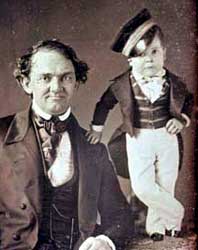
Showman P.T. Barnum (l) with his protegee, "General Tom Thumb" (born as Charles Sherwood Stratton). Daguerrotype by Samuel Root, 1850

The best known of circus pioneer P.T. Barnum‘s performers was Charles Sherwood Stratton (1838-1883), also known as General Tom Thumb. Stratton weighed 9 lbs. 8 oz. at birth, a bouncing baby boy for the time, but stopped growing at six months. When Barnum discovered him at the age of five, Stratton weighed only 15 lbs. and was 25 inches tall. 

“The boy barely came up to the showman’s knees!” (1) 

Barnum wasted no time signing up the boy as a sideshow attraction. His parents happily rented out their child for $7 a week plus room, board, and traveling expenses. Barnum installed the Strattons in a fancy New York City apartment above his museum of human curiosities. Barnum then began transforming Little Charlie into an international celebrity he christened “General Tom Thumb,” recalling the tiny fictional knight of King Arthur’s round table. The knight was so small, he rode a mouse and battled spiders. 

1844 stereograph depicting General Tom Thumb as Napoleon. Although "Tom" was really six at the time, P.T. Barnum promoted him as a 13-year-old.

Barnum taught the little dwarf to dance, sing, and tell jokes while dressed in elaborate costumes as Cupid, Napoleon, and Frederick the Great. At five, Tom learned to drink wine and at seven he took up cigar smoking. Barnum billed Tom Thumb as the “smallest man alive.”  

In 1844, Barnum took his young protege on a much-publicised European tour debut. Tom Thumb was a huge sensation, appearing before the crowned heads of Europe and visiting Queen Victoria not once, but twice. Audiences were enchanted with the man-boy whose charm combined innocence with pomposity. Over time, Tom made so many visits to royalty that Barnum had a special carriage built for him. 

“Only 11″ high, it was painted blue and lined with silk. Drawn by ponies only 28″ tall, and driven by children dressed in livery, it caused a sensation wherever it went.” 

Years went by and the money from Tom Thumb’s tours made him a rich man. “The Man in Miniature” moved to a specially-designed mansion for him and his parents in his hometown of Bridgeport, Connecticut. 

Lavinia Warren (1841-1919), photo c. 1855-1865

It was said that, by the age of 19, Tom had been kissed by a million and a half girls.Soon, though, the United States was plunged into the Civil War and Tom wanted more than just kisses from strangers. He began looking for a wife. He found her in the diminutive form of another little person, the charming and very beautiful Lavinia Warren

On February 10, 1863, the two were married at Grace Episcopal Church in New York City. The wedding was front page news. Billed as “the fairy wedding,” it was the social event of the season. People clamored for invitations, yet only two thousand people were invited. 

"The Fairy Wedding" of General Tom Thumb (Charles Stratton) and Lavinia Warren. This is a reenactment of the ceremony staged by photographer Mathew Brady after the Feb. 10, 1863 event.On the left in each picture is the best man, George Washington Morrison Nutt, known as Commodore Nutt, who had courted Lavinia unsuccessfully; Tom Thumb; Lavinia, and Minnie Bump AKA Minnie Warren, Lavinia's younger and even more petite sister


As Tom and Lavinia made their way up the center aisle to the altar, only guests seated along the aisle could see them. Once they arrived at the chancel, women stood on tiptoes and a few climbed on chairs to witness the ceremony. Afterwards, P.T. Barnum staged a reception for the newlyweds at the Metropolitan Hotel. Barnum charged $75 a ticket. Although there was a demand for 15,000 tickets, only 5,000 were sold. 

At the reception, the Strattons stood on a piano to receive their guests. Later on their honeymoon, they traveled to Washington, D.C., to the White House, where President Lincoln gave them a fancy party. In the course of the evening, the president told General Tom Thumb that he had put him completely in the shade, as he [the General] was now the center of all attention. 

(1) Fleming, Candace. The Great and Only Barnum: The Tremendous, Stupendous Life of Showman P.T. Barnum. New York: Schwartz & Wade Books, 2009.

Read Full Post »

Charles Dickens at writing desk

By the time Charles Dickens turned ten, his family had lived in six different houses, each poorer than the one before. Although Charles’ father John Dickens was employed as a clerk in the Navy Pay Office, he lived well beyond his means. Plus, the family kept growing; there were eight children in all, which meant many mouths to feed.

Then, in 1822, John Dickens was transferred to London and the family followed. Things went rapidly downhill. John Dickens was soon in debt up to his eyeballs. He informed Charles that he no longer could afford to send him to school. This broke Charles’ heart. The headmaster at his school had already recognized Charles’ special intelligence and imagination and Charles wanted to be a man of letters.

To pay the butcher and the baker, Charles was sent with armloads of books to sell at the pawnshop. Charles was humiliated and heartbroken. Gone were the wonderful hours in his little attic room in Chatham, reading tales of heroes like Robinson Crusoe and Peregrine Pickle. Now he was forced to part with his beloved stories, his only escape from the drudgery of his life. The books were soon followed by all the household goods, sold in an attempt to pay off the family’s debts, and keep John Dickens out of debtors’ prison.

In this 1840 engraving, 'Love Conquered Fear,' fictional character Michael Armstrong, a boy adopted by the mill owner, is shown embracing his brother Edward who is one of the ragged factory boys working amongst the spinning mules. By Michael's foot, a child can be seen crawling out from under a mule, employed to keep the floor under the mules dust and fiber free to minimise risk of fire. These poor boys often suffered horrific injuries when crushed by the moving machinery. From Frances Trollope's ''The Life and Adventures of Michael Armstrong'' London 1840.

Then, in “an evil hour for me,” Charles was offered work at Warren’s Blacking Factory at six shillings a week, or about $1.40.  Charles’ parents jumped at the offer. Charles remembers:

It is wonderful [shocking] to me how I could have been so easily cast away at such an age….My mother and father were quite satisfied. They could hardly have been more so if I had been twenty years of age, distinguished at a grammar-school, and going to Cambridge.”

No one – no neighbors, friends, or family members reached out to save Charles from this terrible fate. So, on Feb. 9, 1824, at the tender age of twelve, he entered the business world to earn wages for the family. From eight in the morning until eight at night, six days a week, Charles worked alongside rough boys in a dark room covering pots of boot polish and gluing on labels.  The work conditions were appalling:

“The blacking-warehouse was the last house on the left-hand side of the way, at old Hungerford Stairs. It was a crazy, tumble-down old house, abutting of course on the river, and literally overrun with rats. Its wainscoted rooms, and its rotten floors and staircase, and the old gray rats swarming down in the cellars, and the sound of their squeaking and scuffling coming up the stairs at all times, and the dirt and decay of the place,rise up visibly before me, as if I were there again. The counting-house was on the first floor, looking over the coal-barges and the river.”

 Victorian children are shown working in a cotton mill. At the beginning of British Queen Victoria’s reign (1837), many children worked in factories for cheap wages. Some workers were as young as five. Few citizens questioned the practice of employing children at the time as there were no laws to protect them. The novels of British author Charles Dickens (1812-1870) with their depiction of poverty did much to bring about positive social change and improve the living conditions of the poor.
 
 
Then, two weeks later, John Dickens was arrested and thrown into Marshalsea Prison, where he had to stay until his debts were paid. Charles’ mother and his seven siblings were allowed to live there with him, everyone living in one room, except, alas, Charles. The blacking factory was too far from the prison for Charles to get back before the gates were shut at night. Charles was sent to live in a cheap boarding house. After work he wandered the dark streets of the big city, utterly alone, totally miserable, shabbily dressed, anticipating a dinner of bread and cheese in an empty room.
 
Those days were so crushingly painful for Charles that, years later, when he was a grown man with a family of his own, he could not walk those same streets without being reduced to tears. As a writer, Dickens filled his books with people and places from those bitter days, offering a social commentary that improved the lives of the poor. The novel Oliver Twist (1839), for example, shocked readers with its depiction of poverty and crime in Jacob’s Island, resulting in an actual clearing of the slum.

For more on Victorian child labor, click here.

Readers: For more on Charles Dickens, scroll down the right sidebar: Categories/People/Charles Dickens. Enjoy!

Read Full Post »

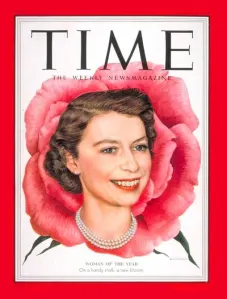
TIME magazine's 1952 Woman of the Year: Queen Elizabeth II of England (Jan. 5, 1953 cover)

TIME magazine's 1952 Woman of the Year: Queen Elizabeth II of England (Jan. 5, 1953 cover)

In February 1952, Princess Elizabeth was touring Kenya with her husband Prince Philip, the Duke of Edinburgh when she received the bad news that her father, King George VI of Great Britain, had passed away. Thus, at the tender age of 25, Elizabeth ascended the throne to become Queen of the United Kingdom, Canada, Australia, New Zealand, South Africa, Pakistan, and Ceylon. She took the title Queen Elizabeth II although she was not a descendant of Queen Elizabeth I (1533-1603), who was the last Tudor queen. Queen Elizabeth II belongs to the Royal House of Windsor, formerly known as Saxe-Coburg and Gotha.

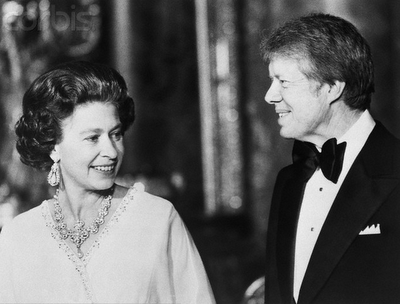
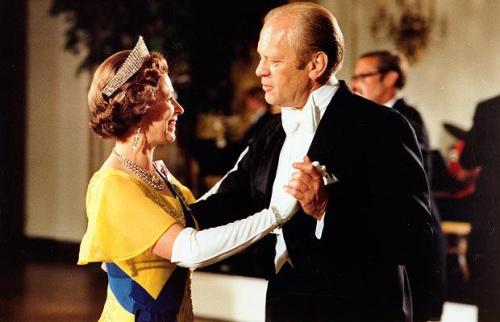
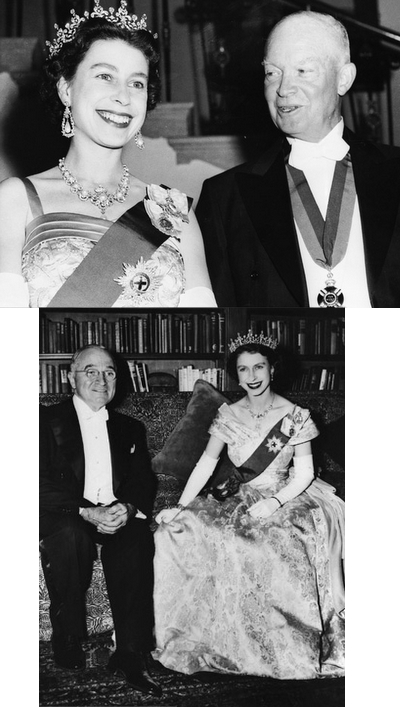
During the Queen’s reign, there have been 11 U.S. presidents. Queen Elizabeth II has met every one of them except Lyndon B. Johnson. She met Harry Truman before she became queen and Herbert Hoover when he was a former president.

Here is a photo gallery of Queen Elizabeth II and 12 U.S. Presidents:

The Queen with President Barack Obama in 2009

The Queen with President Barack Obama in 2009

The Queen with President George W. Bush in 2003

The Queen with President George W. Bush in 2003

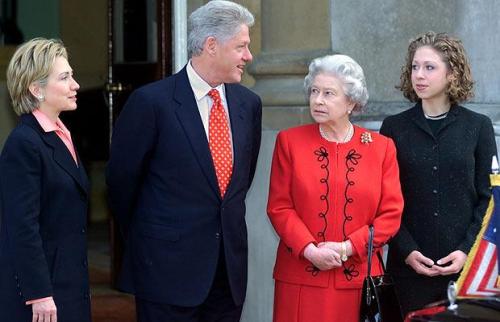
The Queen with President Bill Clinton in 2000

The Queen with President Bill Clinton in 2000

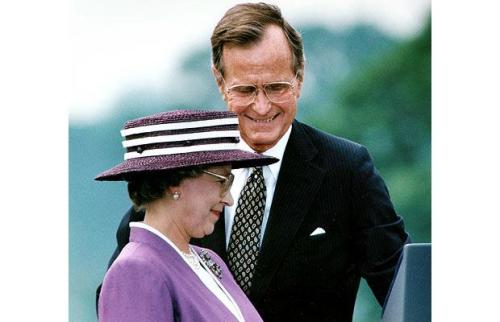
The Queen with President George H. Bush in 1991

The Queen with President George H. Bush in 1991

The Queen with President Ronald Reagan in 1982

The Queen with President Ronald Reagan in 1982

The Queen with President Jimmy Carter in 1977

The Queen with President Jimmy Carter in 1977

The Queen with President Gerald Ford in 1976

The Queen with President Gerald Ford in 1976

The Queen with President Nixon 1970

The Queen with President Richard Nixon in 1970

The Queen and Prince Philip with President John and Jackie Kennedy (early 1960s)

The Queen with President John F. Kennedy in 1961

The Queen with former President Herbert Hoover in 1957

The Queen with former President Herbert Hoover in 1957

The Queen with Presidents Dwight Eisenhower (top) and Harry Truman (1950s)

The Queen with Presidents Dwight D. Eisenhower (top) in 1957 and Harry Truman (bottom) in 1951

Readers, for more on the Queen, scroll down the right sidebar to “Categories” – “People” – “Queen Elizabeth II”

Read Full Post »

Self-Portrait by Richard Avedon

Self-Portrait by Richard Avedon (1923-2004)

Photographer Annie Leibovitz doesn’t talk to her subjects when photographing them. “I certainly can’t talk to people and take pictures at the same time. For one thing, I look through a viewfinder when I work.” (1)

But famed photographer Richard Avedon had a different style. Leibovitz observed that Avedon “seduced his subjects with conversation. He had a Rolleiflex that he would look down at and then up from. It was never in front of his face” but next to him while he talked. (1)


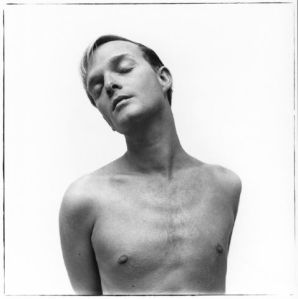
Truman Capote, author of "In Cold Blood" and "Breakfast at Tiffany's" photographed by Richard Avedon in New York City, 1955.

Truman Capote, author of "In Cold Blood" and "Breakfast at Tiffany's" photographed by Richard Avedon in New York City, 1955.

In this way, Avedon got what he wanted from his sitter. According to writer Truman Capote, Avedon was interested in “the mere condition of a face.”

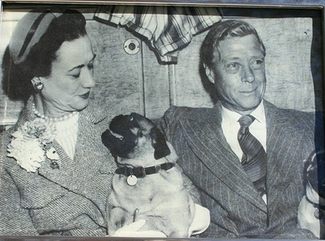
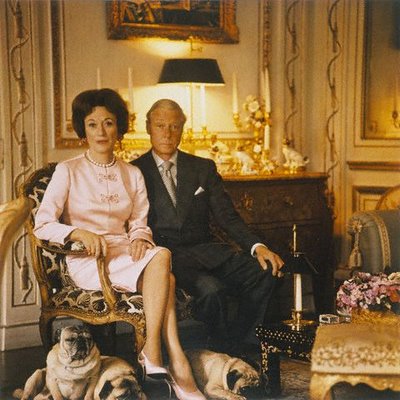
The Duchess and Duke of Windsor with one of their beloved pugs.

The Duchess and Duke of Windsor with one of their beloved pugs.


Some, though, felt that Avedon’s impulses had a cruel edge, showing the face in a harsh light. Here’s a case in point: In 1957, Richard Avedon scheduled a New York City appointment to photograph the Duke and Duchess of Windsor, formerly King Edward VIII of the United Kingdom and Wallis Warfield Simpson of Baltimore. The Windsors were very practiced at putting on happy, regal faces for the camera and Avedon anticipated that. As a royal pair, they were endlessly photographed since they had nothing better to do with themselves since the Duke abdicated the British throne in 1936, giving up crown and kingdom, and moving to France with Wallis.

But Avedon didn’t want that kind of stock photo of the royal pair. According to another fellow photographer, Diane Arbus, Avedon knew that the Windsors were avid dog lovers and would use this knowledge to cruel advantage.

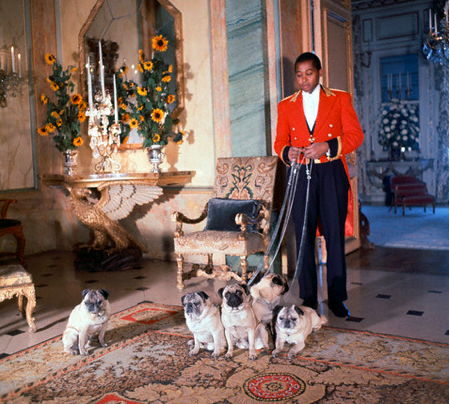
Valet in livery of the Bois de Bologne, Paris, home of the Duke and Duchess of Windsor with pugs Mr. Disraeli, Mr. Chu, Trooper, Imp, and Davy Crockett

Valet in livery of the Bois de Bologne, Paris home of the Duke and Duchess of Windsor with pugs Mr. Disraeli, Mr. Chu, Trooper, Imp, and Davy Crockett


In 1997, Sotheby's auctioned off the contents of the Paris home of the Duke and Duchess of Windsor. Included in their possessions were these pug pillows arranged at the foot of the Duchess' bed. Although Wallis, the Duchess, was fastidious about cleanliness, she allowed the pugs to sleep in the bed with her. "“Paper money for the Duchess was either ordered new and crisp from a bank or wash cleaned and ironed by the housemaids; coins were always washed. Each evening, just before dinner was served, two maids could be found carrying bedsheets through the halls by their corners; the bed linens, having just been ironed, were destined for the rooms of the Duke and Duchess. Wallis could not stand wrinkles in her bed….Once the bed was made, a plastic sheet was spred atop the satin eiderdown so that the pugs could climb onto the bed with Wallis; there she would feed them the hand-baked dog biscuits prepared fresh each day by her chef. Usually the pugs slept on the bed with her, although the Duke’s favorite might disappear through the boudoir to his own spot at the foot of his master’s bed.” The Duchess of Windsor: The Uncommon Life of Wallis Simpson by Greg King

In 1997, Sotheby's auctioned off the contents of the Paris home of the Duke and Duchess of Windsor. Included in their possessions were these pug pillows arranged at the foot of the Duchess' bed. Although Wallis, the Duchess, was fastidious about cleanliness, she allowed the pugs to sleep in the bed with her. "“Paper money for the Duchess was either ordered new and crisp from a bank or wash cleaned and ironed by the housemaids; coins were always washed. Each evening, just before dinner was served, two maids could be found carrying bedsheets through the halls by their corners; the bed linens, having just been ironed, were destined for the rooms of the Duke and Duchess. Wallis could not stand wrinkles in her bed….Once the bed was made, a plastic sheet was spread atop the satin eiderdown so that the pugs could climb onto the bed with Wallis; there she would feed them the hand-baked dog biscuits prepared fresh each day by her chef. Usually the pugs slept on the bed with her, although the Duke’s favorite might disappear through the boudoir to his own spot at the foot of his master’s bed.” The Duchess of Windsor: The Uncommon Life of Wallis Simpson by Greg King

This is what he did: When Avedon arrived at the appointment to photograph the Windsors, he got them seated just as he wanted them then told them a lie. He explained how, on his way to meet them, his taxi had accidentally run over a dog in the street and killed it. As the Windsors flinched with sympathetic horror, Avedon clicked the shutter – and caught their expression. Here is that photo.

The Duchess and Duke of Windsor, New York, 1957. Photograph by Richard Avedon

The Duchess and Duke of Windsor, New York, 1957. Photograph by Richard Avedon

The photograph caused an international sensation. Some said it made the Duchess look like a toad. British Royalists were outraged at the unflattering portrait. But Avedon defended lying to the couple to conceive the portrait, arguing that his photographs tended to show what people were really like.

If that was indeed true, the Windsors appeared to be two very dreadful people, a suspicion already aroused by their most ungracious familiarity with Adolf Hitler and his Nazi cronies in the pre WWII years. While living in an elegant Paris home provided by the French government on a lavish income bestowed on them by the  British government, the Windsors regularly made pro-fascist remarks to the press as well as disparaging comments about their lack of loyalty to either of  their host countries, France and Britain. They palled around with British traitors like Oswald Mosley and wife Diana Mitford in the French countryside until the Duke’s brother, the reigning King George VI of the United Kingdom got wise to the danger and shipped them off to the Bahamas for the duration of the war.

Avedon once remarked that the Windsors loved dogs more than they loved Jews.

(1) Leibovitz, Annie. Annie Leibovitz at Work. New York: Random House, 2008.

Readers: For more posts on this site on Annie Leibovitz or the Duke and Duchess of Windsor, scroll down the right sidebar: Categories: People.

Read Full Post »

1936 The Year of Three British Kings: George V, Edward VIII, George VI

1936 The Year of Three British Kings: dad George V and his 2 sons - George VI & Edward VIII

The year 1936 brought many changes within the British monarchy. In January of that year, the first monarch of the House of Windsor, King George V, died and his son, Edward VIII ascended the throne. King Edward VIII though was not destined to rule long. He had a married American mistress – Wallis Warfield Simpson – who was in the process of divorcing her second husband. The King’s choice of sweetheart would soon bring him tumbling down.

Wallis Warfield Simpson, Duchess of Windsor (1896-1986). Wallis' second husband Ernest Simpson couldn't keep her happy. She was accustomed to a grander style of living than he was capable of providing. She found that way of life with the then Prince of Wales, who ascended to the British throne in 1936 as King Edward VIII. The King was obsessed with Wallis, showering with jewels and clothes and taking her on expensive cruises - while she was still married to Mr. Simpson. Wallis had cast her spell.

Wallis Warfield Simpson, Duchess of Windsor (1896-1986). Wallis' second husband Ernest Simpson couldn't keep her happy. She was accustomed to a grander style of living than he was capable of providing. They were living well beyond their means and having to fire servants when, in 1931, she was introduced to the playboy Prince of Wales, who ascended to the British throne in 1936 as King Edward VIII. The King - called "David" by his friends and family - dropped all his other married girlfriends and became obsessed with Wallis, showering her with jewels and clothes and taking her on expensive ocean cruises - while she was still Mrs. Married Simpson.

The King shocked the nation – already reeling from the King’s scandalous behavior of appearing in the society pages with Mrs. Simpson – by announcing that he planned to marry Mrs. Simpson.

The British people and the government would never have accepted Mrs. Simpson as their queen. Divorced people were not accepted at court, especially ones with two living ex-husbands. Although the King was not forbidden to marry Mrs. Simpson, Prime Minister Stanley Baldwin advised him, on religious and political grounds, that he must make a choice between the throne and marrying Mrs. Simpson – or the government would resign.

By December 1936, King Edward had made his decision. He used his power to expedite Wallis’ divorce from Ernest Simpson [divorces took years back then] then, declared to his kingdom – the United Kingdom, Canada, and India – that it was impossible to carry out his duties “without the help and support of the woman I love,” and gave up the throne. Edward became the only monarch in the history of Great Britain to voluntarily abdicate. Edward’s younger brother, King George VI, then ascended the throne. Edward did marry Wallis and they became the Duke and Duchess of Windsor, settling in France until World War II began.


Elizabeth Bowes-Lyon [pictured] was Wallis’ sister-in-law. She was married to King George VI, the Duke of Windsor’s younger brother who ascended the throne following his  1936 abdication. Elizabeth was known as “The Queen Mum” in later years, after King George VI died in 1952 and their daughter, “Lilibet,” became Queen Elizabeth II. Queen Elizabeth II’s mother – also called Queen Elizabeth when she was queen – died in 2002 at the age of 101.  The Queen Mum hated Wallis, the Duchess of Windsor, and was determined that Wallis would never reenter British society after causing the abdication crisis. She also blamed the Duke and Wallis for the premature death of her husband George VI in 1952 upon the stress of his reign as king – again, because of her brother-in-law’s abdication to marry Wallis. Wallis wasn’t so happy with the Queen herself and returned her hostile sentiments, ridiculing the Queen’s fussy style of confectionary dress by nicknaming her “Cake.” Wallis had never forgotten the snub that King George VI gave her – at his wife Queen Elizabeth’s insistence – of refusing to allow Wallis to be referred to as “Her Royal Highness.”"The Queen Mum" in later years. Queen Elizabeth II's mother died in 2002 at the age of 101. She hated the Duchess of Windsor and the Duchess of Windsor returned her sentiments, calling her the dowdy duchess [when the Queen Mum was the Duchess of York] and "Cake" for her confectionary style of dressing.

The abdication and the subsequent exile to France of the newly titled Duke and Duchess of Windsor turned out to be a gigantic blessing for the UK, because, by September of 1939, Great Britain would declare war on Nazi Germany. It was a good thing King Edward VIII had been replaced with the level-headed King George VI and his queen, Queen Elizabeth (known later as the Queen Mum). They had the good sense to see the threat a Nazi Germany presented and the courage to lead the British people through the terrible bombings of Great Britain by the Nazis. King George VI began his reign as a reluctant king. He was a nervous man with a pronounced stutter who never wanted to rule. But, with Queen Elizabeth by his side, they were able to summon the strength from God and selves to help the British people endure the war and oppose the Nazi regime.

“When war broke out in 1939, George VI and his wife resolved to stay in London and not flee to Canada, as had been suggested. The King and Queen officially stayed in Buckingham Palace throughout the war, although they usually spent nights at Windsor Castle to avoid bombing raids. George VI and Queen Elizabeth narrowly avoided death when two German bombs exploded in a courtyard at Buckingham Palace while they were there.”

So, as history would have it, Great Britain owes an enormous debt to Wallis, the Duchess of Windsor, for spiriting the Duke away before he could do any real harm. At the time, it seemed a great sadness for the Duke to have to give up the throne because convention wouldn’t allow for him to be married to the Duchess. But now we know that it would have been a disaster for him to be King during World War II. Because, as it turned out, both he and the Duchess were  Nazi sympathizers. They held their wedding ceremony at the Chateau de Cande in Mont, France, the home of Nazi collaborator Charles Bedaux.

Within months, Bedaux had arranged for them to travel to Germany to dine with Adolf Hitler. It was widely believed that Hitler planned to install the Duke back on the British throne after the Germans had conquered England. The Duke was desperate for a kingdom and made no secret of his fondness for fascism. Fortunately,the Duke’s brother, the King, got wind of his brother’s nefarious activities and schemes and, at the start of the War, whisked him and the Duchess off to a British island [the Bahamas] far out in the Caribbean. Had  Edward been the British monarch during WWII, not George VI, we might today to looking at a frighteningly different world order.

King George V, the Duke of Windsor’s father, never thought much of his son David. He was disgusted by his son’s playboy ways and inability to grow up and settle down.

The King [George V] was reluctant to see Edward inherit the Crown, and was quoted as saying of Edward [the Duke of Windsor]:”After I am dead, the boy will ruin himself in 12 months.”

George V knew his son well. King Edward VIII…or “David,” the Prince of Wales,  the Duke of Windsor, – he had so many names, it can be so confusing – was self-indulgent to the point of self-destruction. King Edward VIII’s reign as monarch was one of the shortest in British history, lasting  only 325 days, or about 11 months, one month less than his father had so sagely predicted. Edward never did have a coronation ceremony. He was never crowned king.

Readers, for more on the Duke and Duchess of Windsor on this blog:

See “Wallis, the Duchess of Windsor” and “Coco Chanel, Nazi Lovers, and the Windsor Set.”

Read Full Post »

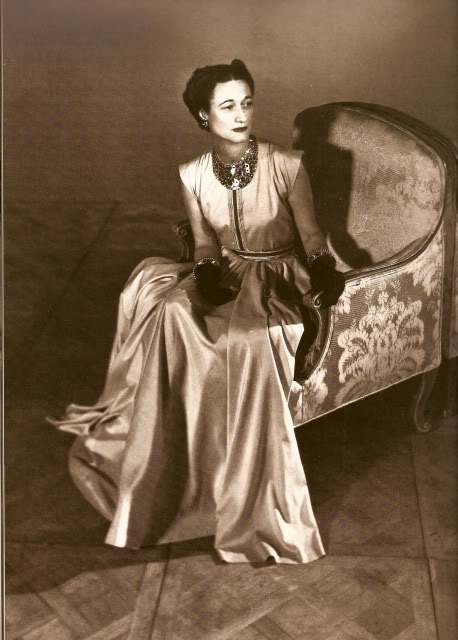
The Duchess of Windsor filled her empty life by buying expensive clothes and getting the Duke to buy her costly jewels. She was always immaculately dressed and never casual. In 1935, she made the Paris Couture best-dressed list and remained there for 40 years.

Wallis, the Duchess of Windsor (1896-1986), is remembered for her stylishness. She filled her empty life by buying expensive clothes from the big Paris fashion houses like Chanel and getting the Duke to buy her costly jewels from Cartier. The Duchess of Windsor was always immaculately dressed and never casual. In 1935, she made the Paris Couture best-dressed list and remained there for 40 years.

In my previous post, “Coco Chanel, Nazi Lovers, and the Windsor Set,” I described the wave of attention the Duke and Duchess of Windsor received when they settled in Paris in the late thirties. A glamorous social set of fashion designers, Nazi sympathizers, American heiresses, British ex-pats, and assorted other idle rich people welcomed the Windsors and became a sort of parallel court for the displaced royals. This French upper-crust group was dubbed “the Windsor Set.” The press buzzed about them like bees around a hive. All  their comings and goings, designer clothes, fancy homes, and elegant soirees were endlessly photographed and reported in the society columns of the day.

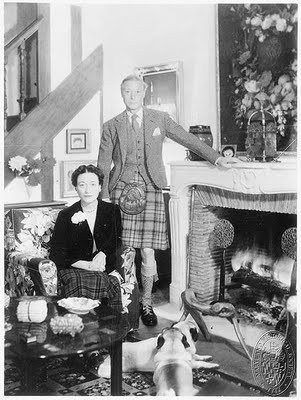
The Duchess and Duke of Windsor at hone

The Duchess and Duke of Windsor at home

At the center of this new social whirl was the Duchess of Windsor. She had never gotten over being snubbed by the British Royal Family and being barred from getting the attention she felt she and the Duke deserved.

Wallis had always been obsessed with her appearance. She knew she wasn’t a great beauty, having once said,

” Nobody ever called me beautiful, or even pretty.”

What she lacked in looks, she made up for in other ways. She selected simple, well-tailored clothes that accented her slim, almost boyish figure. Against this plain backdrop, she dripped with sometimes enormous jewels, sometimes mixing real gems with costume pieces, the real things being given to her by the Duke. Her taste ran to big colorful stones and yellow gold. She amassed a huge collection of jewelry which was sold at auction in 1987 for a record-shattering $50 million. “An 18-karat-gold cigarette case from Cartier—engraved with a map of Europe and set with 37 gems to mark the couple’s premarital holidays—sold for more than $290,000; Elizabeth Taylor phoned in a bid of $623,000 and snagged a diamond brooch.”

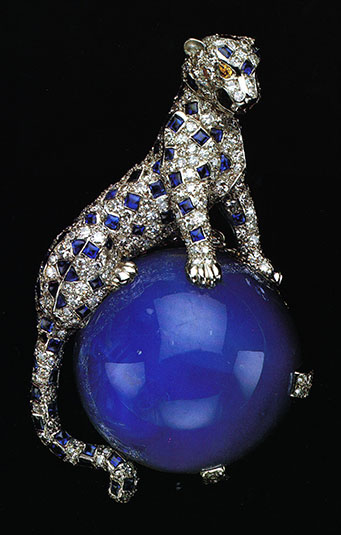
In 1949, the Duchess of Windsor acquired this diamond and sapphire panther pin from Cartier. The panther is crouched in a life like pose on a large perfect round cabochon star sapphire weighing 152.35 carats. This panther pin was one of the Duchess' favorite pieces which she frequently wore. It created an envy among other jewelry collectors and a demand for Cartier to produce more panther pieces. Today, the panther is a Cartier icon. The Duchess of Windsor's animal pieces became her signature.

In 1949, the Duchess of Windsor acquired this diamond and sapphire panther pin from Cartier. The panther is crouched in a life like pose on a large perfect round cabochon star sapphire weighing 152.35 carats. This panther pin was one of the Duchess' favorite pieces which she frequently wore. It created an envy among other jewelry collectors and a demand for Cartier to produce more panther pieces. Today, the panther is a Cartier icon. The Duchess of Windsor's animal pieces became her signature.

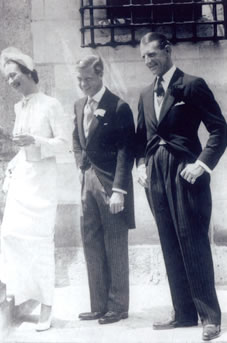
Wallis and Edward with best man Edward "Fruity" Metcalf at their royal wedding, June 3, 1937, at the Chateau de Cande, Mont, France

Wallis and Edward with best man Edward "Fruity" Metcalfe at their royal wedding, June 3, 1937, at the Chateau de Candé, Mont, France

Necklaces, bracelets, lapel pins – she had them all. The only gap in her jewelry collection was rings. The Duchess hated her hands. She thought they were big and ugly. (Notice the black gloves in the first photo above). Acclaimed British photographer Cecil Beaton photographed the Windsors many times. He took their wedding photos at the Chateau de Candé. Beaton remembered of that session that Wallis

“twisted and twirled her rugged hands. She laughed a square laugh, protruded her lower lip. Her eyes were excessively bright, slightly froglike, also wistful.”


Read Full Post »

Wallis Warfield marries the former King Edward VIII of Britain on June 3, 1937, in France. The day before the wedding, the Prince's brother, the new British king, George VI, sent him a letter granting him and Wallis new titles: the Duke and Duchess of Windsor. The titles were hollow; there was no dominion of Windsor to rule. Even worse: the King's letter contained a bomb - the Prince, despite his abdication of the throne, could continue to "hold and enjoy...the title, style or attribute of Royal Highness," but his bride, the Duchess, could not, nor could any of their offspring. She, though a duchess, was denied what her sister-in-laws would enjoy - that her name would be preceded by the magic initials 'H.R.H.' "What a damnable wedding present!" Windsor shouted. (J.Bryan III and Charles J.V. Murphy,

Wallis Warfield (Simpson) marries the former King Edward VIII of Britain on June 3, 1937, in France, after he gave up the British throne to be with her. Wallis Warfield Simpson was an American divorcee. For the King to have married her and tried to install her as his Queen would have precipitated a constitutional crisis in Great Britain....The wedding day dawned bright and sunny. It was Wallis' third wedding; her dress was not white but blue. Blue was also the mood. The day before the wedding, the former king's brother, the new British king, George VI, sent Edward a letter granting him and Wallis new titles: the Duke and Duchess of Windsor. The titles were hollow; there was no dominion of Windsor to rule. Even worse: the King's letter contained a bomb - the former king, now titled the Duke, despite his abdication of the throne, could continue to "hold and enjoy...the title, style or attribute of Royal Highness," but his bride, the Duchess, could not, nor could any of their offspring. She, though a duchess, was denied what her sister-in-laws would enjoy - that her name would be preceded by the magic initials 'H.R.H.' At her entrance, no women had to curtsey, no men to bow. She would not be referred to as "Her Highness" but with the lower form of "Her Grace." "What a damnable wedding present!" Windsor shouted upon reading the King's letter. (Bryan III, J. and Murphy, Charles J.V., The Windsor Story. New York: Dell, 1979.)

In 1937, after King Edward VIII had given up the British throne to marry his American divorcee, Wallis Warfield Simpson, the two tiny, trim party animals were exiled to France, where they were doomed to live a life of idle nothingness. They were given the new but hollow titles of the Duke and Duchess of Windsor. Accustomed to a lifetime of adulation and privilege yet denied a kingdom, the Duke (and the Duchess), set about creating an imaginary realm of their own that would given them the validation they craved as royals. This new kingdom:

“…was a region whose borders were outlined in society pages, peopled mostly by glamorous nobodies lucky enough to have been born into wealth. It was an ornamental place, whose citizens, according to Andrew Bolton, the curator of ”Blithe Spirit” [a past costume exhibit at the Metropolitan Museum], were unsurpassed ”in the beauty, elegance and craftsmanship” of their dress. For self-indulgence, they were also hard to beat.”

The people who congregated around the Duke and Duchess were dubbed the “Windsor set.” They were all-consumed with the photographic image.

“They arranged those lives to suit the lens. Voluntarily estranged from the real aristocracy, the Duke of Windsor, with the aid of his wife, the former Wallis Warfield Simpson, set up a parallel court composed of people like Elsie de Wolfe, the interior decorator and social arbiter; Mona Bismarck, a gorgeous adventuress who was the daughter of a stableman on a Kentucky horse farm; and Daisy Fellowes, whose fortune derived from sewing machines and who had the distinction of being one of the first people on record to alter her nose surgically.”

the Duke and Duchess of Windsor at home with their precious pug dogs. The Duchess, the former Wallis Warfield Simpson, often appeared in her stylish best in public with a pug tucked under one arm. It became a fashion trend - to carry a dog around with you when away from home.

the Duke and Duchess of Windsor at home with their precious pug dogs. The Duchess, the former Wallis Warfield Simpson, often appeared in her stylish best in public with a pug tucked under one arm. It became a fashion trend - to carry a dog around with you when away from home.

Granted, the Windsors were despicable people, dining with Adolf Hitler in 1937 and hobnobbing with fellow Nazi sympathizers and British ex-pats Oswald Mosley and wife Diana Mitford. Nevertheless, the Duke and Duchess – and their fancy friends – obsessed with clothing,  had tremendous style.

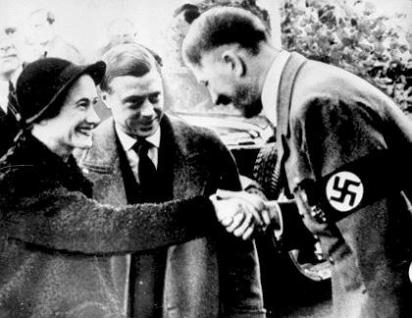
Adolf Hitler kisses the hand of the Duchess of Windsor as her husband the Duke looks on, admiringly. The Duke and Duchess of Windsor visited Germany in 1937 before WWII broke out across Europe. They were outspoken supporters of Nazi fascism and suspected of spying for Germany. At the beginning of the war, the Windsors were whisked out of France to safe haven in the Bahamas, where the Duke served out the war years as governor. There he could do Britain little harm - and he was less likely of being kidnapped by the Germans who were reportedly interested in installing him as a puppet king in a conquered Great Britain under German rule.

Adolf Hitler kisses the hand of the Duchess of Windsor as her husband the Duke looks on, admiringly. The Duke and Duchess of Windsor visited Germany in 1937 before WWII broke out across Europe. They were outspoken supporters of Nazi fascism and suspected of spying for Germany. At the beginning of the war, the Windsors were whisked out of France to safe haven in the Bahamas, where the Duke served out the war years as governor. There he could do Britain little harm - and he was less likely of being kidnapped by the Germans who were reportedly interested in installing him as a puppet king in a conquered Great Britain under German rule.

Fashion designer Gabrielle "Coco" Chanel (French, 1883-1971) at Lido Beach in 1936

Fashion designer Gabrielle "Coco" Chanel (French, 1883-1971) at Lido Beach in 1936

"Evening Dress," 1938. Gabrielle ("Coco") Chanel. Black Silk Net with Polychrome Sequins. The Metropolitan Museum of ARt, New York. Special Exhibit: "Blithe Spirit: The Windsor Set" The decoration of sequined fireworks on this evening dress, which was worn by the Countess Madeleine de Montgomery to Lady Mendl's seventy-fifth birthday party in 1939, is a fitting climax to le beau monde of the 1930s. It was the end of an era when, on Sept. 1, 1939, Parisians heard an early-morning radio announcemen from Herr Hitler in German, at once translated into French, that "as of this moment, we are at war with Poland." The thirties were over; the Second World War had begun.

"Evening Dress," 1938. Gabrielle ("Coco") Chanel. Black Silk Net with Polychrome Sequins. The Metropolitan Museum of Art, New York. Special Exhibit: "Blithe Spirit: The Windsor Set" The decoration of sequined fireworks on this evening dress, which was worn by the Countess Madeleine de Montgomery to Lady Mendl's seventy-fifth birthday party in 1939, is a fitting climax to le beau monde of the 1930s. It was the end of an era when, on Sept. 1, 1939, Parisians heard an early-morning radio announcement from Herr Hitler in German, at once translated into French, that "as of this moment, we are at war with Poland." The thirties were over; the Second World War had begun.

The Windsors were famous for their elegant Paris dinner parties, creating a demand for expensive clothes and jewels for them and their guests. Thus, the prewar years in France from 1935-1940 were rich in the decorative arts, putting trendy fashion designers front and center. It was a time when Gabrielle “Coco” Chanel was “rethinking the suit” to allow for the way women really move and Elsa Schiaparelli* was designing lobster dresses with surrealist Salvador Dali.*

Then Hitler invaded Poland and World War II shattered the fantasy world of endless cocktail parties and silk and organza gowns made to order. The Germans invaded and occupied France.

Shockingly, Coco Chanel spent the war years living at the Ritz in Paris with a Nazi officer. After the war was over, Chanel was arrested by the free French for suspicion of collaborating with the Nazis. She purportedly offered this explanation for sleeping with the enemy:

 “Really, sir, a woman of my age cannot be expected to look at his passport if she has a chance of a lover.”

It is generally believed that Winston Churchill  intervened with the French government, convincing them to let his old friend Coco Chanel escape to Switzerland rather than be paraded through the streets of Paris with her head shaved like other female Nazi collaborators.

Women accused of being Nazi collaborators are humiliated after the liberation of France, 1944. © Hulton-Deutsch Collection/Corbis

Women accused of being Nazi collaborators are humiliated after the liberation of France, 1944. © Hulton-Deutsch Collection/Corbis

Jackie Kennedy in her pink Chanel suit and pillbox hat, riding through Dallas in a motorcade just minutes before a sniper kills her husband, President John F. Kennedy

Fast forward 19 years. It's November 22, 1963. Jackie Kennedy,* in her pink Chanel suit and pillbox hat, is riding through Dallas in a motorcade just minutes before a sniper kills her husband, President John F. Kennedy

*For more on the Kennedys on this blog, please see right sidebar – Categories – People  – the Kennedys.
See “Wallis, the Duchess of Windsor,” which follows this blog post.

Read Full Post »

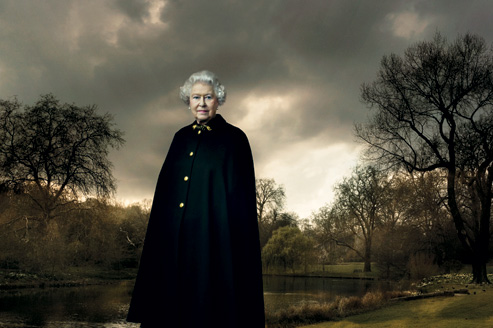
photo of Queen Elizabeth II at Buckingham Palace, March 28, 2007, by Annie Leibovitz

Annie Leibovitz photographed Queen Elizabeth. Here’s what she had to say about that experience.
Excerpted from Annie Leibovitz at Work, by Annie Leibovitz, published by Random House © 2008

The Queen

In 2007, a few weeks before Queen Elizabeth visited the United States for the 400th anniversary of the founding of Jamestown, I was asked to take her portrait. I was the first American to be asked by the Palace to make an official portrait of the Queen, which was very flattering. I felt honored. I also felt that because I was an American I had an advantage over every other photographer or painter who had made a portrait of her. It was O.K. for me to be reverent. The British are conflicted about what they think of the monarch. If a British portraitist is reverent, he’s perceived to be doting. I could do something traditional.

It’s ironic that the sitting with the Queen became controversial. I’m rather proud of having been in control of a complicated shoot. The controversy arose about two months after the pictures were published, when the BBC claimed that the Queen had walked out while we were shooting. This was completely untrue, and although they retracted the claim and issued an apology to the Queen and to me almost immediately, the scandal had a life of its own. The story, which came to be referred to as Queengate, wouldn’t die. Eventually the head of BBC One resigned over it.

When I was preparing for the shoot, I thought about using the landscape around Balmoral Castle, in Scotland. I brought this up in the very first conference call with the Palace. I said that Americans thought of the Queen as an outdoorswoman. I had been influenced by Helen Mirren’s performance in The Queen and I couldn’t help mentioning how much I liked her character in that film. There was a long silence on the other end of the line.

The second idea I had, after Balmoral, was to photograph the Queen on horseback. I asked where she rode and they said she went riding every Saturday at Windsor Castle. I said that I would love to see her in her riding clothes, and in a later conversation I asked if she could stop during her weekend ride and get off her horse and mount it again. That is, could I do a portrait of her in the trees. They said, No, it was not possible. She just rode the horse and came back, and, anyway, she didn’t wear riding clothes anymore. A few days later they said it was going to be Buckingham Palace and no horses.

I realized that I was going to need some time on the ground for this. When we arrived in London, we went straight to the palace and were shown all the rooms, including the throne room—everywhere except the private quarters. And then we scouted the back. There was a wintery sky and the trees didn’t have leaves. It was an appropriate mood for this moment in the Queen’s life. There was no way, however, that she was going to stand outside in formal attire.

For a sitting like this you don’t put all your eggs in one basket. You try to have as many options as possible. I kept thinking that somehow I would get the Queen outside, but I began choosing formal outfits. I narrowed the robes down to a very handsome Order of the Garter cape, but then we were told that she could wear only a white dress under it. We were lobbying for a gold dress. I was also hoping for a dress with more body to it. The Queen wears very streamlined dresses now that she’s older, and I wanted her in something with more volume. But she didn’t have anything like that. Finally everyone agreed that she could wear a gold-and-white dress under the Order of the Garter robe. The Queen was 80 years old. She was sturdy, but putting on and taking off a lot of heavy clothes is tiring, and she had to be dressed in layers to expedite things. The gold-white dress became the base.

I was still upset that I couldn’t get her outside. It was so beautiful out there. And it wasn’t cold or raining or anything. I began thinking about what Cecil Beaton had done. He brought in flowered backdrops. Beaton was big on backdrops. He made very stagy portraits. Perhaps because the pictures were made in black and white you don’t notice the backdrops. They sort of go out of focus. I realized that I could do something similar digitally. I decided to photograph the garden and the trees for a backdrop.

The Palace had given us 25 minutes with the Queen, so there had to be a battle plan. I chose a grand reception room, the White Drawing Room, as the principal setting because of the light from the tall windows. Supplementary lights had been pre-set so that when the Queen moved from one spot to another all we needed to do was switch them on. We had constructed a gray canvas backdrop in an anteroom, and she was to come in there wearing the Order of the Garter robe and the dress, but no tiara. The first shot was to be made on a balcony, with the sky behind her. That sky could be digitally exchanged later for the pictures I had taken in the gardens the day before. I didn’t want her to be wearing a tiara in the gardens.

The morning of the shoot, the Queen came walking down the hall very purposefully. She was definitely a force. This was all being taped by the BBC for a documentary. I would never have agreed to their being there if I felt I had any choice, but they had been following her around for months. Their microphone picked up her saying, “I’ve had enough of dressing like this, thank you very much,” as she marched down the hall. Later, when segments of footage for the BBC were edited for a promotional film, it appeared as if the Queen were stomping out of the photo session rather than going into it. Thus the brouhaha.

The Queen was about 20 minutes late, which we thought was a little strange. When that happens, you never know if it can be made up on the other end. My five-year-old daughter, Sarah, had come with us, and she curtsied and offered the Queen flowers, and I introduced my team. At this point I was in shock. The Queen had the tiara on. That was not the plan. It was supposed to be added later. The dresser knew that. The Queen started saying, “I don’t have much time. I don’t have much time,” and I took her to the first setup and showed her the pictures of the gardens. I think she understood what we had in mind. Then I walked her into the drawing room, probably sooner than I would have if things had been going well. She composed herself when I took some pictures.

I knew how tight everything was, especially with the loss of 20 minutes, and I asked the Queen if she would remove the tiara. (I used the word “crown,” which was a faux pas.) I suggested that a less dressy look might be better. And she said, “Less dressy! What do you think this is?” I thought she was being funny. English humor. But I noticed that the dresser and everyone else who had been working with her were staying about 20 feet away from her.

We removed the big robe, and I took the picture of the Queen looking out the window, and then I said, Listen, I was a little thrown when you first came in, and I have one more picture I’d like to try, with an admiral’s boat cloak. I was thinking of one of Cecil Beaton’s last pictures of the Queen. A very stark and simple and strong portrait in which she’s wearing a boat cloak. We went back into the anteroom, where the gray canvas backdrop had been set up, and she took off the tiara and put on the cloak. That’s the shot we digitally imposed on pictures of the garden.

Right after we finished, I went up to the press secretary and said how much I loved the Queen. How feisty she was. Later I mentioned to a couple of friends that she had been a bit cranky, but it was nothing unusual. What was remarkable about the shoot, and I wrote the Queen a note about this later, was something the BBC missed: her resolve, her devotion to duty. She stayed until I said it was over. Until I said, “Thank you.” We were finished a little before our allotted 25 minutes were up.


Readers, for more on this episode, read my post, “The Queen is Mad.”

Read Full Post »

John Lennon, right, from a scene in the fantastically funny film, "A Hard Day's Night." Lennon is "sniffing a coke" while sitting next to Wilfrid Brambell who plays Paul McCartney's grandfather, constantly referred to as "a clean old man" and the source of great trouble to the Beatles in the show.

John Lennon, right, from a scene in the fantastically funny film, "A Hard Day's Night" (1965). Traveling on a train, Lennon sits next to Wilfrid Brambell, who plays Paul McCartney's grandfather. John is "sniffing coke." Paul's grandfather is constantly referred to as "a clean old man." In fact, he is not, and is the source of great trouble to the Beatles, in particular, Ringo, in this pseudo rock documentary.

Beatle John Lennon (1940-1980) had a witty sense of humor. During live performances of “I Want to Hold Your Hand,” Lennon often changed the words to “I want to hold your gland,” because of the difficulty hearing the vocals above the noise of screaming audiences in the grip of Beatlemania.

At the Royal Variety Show in 1963—in the presence of members of the British royalty, including Her Majesty Queen Elizabeth the Queen Mother, Princess Margaret, and Lord Snowdon —Lennon quipped to the largely upper-crust audience:

“For our next song, I’d like to ask for your help. For the people in the cheaper seats, clap your hands … and the rest of you, if you’ll just rattle your jewelry.”

 
A clip from this London performance is shown below, with the Beatles singing, “With Love From Me to You,” “Until There Was You,” and “Twist and Shout.” Paul makes a joke before “Until There Was You,” referring to American singer Sophie Tucker as a group (she was large). John makes his jewelry comment before playing my all-time favorite “Twist and Shout.” Enjoy.

Read Full Post »

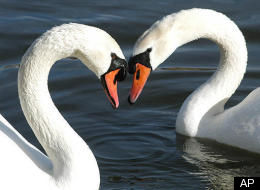
The third week in July is set aside for the annual swan count along the Thames.

The third week in July is set aside for the annual swan count along the Thames.

“All swans – unmarked – in open water – belong to the [British] Crown, and have since the Twelfth Century,” says David Barber, Queen Elizabeth’s official swan marker for 16 years. Although, legally, the Queen retains ownership over all unmarked swans in the United Kingdom, the royal British monarch only exercises her rights over a 79-mile stretch of the Thames River. Barber’s job, with the help of a crew in boats, is to annually count the number of unmarked swans in the Thames. This tradition, called “swan-upping,” takes place over a 5-day period the third week in July.

Swan Upping Long Ago - the best way to tag a bird was to sit on it

Swan Upping Long Ago – the best way to tag a bird was to sit on it


The ritual [of swan upping] was first documented in the 12th Century, when the bird was a popular dish at medieval feasts. The monarchy laid claim to the birds, which were a valuable food commodity, and doled out ownership charters in exchange for favors. Up to the mid-1800s, swan marking was akin to cow branding: A unique mark, carved into the beak of a newborn cygnet, designated ownership by a specific, chartered family or organization.

Henry VIII reportedly enjoyed swan at his dinner table. Today, swan eating doesn’t go down so well with many Britons, who live in a country that Dr. Perrins describes as “bird oriented.” In 2005, the Master of the Queen’s Music, Sir Maxwell Davies, made headlines when he found a dead swan on his property and made a terrine of it. Mark McGowan, an activist artist, upset Britons when he ate swan in a performance protest against the queen in 2007.

A Swan Upping Boat on the River Thames in England

A Swan Upping Boat on the River Thames in England today

This week, Mr. Barber’s crew counted and weighed roughly 120 newborn swans. When they come upon a brood, the rowers yell “All up!” and surround the birds with their skiffs. After deftly bringing the swans aboard, the uppers temporarily tie them up.

“The best way is to sit on the bird,” said Robert Dean, a boat builder and three-year veteran of the royal crew, who stood on the Eton dock Monday morning with a bundle of swan ties holstered in his belt. Once the newborn swans are weighed and tagged with identification rings, they are entered into the log and released into the river.

For the swans, it is a painless affair — and it has helped save their lives. In the 1980s, swan upping records helped alert Dr. Perrins to a sharp decline in the swan population on the Thames caused by lead poisoning from fishing weights. After a successful campaign to ban the implements, the number of mute swans returned to normal — about 35,000 across the country today, Dr. Perrins said.

The identification rings used by the swan uppers also assist local rescuers, who use them to return injured birds to their broods after treatment. Swan Lifeline, a local agency that treats about 1,100 sick swans each year, cures common injuries from fishhooks and dog attacks, as well more exotic wounds, as when swans fly through greenhouses accidentally. Working closely with Swan Lifeline, Mr. Barber coordinates the removal of as many as 100 swans before the Henley Royal Regatta on the Thames.” (1)

Queen+Elizabeth+II+Attends+Annual+Swan+Upping+_XgDImnk-EXl

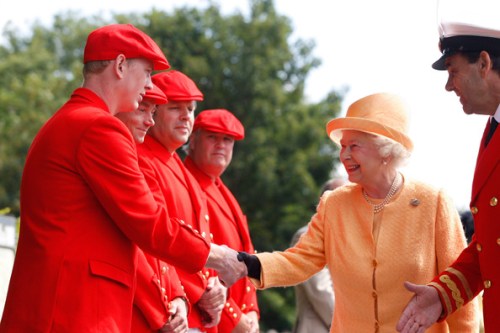
For the first time in her 57-year reign, Queen Elizabeth attended the launch party on July 20.

In the following youtube video, the Queen’s swan marker David Barber explains and demonstrates the practice of swan-upping.

(1) “In Her Majesty’s Service, Loyal Minion Courts,” The Wall Street Journal, July 24, 2009.


Read Full Post »

In this March 2007 photo, Britain's Queen Elizabeth II greets American photographer Annie Leibowitz at a reception prior to their photo shoot. Notice that the Queen has her black Launer purse on her arm.

In this March 2007 photo, Britain's Queen Elizabeth II greets American photographer Annie Leibovitz at a reception prior to their photo shoot. Notice that the Queen has her black Launer purse on her arm.

Prior to her May 2007 visit to the United States, Queen Elizabeth II sat for a series of official photographs by famous celebrity photographer Annie Leibovitz. Ms. Leibovitz is well known for her sometimes controversial celebrity photographs including one of a naked John Lennon hugging a fully clothed Yoko Ono.

December 8, 1980 photograph of John Lennon with wife Yoko Ono taken by Annie Leibowitz. Five hours after this photo shoot, Lennon was shot dead.

December 8, 1980 photograph of John Lennon with wife Yoko Ono taken by Annie Leibowitz.

Leibovitz has said the original concept for the now legendary John Lennon and Yoko Ono Rolling Stone cover was for both to appear nude, designed to mark the release of their album “Double Fantasy.” As legend has it, Lennon was game, shedding his clothes quickly, but Ono felt uncomfortable even taking off her top. Leibovitz recalled for Rolling Stone:

“I was kinda disappointed, and I said, ‘Just leave everything on.’ We took one Polaroid, and the three of us knew it was profound right away.”

It was December 8, 1980. Five hours later, Lennon was dead – shot and killed by Mark David Chapman in front of his Manhattan apartment.

Now back to what I was saying about the Queen:

Leibowitz took the official portraits of Queen Elizabeth II in March 2007. One of the photos, shown below, shows a very serene Queen sitting in the White Drawing Room at Buckingham Palace dressed in a pale gold evening dress, fur stole, and diamond tiara. The wide shot captures the Queen gazing towards a large open window and reveals some of the room’s furnishings and a reflection of a chandelier in a mirror. The room is dark except for the soft light flooding through the open window. All is calm.

Queen Elizabeth II photographed by Annie Leibowitz, March 2007

Queen Elizabeth II, photographed by Annie Leibowitz, March 2007

The session was going smoothly until Leibovitz asked the Queen to take off her tiara (crown) to look “less dressy” for the next photo. The Queen flew into a huff and replied:

“Less dressy? What do you think this is?”

Queen Elizabeth II, photographed by Annie Leibowitz, March 2007. The Queen is not amused after having been asked by Leibowitz to take off her crown, which is actually a tiara.

The Queen was definitely not amused and the tiara stayed on the royal head.

The incident was caught on tape and included in a  BBC documentary “A Year with the Queen.” The BBC kept the footage and included it in a  promotional trailer for the film. The trailer shows the Queen telling an aide, “I’m not changing anything. I’ve had enough dressing like this, thank you very much” and storming out of the room.  The BBC later apologized and admitted that the sequence of events shown on the trailer had been misrepresented, as the Queen was in fact walking to the sitting in the second scene, not exiting. This led to a BBC scandal and a shake-up of ethics training. The event is known as “Tiaragate” and “Crowngate.” According to sources, the Queen was still furious about the incident months later.

Here’s the NBC-TV report:

Read Full Post »

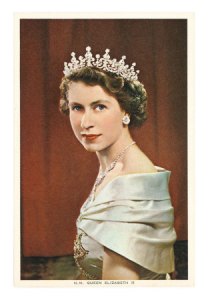
the newly-crowned Queen Elizabeth II

the newly-crowned Queen Elizabeth II

Here is a typical weekday morning for Queen Elizabeth II while in residence at  Buckingham Palace in London:

7:30  The maid enters her bedroom with a tray of  morning tea: 2 silver pots of Earl Grey, milk, and a few biscuits. The cup and saucer are bone china. The linen napkin bears the royal cypher “EIIR” (Elizabeth II Regent). The maid sets down the tray on a bedside table and crosses the room to open the bedroom curtains. She then turns on the radio which is tuned to BBC Radio 4’s Today programme. The Queen listens to the day’s news as she sips her tea. Outside her window the traffic on Constitution Hill is building and people are strolling through Green Park. The maid draws a bath.

While the Queen is bathing, the maid lays out the first of perhaps many outfits the Queen will wear that day, depending upon the royal schedule. Once the Queen is dressed, the Queen’s hairdresser styles her hair.

8:30  The Queen joins her husband Prince Philip for breakfast which is served in the first floor dining room that overlooks the Palace garden. Prince Philip has had a shower and coffee. During their breakfast together, the Prince may place little morsels of food on the bird feeder outside the window. A tail-coated footman brings the breakfast – whole wheat toast with marmalade and more tea and coffee. The Queen reads her papers: The Daily Telegraph and The Racing Post.

9:00  The Piper to the Sovereign – referred to as the “Queen’s Piper” – steps into the Palace garden. He is wearing a kilt of Royal Stewart tartan and two eagle feathers in his headwear.  The Queen and Prince Philip listen as he tunes his bagpipes. For the next fifteen minutes, the Queen’s Piper plays a selection of bagpipe tunes below the dining room window.

9:30  The Queen is seated at her Chippendale desk in her office to begin reviewing her correspondence. A footman comes in with her corgis, who have just had their morning walk in the garden. She works all morning. After lunch, she may take the dogs for a walk herself.

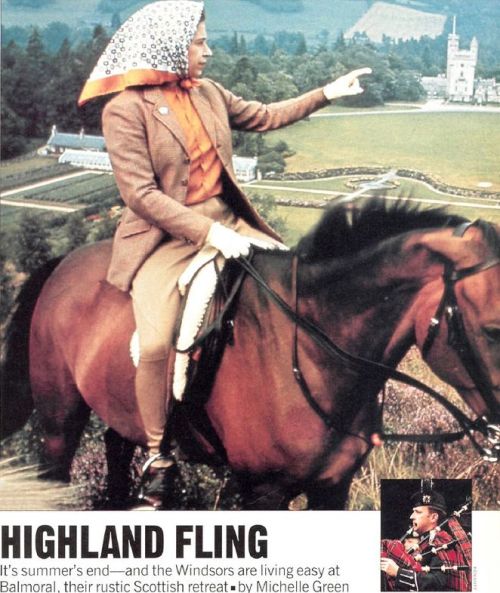
This 1994 People magazine photograph shows Queen Elizabeth II at Balmoral, her Scottish Highland hideaway every August. Whether at Balmoral, Windsor Castle, or Buckingham Palace, the Queen's weekdays start with a fifteen-minute bagpipe serenade. When at Balmoral, the pipers wear the Balmoral tartan.

Above, a 1994 People magazine photograph shows Queen Elizabeth II at Balmoral, her Scottish Highland hideaway she retreats to every August. Whether at Balmoral, Windsor Castle, or Buckingham Palace, the Queen’s weekdays start with a fifteen-minute bagpipe serenade at 9 a.m. When at Balmoral, though, the pipers wear the Balmoral tartan.

For more on Queen Elizabeth II, look in the left column “Categories-People-Queen Elizabeth II.” I’ve written many posts on the Queen; I hope you enjoy them!


Read Full Post »

Buckingham Palace

Buckingham Palace

He wasn’t the first person to scale the garden wall of Buckingham Palace. The year before, three German tourists had done it. While there had been others who’d breached Palace security, Michael Fagan was to become one of the most infamous.

1982 Buckingham Palace Intruder Michael Fagan

1982 Buckingham Palace Intruder Michael Fagan

It was 7:15 a.m. on July 9, 1982. Michael Fagan, 31, had been up all night, drinking whisky, and wandering London’s dark streets, brooding. He had just been released from the psychiatric ward at Brixton Prison. The judge had sent him there after he slashed his wrists with a broken bottle during his court hearing on charges that he stabbed his teenage stepson in the neck with a screwdriver. (1)

Fagan was discouraged. He was broke and faced a mountain of debt. His wife was unfaithful. There were problems with his kids and even his mum. The voices in his head told him to go and tell the Queen how unhappy he was and she would help. The voices told him he could do it. These were the same voices that before had talked him into climbing the towers of the bridges across the Thames River and to strip off his clothes and dive into the Grand Union Canal.

A guard at Buckingham Palace

A guard at Buckingham Palace

It was 7:15 on the morning of July 9, 1982 when Fagan, unshaven and dressed in jeans and a dirty t-shirt, gathered up his courage, climbed over the black iron fence of Buckingham Palace, and dropped down on the grounds of the royal residence. No guards noticed. He found an open window and crawled in. But the Queen wasn’t in that room, it held only an old stamp collection (King George V’s $20 million stamp collection). Fagan was not a thief. He wanted only to find the Queen. An alarm was tripped twice, but the policeman at the palace sub-station thought it was malfunctioning and turned it off both times.

Fagan then went back out into the courtyard and spied a 55 foot drainpipe that lead to the second floor. “I climbed it in seconds,” he proudly told interviewers later. “I was a Prince of the Earth.” He pulled back some wire meant to keep pigeons away and crawled in a window. He found himself in the office of Vice Admiral Sir Peter Ashmore, the man responsible for the Queen’s security. He took off his sandals and socks and proceeded to explore the Palace barefoot with dirty hands.

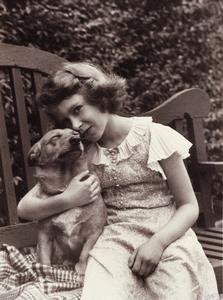
Princess Elizabeth, age 9 or 10, comforts her corgi Dookie, 1936

Princess Elizabeth, age 9 or 10, comforts her corgi Dookie, 1936

This wasn’t the first time Fagan had broken into the Palace. Only the month before, he’d had a practice run. He’d entered through an unlocked window on the roof and wandered about for a half hour. He viewed the royal portraits and rested on the thrones before entering the Postroom, where he drank half a bottle of California white wine before leaving.

On this, his second, visit to the Palace, Fagan was on a mission. He had to find the Queen. He wandered the corridors in search of her, and, on the way, cutting his hand on a glass ashtray. When he spied some dog dishes on the floor, he knew the Queen was near. She was never far from her precious dogs (See previous post, “Queen Elizabeth’s Corgis and Dorgis.”) He passed a housemaid who said, “Good morning,” then entered the Queen’s bedroom.

The Queen awoke to find a strange man sitting on the edge of her bed, cradling a broken ashtray and dripping blood on her bed linens. She kept calm and picked up the phone, asking the operator to summon the police. The operator did call the police but they didn’t come. She pushed the button for a chambermaid yet no one appeared. The armed guard regularly stationed at the Queen’s bedroom door was not at his post; he had taken her dogs out for a walk. Meanwhile, Fagan talked away, still sitting on her bed. He wanted to talk about love but the Queen didn’t. He thought it a coincidence that both he and the Queen had four children. Fagan wanted a cigarette. Again, the Queen called the palace switchboard yet no one responded.

After the Queen had spent ten minutes with the mentally disturbed, bleeding intruder, a chambermaid entered the Queen’s quarters and exclaimed, “Bloody hell, ma’am! What’s he doing in there?” The chambermaid then ran out and woke up a footman who then seized the intruder. The police arrived twelve minutes after the Queen’s first call.

When the public learned of this incident, they were outraged at the lapse of security around their Queen. Prime Minister Margaret Thatcher personally apologized to the Queen and measures were immediately taken to strengthen palace security.

Nevertheless, a 1999 report by the Royal Protection Squad stated that, in the six years previous, at least 6,000 mentally-ill persons had visited British royal residences or written to the royal family. Most of the mentally-disturbed people are harmless, the report stated, but the police guarding royalty are still trained to handle the few intruders who do indeed pose a danger. 

A man protests at Buckingham Palace, insisting upon his right to appear in public naked

A man protests at Buckingham Palace, insisting upon his right to appear in public naked

Over the years, the Royals have attracted unwanted attention from, among others, a group of lesbian anti-nuclear demonstrators who scaled the walls with ladders, and an American paraglider who landed on the roof as a stunt.


(1) Erickson, Carolly. Lilibet: An Intimate Portrait of Elizabeth II. (New York: St. Martin’s, 2004)


For more on Queen Elizabeth II, look in the left column under “Categories – People – Queen Elizabeth II.” I’ve written many posts on the Queen; I hope you enjoy them!

For more on Insane Asylums, scroll to the very bottom of “Categories – The Insane Asylum.”

Read Full Post »

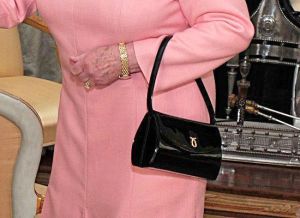
Queen Elizabeth's Launer handbag (4/1/09 Buckingham Palace with Obamas)

Queen Elizabeth's Launer handbag (4/1/09 Buckingham Palace with Obamas)

Since I’ve been blogging about Queen Elizabeth in general and her purse-carrying habit in particular, I’ve looked at a lot of of images of the Queen carrying purses. She seems to prefer small, unfussy black leather handbags, though she has carried a white purse before, I know. At first, the black leather handbags looked as if they could be just one bag. Closer inspection revealed slight differences in straps, patinas, and shapes. In all the bags I scrutinized, though, one theme was a constant. The clasp on the different bags was always the same. The clasp was distinctive  – covered with a gold rope emblem. The clasp looked like a string you tie on your finger to remember something. Was it a logo, perhaps? I sensed a designer lurking about.

 I was slow to catch on. Of course. The Queen doesn’t buy her purses off the rack at Macy’s; she has a royal pursemaker. That’s why the purses looked so similar. They were made by the same company.

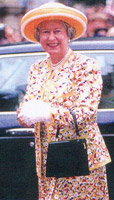
Queen Elizabeth in Jamestown (5/4/2007) with handbag

Queen Elizabeth in Jamestown (5/4/2007) with handbag

A little further digging for the name of the designer turned up a lot of information. Evidently, not only does Her Royal Highness have a royal pursemaker to make her purses – Launer’s of London – but also a royal milliner to make her hats and a royal dressmaker to make her dresses. Currently, three British royals, The Queen, her husband Prince Philip ( AKA the Duke of Edinburgh) and their son Prince Charles (AKA the Prince of Wales) may grant “Royal Warrants of Appointment” to tradespeople who supply goods or services to a royal court or certain royal personages. The warrant allows the supplier to advertise the fact that they supply to the royal family. The Royal Warrant does not mean that these specially-honored companies must then give the Royals their goods and services for free. Rather, suppliers both continue to charge their royal customers as well as reap incredible bonuses in the marketplace courtesy of the royal endorsement.

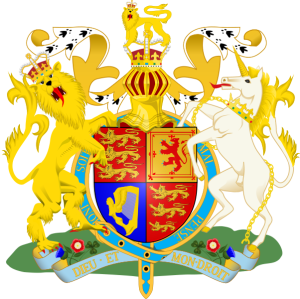
Her Royal Majesty Queen Elizabeth's coat-of-arms

Her Royal Majesty Queen Elizabeth's coat-of-arms

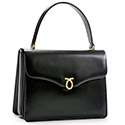
Launer's "Royale" handbag

Launer's "Royale" handbag

Launer of London holds the Royal Warrant for supplying the Queen with her leather goods and purses. On the “About Us” page on the Launer company website, the Queen’s coat-of-arms is displayed boldly at the top left and right of the page. Under the company’s history, we read that:

photo of Queen Elizabeth II on the Launer company website

photo of Queen Elizabeth II on the Launer company website

In 1991, Her Majesty the Queen visited the factory on 4th March, spending virtually the whole afternoon with all the employees and seeing all the various stages of making both handbags and personal leather goods. This was a great honour for the company, and in the following year Launer was also given the right to add leather goods to the warrant.

Read Full Post »

« Newer Posts - Older Posts »