Feeds:
Posts
Comments

Archive for the ‘British Royal Family/Nobles’ Category

My husband, Tom Rogers, and I at our wedding banquet. 1986

My husband, Tom Rogers, and I smile for the camera at our wedding banquet at Green Pastures, Austin, Texas. 1986

Me 1988

I wasn’t thrilled when I learned I had to have a Caesarean section, especially in view of the fact that my doctor had not discovered my baby was breeched until I was already dilated nine centimeters and after he had already given me a spinal block. I was 33, somewhat of a late mother, maybe even a reluctant mother. I was a terrible chicken where childbirth was concerned. I had not rushed into having a child. The fear of having to have a Caesarean kept me back. Now my baby was trying to come out through my back and I had no choice but to submit to the knife.

Not only did I have to have a Caesarean that day in July 1988, but, because of the spinal block, the doctor would not give me any more anesthesia, so I had to go into the operating room wide awake. In a little freak-out, I made the doctor erect a tent over my abdomen so I could not see what he was doing in the surgery. I guess I didn’t want to see them cut me.

My husband was there. He sat on a stool beside me and, with characteristic keen intent, watched the whole thing. What I remember most is the way it felt to have those masked people putting their hands into my stomach and digging around. I felt like a giant purse that they were digging around in, looking for a cigarette or something that had drifted to the bottom among tobacco and gum wrappers and dust. After a while, they must have found what they were looking for, because, after endless tugging and pushing and clawing, they reached deep down and pulled out a little baby, my little baby, my baby girl. She had a shriveled face that looked just like my mother-in-law’s.

“Helen!” I exclaimed, calling out my mother-in-law’s name.

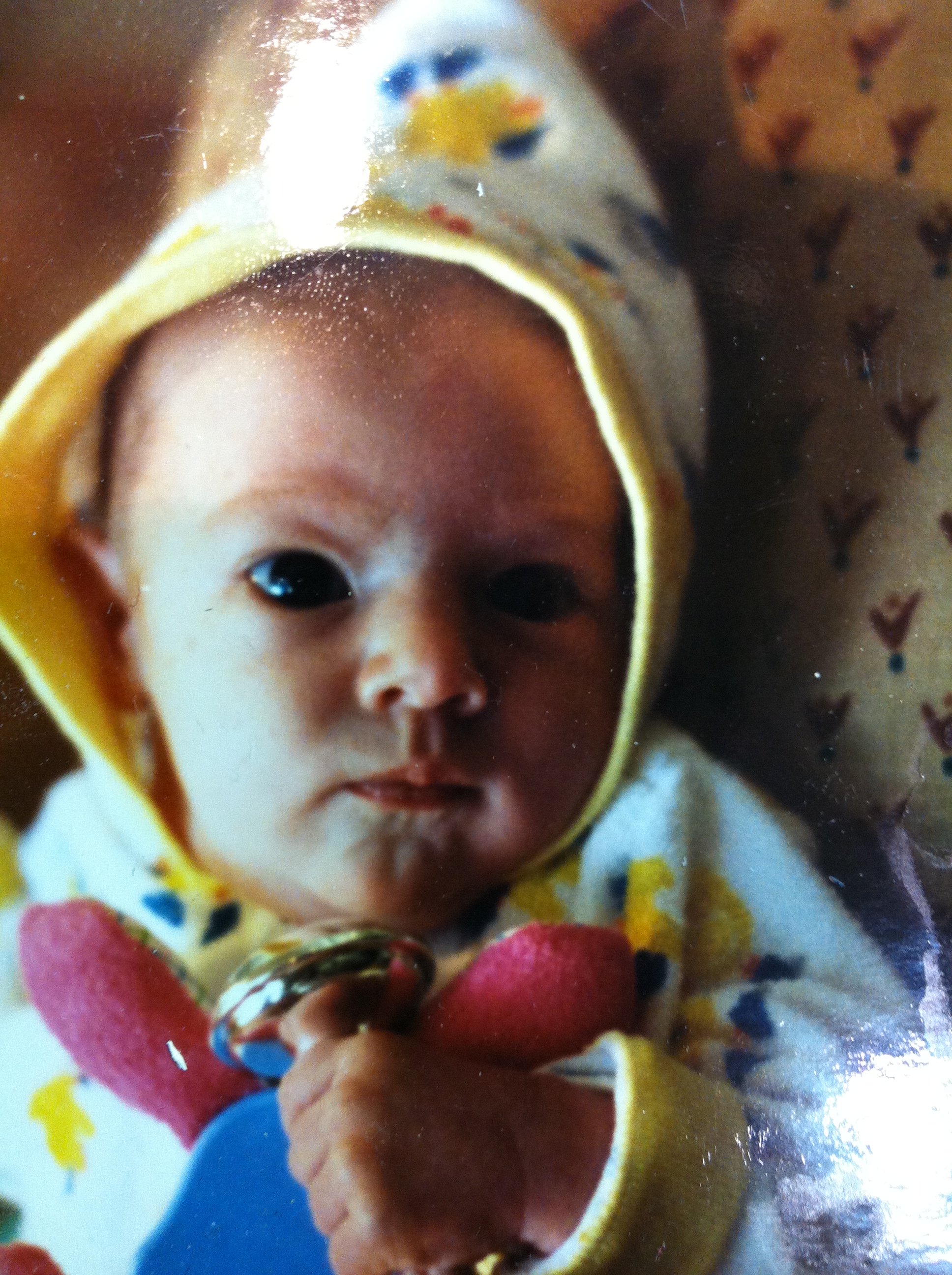
Katie Rogers at one month. 1988

Katie Rogers, born healthy, pictured at one month. 1988

If it had been 129 years earlier, in 1859, and not 1988, with modern medicine, there would not have been a Caesarean for me. My daughter Katie might have thrashed around inside of me until I bled to death and she suffocated.

“[A Caesarean] was long considered an extreme measure, performed only when the mother was already dead or considered to be beyond help. In Great Britain and Ireland, the mortality rate [in mothers] in 1865 was 85%.” (1)

Princess Vicky 1859

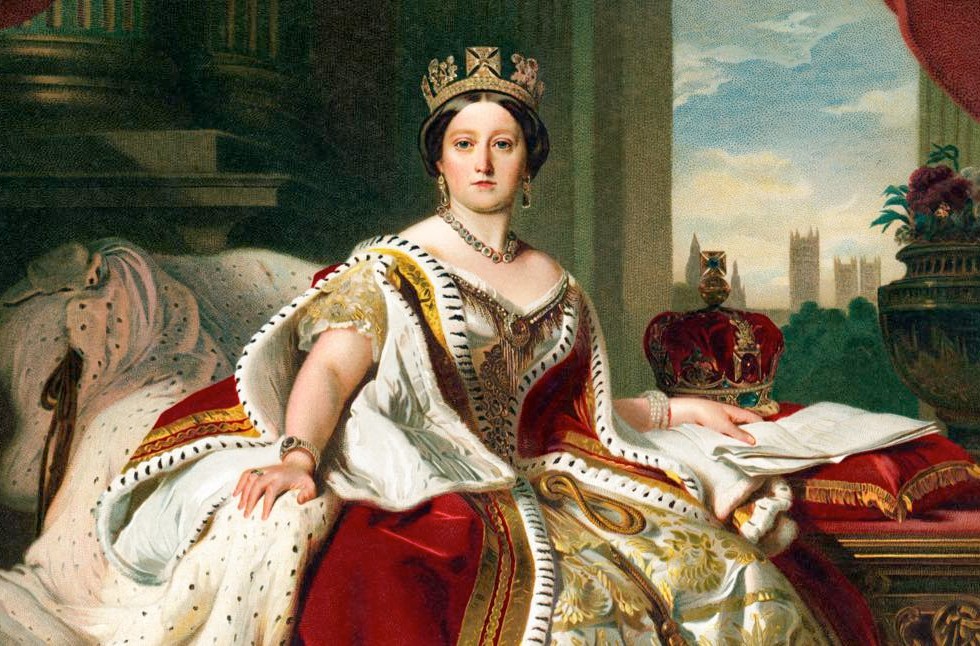
Queen Victoria of Great Britain (1819-1901) was sure that arranging marriages for her children and grandchildren in the royal houses of Europe would insure a lasting peace; after all, the countries would be tied by blood and relatives would never fight each other. Her first “power pairing” was the marriage of her eldest child, Victoria (“Vicky”), the Princess Royal, with Prince Frederick of Prussia, the cream of the German royal houses:

“As the royal couple departed London at the end of January [1858] during a heavy snowfall, the populace of that city still turned out onto the streets to cheer and chant, “God save the Prince and Bride! God keep their lands allied!”

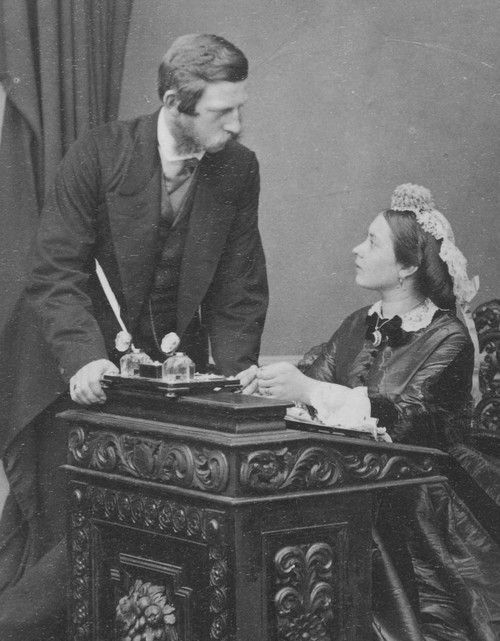
Frederick III of Prussia and his wife Princess Vicky. Undated photo, Ca early to mid1860s.

Frederick III of Prussia and his wife Princess Vicky. Undated photo, Ca early to mid1860s.

Twelve months later, Princess Vicky was in labor with her first child. Her mother had sent Scottish doctor Sir James Clark to Berlin to assist the German obstetrician Eduard Martin and, specifically, to administer to Vicky the “blessed chloroform,” the new miracle drug that the Queen had discovered and that had so eased the pain of her last two deliveries (children #8 and 9).

However, chloroform was not to be the solution for her daughter. For Vicky,

“The entire experience was ghastly….[D]espite the fact that she inhaled chloroform for hours on end, the birth was extremely painful….Dr. Martin had to work under her long flannel skirt so that royal decency prevailed.” (2)

The chloroform, “two-thirds of a bottle,” rendered Vicky insensible to help the doctors, who found themselves in a deadly position. The baby was coming out bottom first, in breech position, with its arms stretched over its head. The umbilical cord was being crushed by the head in the birth canal. The odds were stacked against a successful vaginal delivery: In that same year in Germany, 98% of breech births were stillborn. The doctors would not take a knife to a royal princess; besides, a Caesarean would have killed her. It would be another 40 years before that procedure would be performed in a clinic.

Dr. Martin reached into the birth canal and pulled the baby’s legs out. Then he reached deep inside to pull the left arm through and pull the body out by rotating it. The motion pulled the baby out but the “nerve complex in the neck was torn” and the baby suffered from fetal asphyxia. (3)
The baby lay motionless. The doctor’s report said that, “the baby was seemingly dead to a high degree.” Vicky was exhausted. It had been ten hours since her waters broke.

Then the baby cried.

“It’s alive and it’s a prince!” her mother-in-law wrote Queen Victoria.
The newborn boy was a royal prince and second in line to the Prussian throne. His name was Wilhelm, William in English, as he was half-English, half-German in blood.
Three days would pass before a nursemaid would mention that there was a mysterious crease between Wilhelm’s left shoulder and arm. The left arm was permanently paralyzed, caused by the pressure exerted on the shoulder during the delivery.

Treatment for Wilhelm

Vicky was devastated that her son, heir to the Prussian throne, should be handicapped. To be Prussian in 1859 was to be independent, manly, and warlike, not weak and crippled. Prussian men, like the statesman Otto von Bismarck, fought duels often with the intent to get slashed across the cheek (preferably the left one), get a clean-cut wound that gaped wide into a beautiful scar, rub salt into it to make it stand out, then boast how you got it.

An 1896 picture of a German Corpsstudent (Adolf Hoffmann-Heyden, 1877-1964), showing an extensive fresh fencing scar and some minor old ones, badges of honor at the time.

An 1896 picture of a German Corpsstudent (Adolf Hoffmann-Heyden, 1877-1964), showing an extensive fresh fencing scar and some minor old ones, badges of honor at the time.

“The idea of his remaining a cripple haunts me,” Vicky wrote Queen Victoria regarding Wilhelm.

Vicky was determined to fix Wilhelm’s left arm, to make it work, to make him fit to be a king, in the Prussian way. Of course, she and the doctors didn’t know that his arm was permanently maimed and useless and that nothing could be done to change that. The nerves were so damaged that the muscles didn’t work. At adulthood, his left arm would be six inches shorter than his right and his hand smaller. His left arm locked stiff at the elbow. The condition is known as Erb’s Palsy.

(Kaiser) Wilhelm II of Prussia and Germany and his grandmother, Queen Victoria of Great Britain. Note that Wilhelm's paralyzed left arm is hidden from sight. 1860s

(Kaiser) Wilhelm II of Prussia and Germany and his grandmother, Queen Victoria of Great Britain. Note that Wilhelm’s paralyzed left arm is hidden from sight. 1860s

In Germany in 1859, there was a lot of alternative medical experimentation. When Wilhelm was six months old, his doctors began applying an odd poultice to his left arm. In his presence, they slaughtered a live hare (big rabbit) and tied the flesh of the dead animal, still warm, to the baby’s left arm, hoping that the vitality of the animal would transfer to Wilhelm. This they did twice a week for years.

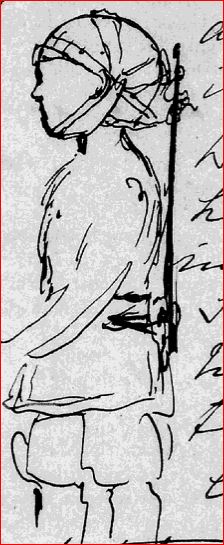
Later, they discovered that Wilhelm’s head was tilting, so they created “Wilhelm’s Machine,” as his mother called it: a barbaric, head stretching device that consisted of a metal rod run up his back, attached at the waist by a belt with a harness that strapped across his head. At the back of his head was a screw they tightened to stretch the head up straight.

The "head stretching machine" was used to correct Kaiser Wilhelm's torticollis: his head was pulled to one side by a birth defect. The drawing is by his mother, Princess Vicky of Prussia, in a letter sent to her mother Queen Victoria. 1860s

The “head stretching machine” was used to correct Kaiser Wilhelm’s torticollis: his head was pulled to one side by a birth defect. The drawing is by his mother, Princess Vicky of Prussia, in a letter sent to her mother Queen Victoria. 1860s

They galvanized his left arm periodically with electric jolts. They cut muscles in his neck. They applied stretching machines to his arm.

They tied his good arm behind him to try to force the left one to work. Of course it didn’t.

His mother made him ride a pony a lot. He would fall off because he had a poor sense of balance, maybe due to the ear infections he had frequently, or because of brain damage at birth.

While his mother’s intent was to prepare Wilhelm to be fit for the throne, these barbaric and medieval procedures had only served to traumatize and depress Wilhelm.

Kaiser Wilhelm II and his mother, Princess Vicky of Prussia. Ca. 1871.

Kaiser Wilhelm II and his mother, Princess Vicky of Prussia. Ca. 1871.

The camera had just been invented and photographs were the rage. The public wanted to see its future king. But Wilhelm’s disability was an embarrassment, something to hide. In photographs, props such as capes, swords, gloves, books, and guns were used to disguise the withered arm. Sometimes he held the left arm up with the right hand.

 Kaiser Wilhelm II, age 4, visits his beloved "Granny" (Queen Victoria) at her Scottish estate at Balmoral. Someone has costumed him carefully so as not to reveal his lame left arm. 1863.

Kaiser Wilhelm II, age 4, visits his beloved “Granny” (Queen Victoria) at her Scottish estate at Balmoral. Someone has costumed him carefully so as not to reveal his lame left arm. 1863.

By the age of 12, Vicky stopped trying to find a cure.As Vicky had more children, she showered her love on her new children, rejecting her damaged son. He suffered deeply. He became filled with rage and prone to violent tantrums.

Kaiser Wilhelm on his 10th birthday, 1869. The gloves are used in an attempt to make his left arm look longer. After seeing the print, it was ordered destroyed but one coy remained.

Kaiser Wilhelm on his 10th birthday, 1869. The gloves are used in an attempt to make his left arm look longer. After seeing the print, it was ordered destroyed but one copy remained.

Wilhelm began to hate the English. His mother was English. An English doctor had crippled him. As he grew up, he would become more and more Prussianized. He would reject the liberal democratic principles favored by his parents and fall under the influence of his German tutor and Otto von Bismarck in favor of aggressive, autocratic rule finding power in military force.

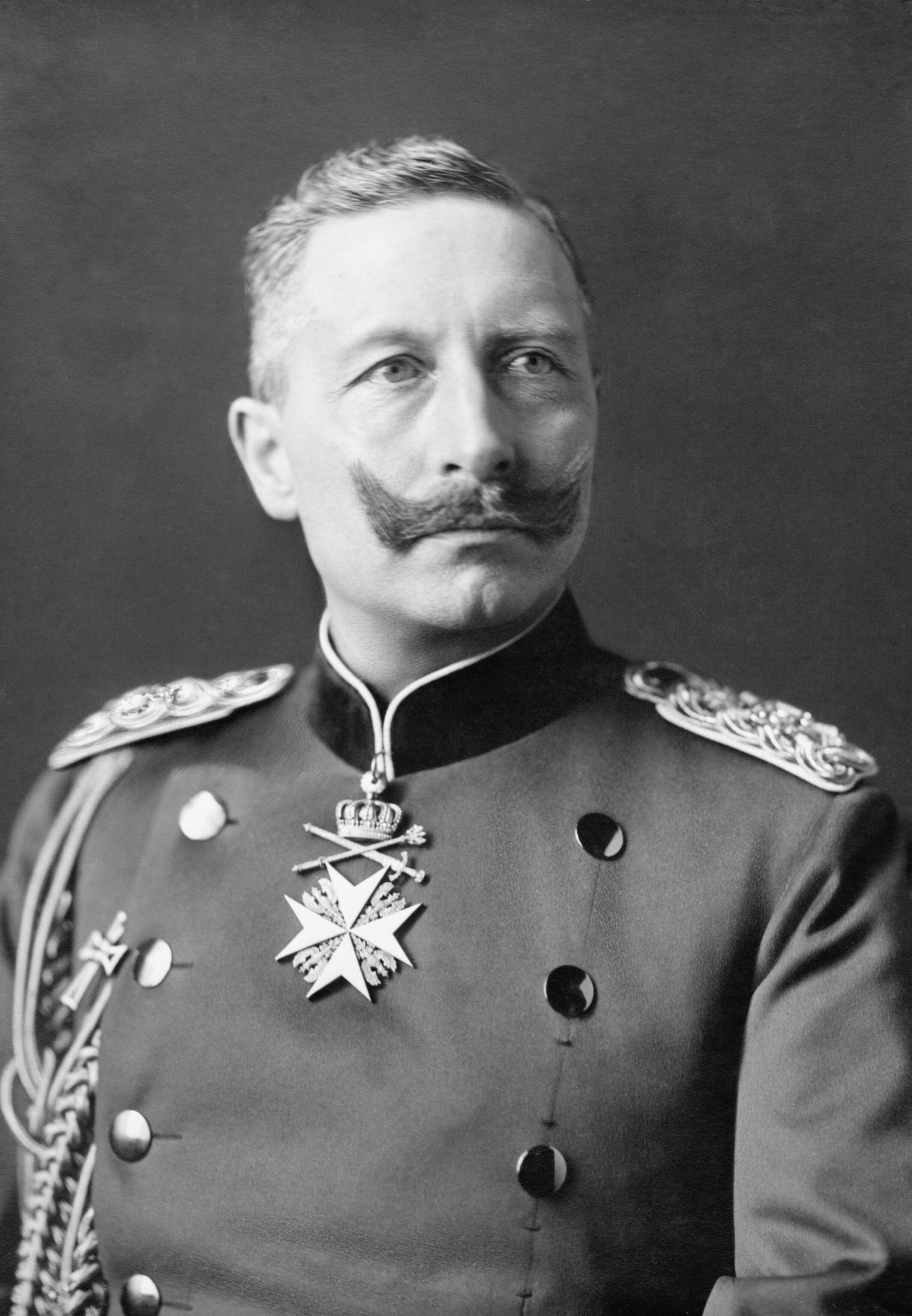
Kaiser Wilhelm II of Germany and Prussia, 1902

Kaiser Wilhelm II of Germany and Prussia, 1902

In 1914, he would have his revenge on his mother and England because, by then, he would be the world leader, Kaiser (Emperor, King) Wilhelm II of Prussia and Germany (1859-1941), whose bellicose (bellicose: demonstrating aggression and willingness to fight) policies would help to bring about World War I.  Three royal cousins –  the leaders of Russia, England, and Germany – would be at terrible war with one another.

Queen Victoria, called “the Grandmother of Europe,” had not lived to see her matchmaking plan to unite Europe through royal marriages fall far afield of its mark. Tens of millions of people would die because of Kaiser Wilhelm and Europe would be devastated. Relatives, history has shown, do fight against one another.

(1) wiki: Caesarean Delivery

(2) Rohl, John. The Kaiser and His Court: Wilhelm II and the Government of Germany. Cambridge: Cambridge University Press, 1997 .

(3) Rohl, John. Kaiser Wilhelm: A Concise Life. Cambridge: Cambridge University Press, 2014.


Read Full Post »

Elizabeth Taylor, age 44, the year she married John Warner. April 1976. Photo: Henry Wynberg

Elizabeth Taylor, age 44, the year she married John Warner. April 1976. Photo: Henry Wynberg

Elizabeth Taylor (1932-2011) was willing to do almost anything to get her seventh husband, Virginia lawyer John Warner, elected to the U.S. Senate in 1978.  To woo voters and the Republican Party leaders, Elizabeth had to prove to be an asset to the campaign. She had to make the transformation from movie queen to political wife. (Readers: For how they got together, read the previous post.)

During their brief courtship, Warner was given cause to worry that she could not make the leap. He recalled inviting Elizabeth to lunch with him in Washington, D.C.. Looking forward to showing her off, he was embarrassed when she appeared at the Bicentennial office (where he was director)

wearing a flowing black silk pajama outfit with a low-cut neckline.” (1)

Then there were her showy jewels, for example, an “eye-popping necklace of…egg-sized canary diamonds and amethysts as big as her fist.” Elizabeth promised her husband she would dress down, cutting down on the diamonds and the décolletage, opulence that would not go over big with plain Southern Virginia folk.

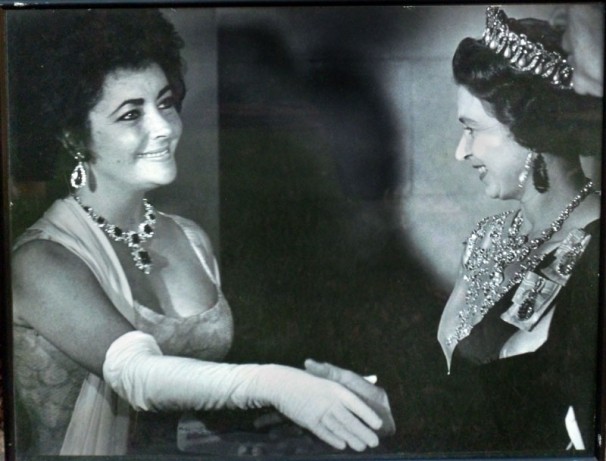
At a British Embassy reception, Queen Elizabeth II of England gets a look at Elizabeth Taylor's famous jewels: the Bulgari Vladimir Suite of emeralds and diamonds from her soon-to-be-ex-husband, Richard Burton. July 1976

At a British Embassy reception, Queen Elizabeth II of England gets a look at Elizabeth Taylor’s famous jewels: the Bulgari Grand Duchess Vladimir Suite of emeralds and diamonds from her soon-to-be-ex-husband, Richard Burton. July 1976

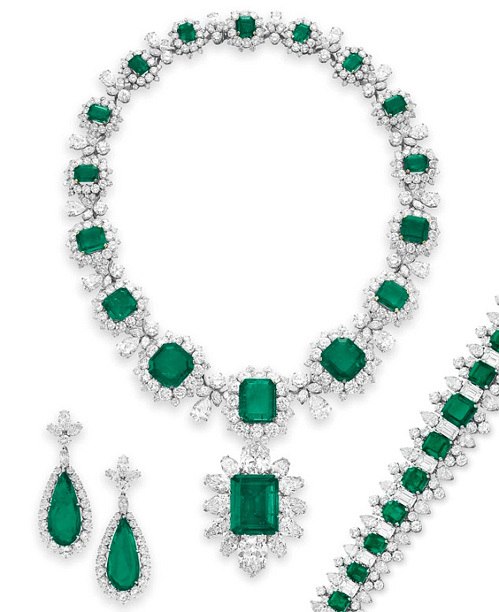
The Grand Duchess Vladimir Suite of emeralds and diamonds, once part of the Elizabeth Taylor Collection

The Grand Duchess Vladimir Suite of emeralds and diamonds, once part of the Elizabeth Taylor Collection

Besides sacrificing her fashion sense, Elizabeth would set her career aside during this period, appearing in only a handful of films and, then, mostly in cameo roles, requiring only a short stint away from the campaign.

Elizabeth Taylor, age 44, wears her signature color, purple, to match her violet eyes. 1977

Elizabeth Taylor, age 44, wears her signature color, purple, to match her violet eyes. 1977

Then there were her friends of the moment, the hard-partying, cocaine-sniffing crowd of the notorious New York disco Studio 54: Liza Minnelli, fashion designer Halston, Andy Warhol, Bianca Jagger. Warner steered her away from hanging out with them at the club (although she did install a discotheque at the farm for entertaining them).

Elizabeth Taylor dances with her fashion designer friend Halston at Studio 54. Note that Elizabeth wears a purple pantsuit. Feb. 1978

Elizabeth Taylor dances with her fashion designer friend Halston at Studio 54. Note that Elizabeth wears a purple pantsuit. Feb. 1978

Self-restraint, too, was called into play, if Elizabeth was going to help Warner hit a home run, for Elizabeth was a hot-blooded woman, prone to hard-drinking, cursing, and screaming at photographers trying to shoot her from uncomplimentary angles.

In January, 1977, weeks after returning from honeymooning in Switzerland, Elizabeth and John hit the campaign trail with an appearance at the Hearts of Gold Ball in Richmond, which they reached by Greyhound bus. From here on out, for Elizabeth, it would be a 23-month slog of kissing babies, speechifying, ribbon-cutting, riding in parades, chairing galas, raising funds, eating corn-on-the cob at county fairs, signing autographs, hurling cream pies, and pinning Warner buttons on Democrats. If a college campus had a drama department, she held a seminar for the students and allowed friendly question and answer sessions, unscripted, with no retakes, to which she was accustomed on a movie set. Toward the end of the race, she and Warner put in 12-15 hour days, riding in planes, buses, cars, and trains to reach their destinations.

John Warner and Elizabeth Taylor in her favorite purple pantsuit by Halston. 1977

John Warner and Elizabeth Taylor in her favorite purple pantsuit by Halston. 1977

Large, enthusiastic crowds turned out to see Elizabeth, accessible to them, no longer protected by bodyguards, as  in her movie stardom days. She shook so many hands that, one day, two blood vessels broke in her hand. That did not slow her down. She continued to shake hands, though her hand was swollen and protected by an elastic bandage. Elizabeth’s bursitis flared up in her shoulder from such rigorous handshaking. She received cortisone injections to help with the pain. Sometimes she campaigned in a wheelchair. But she kept going. She did it because

‘They come to see my wrinkles and pimples, and I don’t disappoint them, do I?’ she laughed. ‘This face has been around a lot of years. People want to see if my eyes really are violet or bloodshot or both. Once they check me out, they can go home and say, ‘I saw Liz Taylor and you know what? She ain’t so hot!'” (1)

At almost every campaign stop, Elizabeth Taylor look-alikes would show up, in big wigs and evening gowns.

Unfortunately, a lot of the people who showed up at rallies came to see if Elizabeth was as obese as it was being reported in the press. The strain of the campaign was beginning to take its toll on her. Her weight had ballooned and she was drinking booze in excess and eating way too much. Joan Rivers was regularly lampooning her with fat jokes on  “The Tonight Show“:

Every time Liz Taylor goes into McDonald’s, the numbers on the sign outside start changing. When she looks up and see five billion, she thinks it’s her weight.”

John Warner and Elizabeth Taylor, ca. 1978

John Warner and Elizabeth Taylor, ca. 1978

Elizabeth was affected by such cruel commentary. Nevertheless, she continued eating and drinking herself into oblivion. Dinner guests reported seeing her eat, in one sitting, mounds of mashed potatoes drowned in gravy, followed by five rich desserts and countless bottles of champagne. (2) In her defense, she remarked:

‘I am not a monument that pigeons can doo-doo on. I am a living human being, and if I want to eat fried chicken six times a day and can still function, that’s up to me!'” (1)

Elizabeth Taylor and John Warner campaign for the U.S. Senate seat. June 2, 1978

In August, 1978, John Warner became the Republic nominee for the U.S. Senate seat from Virginia, when the original nominee was suddenly killed.

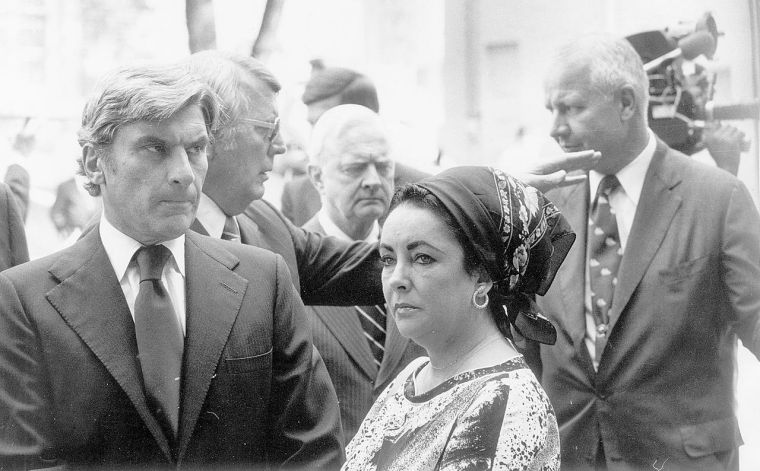
John Warner became the Republican nominee for the 1978 U.S. Senate race by a strange circumstance. Richard Obenshain was the nominee but he died in a plane crash. John Warner and wife Elizabeth Taylor are shown here at Obenshain's funeral. Aug. 5, 1978. Photo: Don Long, Richmond Times Dispatch

John Warner became the Republican nominee for the 1978 U.S. Senate race by a strange circumstance. Richard Obenshain was the nominee but he died in a plane crash. John Warner and wife Elizabeth Taylor are shown here at Obenshain’s funeral. Aug. 5, 1978. Photo: Don Long, Richmond Times Dispatch

The general election was on November 7; there were three months to go. The strain of the long and grueling campaign trail was apparent in both of them; tempers frayed and Elizabeth kept eating, eating, and then eating some more. Some campaign leaders worried that Elizabeth’s star appeal was overshadowing the candidate. They considered removing her from the campaign.

On October 12, 1978, three weeks before the election, Elizabeth was to suffer one of the many freak accidents for which she was known. She appeared at a rally at Big Stone Gap, Virginia. The whole countryside was in a dither to see her.

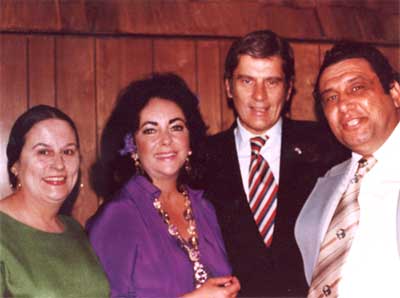
Elizabeth Taylor wore her purple silk Halston pantsuit accessorized with a sumptuous gold necklace studded with amethyst stones the size of cookies and matching drop earrings encrusted with pearls. She had tucked a small bouquet of fresh violets behind one ear. She posed for photo after photo with a smile that was genuine.

Elizabeth Taylor and John Warner, center, pose at a campaign rally in Big Stone Gap, Virginia. Oct. 12, 1978

Elizabeth Taylor and John Warner, center, pose at a campaign rally in Big Stone Gap, Virginia. Oct. 12, 1978. Note the purple Halston pantsuit Elizabeth is wearing.

Later that evening, John and Elizabeth stopped for a chicken dinner at Fraley’s Coach House, where Elizabeth took a bite of a fried chicken breast and accidentally swallowed a two-and-a-half inch bone. The bone lodged in her throat. She clutched her neck, barely able to breathe. She tried to cough it up, but in vain. She stuffed some rolls into her mouth to try to push the bone down her throat but it didn’t work. It was clear that she was choking to death. (3) She was rushed to Lonesome Pine Hospital, where a thoracic surgeon inserted a rubber hose down her throat and stuffed the bone down where it dissolved in digestion. She was overnight in the hospital. The next day, she made the headlines:

‘ACTRESS NEARLY CHOKES AT CAMPAIGN RALLY,’ screamed The Washington Star.

Elizabeth Taylor is assisted by her husband, John Warner (r.) as she returns from a hospital stay in Richmond, Va. Oct. 13, 1978

Elizabeth Taylor is assisted from an airplane by her husband, John Warner (r.) as she returns from a hospital stay in Richmond, Va. Oct. 13, 1978

Strangely, it was about this time that a delegation of women who ran the Warner campaign chose to approach Elizabeth and inform her that she could no longer wear purple to John’s rallies. Everyone knows that purple was her signature color. Her legendary eyes were violet. In a 1997 interview with Kevin Sessums, Elizabeth recalled:

‘If the woman is the politician, then it might be quite different. But if you’re wedded to the politician, it’s like your lips are sealed. You are a robot. They even tell you what you can wear. You can imagine how that sat with me! I was told that I—me!—was not allowed to wear purple because it smacked of royalty.’ 

She told Harper’s Bazaar:

‘The Republican women told me, ‘You simply cannot wear the purple pantsuit you’ve been campaigning in anymore.’ I ended up in a tweed suit. Me. Little tweed suits. What I won’t do for love.'”

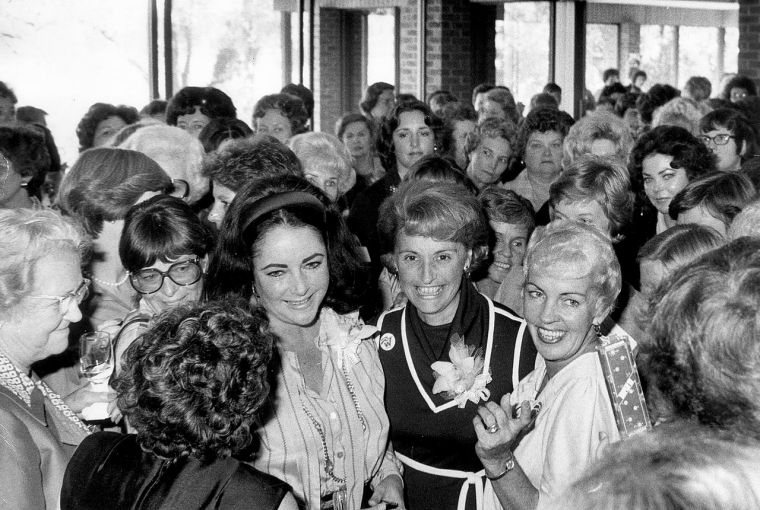
Twelve days before the U.S. Senate election,Republican women crowd around Elizabeth Taylor Warner at the Meadowbrook Country Club, Richmond. Va.  Oct. 26, 1978.

Twelve days before the U.S. Senate election,Republican women crowd around Elizabeth Taylor Warner at the Meadowbrook Country Club, Richmond. Va. Oct. 26, 1978.

On November 7, John Warner squeaked to victory. Out of 1.2 million votes, he was elected to the U.S. Senate from Virginia by only 4,271 votes.  He could not have done it without Elizabeth. Some say that the chicken bone incident moved the public to sympathy for her, swinging the vote in Warner’s favor. Elizabeth joked later

‘I seem to have at least 4, 271 fans in Virginia, so at least I know I pulled my own weight!'” (2)

After the election, the Republican women threw Elizabeth a luncheon in her honor, for all she had done in the campaign. In her Kevin Sessums interview, Elizabeth said she

…put on my purplest Halston pantsuit. I told them the story that the women who ran John Warner’s campaign had forbid me to wear purple. I got up and pointed out one specific woman. I said, ‘That one! Right there!'”

The subjugation of her own ego to John’s for two full years damaged Elizabeth’s self-esteem. There were few movie roles for an aging beauty, especially a puffy one. Elizabeth Taylor, movie star, had lost her self-identity.

John and Elizabeth moved to Washington, D.C., where, on January 16, 1979 in the gallery of the U.S. Senate, John was sworn in with Elizabeth and her mother in attendance. Things looked rosy for the couple at that moment. John and Elizabeth threw each other big Hollywood kisses, but John immediately became consumed by his new job, declaring he would never miss a roll call. Elizabeth was left alone for long stretches of time in their Washington home or Virginia farmhouse, consoling herself with massive quantities of Jack Daniels and chili dogs. She resorted to trips to New York to hang out at Studio 54. Elizabeth liked to have a man around and John wasn’t there for her. Whereas John may have loved Elizabeth, he loved work more.

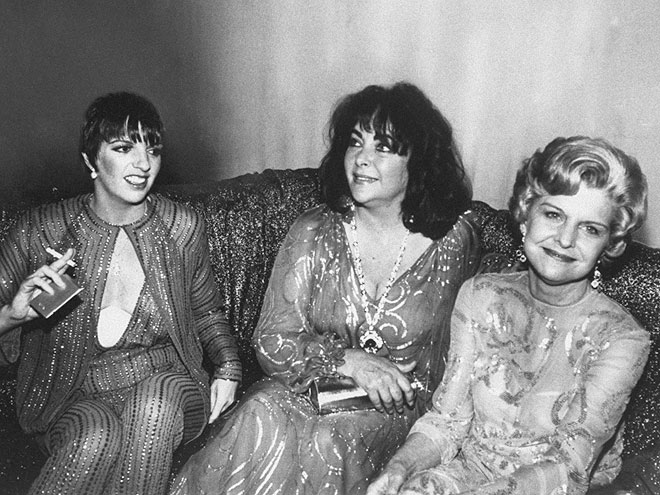
Elizabeth Taylor, center, hangs out at Studio 54 with singer Liza Minnelli (l.) and First Lady Betty Ford (r.). 1979

Elizabeth Taylor, center, hangs out at Studio 54 with singer Liza Minnelli (l.) and First Lady Betty Ford (r.). 1979

Elizabeth had married John Warner in the hopes that he would give her the roots (and a private life) that she had longed for so much in her hurried life. Instead, she had spent the first two years of their marriage on the campaign trail and in the public eye more than before, if that is possible. Her life was more stressful than ever. As a star, she was used to crushingly cruel movie reviews but nothing could have been as brutal as the punishing ridicule she had received from the media for her weight gain.

Though these years were painful for Elizabeth – she and John Warner would divorce after six years of marriage – her worsening addiction to alcohol, pain pills and food would put her feet firmly on a path that led, in 1983, to a life-changing stay at the Betty Ford Clinic. A new Elizabeth Taylor would emerge from the famous rehab: a savvy and respected politician who would use her high profile celebrity to raise mega millions to combat the deadly disease, AIDS, by creating AMFAR.

Elizabeth Taylor, age 55, looking healthy and trim. 1987

Elizabeth Taylor, age 55, looking healthy and trim. 1987

(1) Kelley, Kitty. Elizabeth Taylor: The Last Star. New York: Simon & Schuster, 1981.

(2) Heymann, C. David. Liz: An Intimate Portrait of Elizabeth Taylor. New York; Simon & Schuster, 1995.

(3) Taraborrelli, J. Randy. Elizabeth. New York: Grand Central Publishing, 2006.

Readers: For more on Elizabeth Taylor, click here.

Read Full Post »

In the early morning hours of August 6, 1922, crime novelist Agatha Christie and her husband, Archie Christie, sailed into Honolulu, Hawaii, on the Makura and hailed a taxi.

On their drive to the Moana Hotel, they passed between palm trees and hedges of hibiscus, red, pink, and white oleanders, and blue plumbago. At their hotel, the sea washed right up to the courtyard steps on Waikiki Beach.

They checked into their rooms. From their window, they saw surfers catching waves to shore. They hurriedly changed into their swimsuits to rush down, hire surfboards, and plunge into the sea.

Surfers at Waikiki Beach, Honolulu. Aug./Sept. 1922. Photograph by Agatha Christie

Surfers at Waikiki Beach, Honolulu. Aug./Sept. 1922. Photograph from Christie Archive

brit emp exh 1924 stamppThey had been looking forward to that moment since leaving England eight months earlier. In the interim, the Christies had traveled three-quarters around the world as part of a government trade mission to drum up interest in the 1924 British Empire Exhibition. Their travels had taken them from England to South Africa (where they were introduced to surfing), Australia, and New Zealand. They now had a month-long holiday in Hawaii – all to themselves – before they would rejoin the mission in Canada.

Surfing was much different in Hawaii than it had been in South Africa. The most obvious difference was the surfboard. In South Africa, the boards were short, curved, and made of light and thin wood.

Agatha Christie and a young naval attaché named Ashby stand on Muizenberg Beach, South Africa, following surf bathing, Jan.-March 1922

Agatha Christie and a young naval attaché named Ashby stand on Muizenberg Beach, South Africa, following surf bathing, Jan.-March 1922. Photograph from the Christie Archive

In Hawaii, however, they were great slabs of wood, ridiculously long and even more ridiculously heavy, made even heavier by the fact that, to find a decent wave to catch, a person had to paddle the board a long, long way out from shore to a reef where the waves broke.

Agatha Christie with her Hawaiian surfboard. Aug./Sept. 1922

Agatha Christie with her Hawaiian surfboard. Aug./Sept. 1922. Photograph from the Christie Archive

In South Africa, the waves broke close to shore and were gentle.

Modern day surfing in Muizenberg, South Africa

Modern day surfing in Muizenberg, South Africa

Then there was the matter of what to do when you caught the right wave. In South Africa, surfers rode the wave on their stomachs. In Hawaii, they rode it standing up.

Spotting the right wave to catch was tricky. Agatha recalls:

First you have to recognize the proper wave when it comes, and, secondly, even more important, you have to know the wrong wave when it comes, because if that catches you and forces you down to the bottom, heaven help you….”

On that first day, Agatha indeed caught “the wrong wave.” She and her board were separated and she was forced far underwater. She swallowed “quarts of salt water” and arrived on the surface gasping for breath. A young American retrieved her board for her, saying:

‘Say, sister, if I were you, I wouldn’t come out surfing  today. You take a nasty chance if you do. You take this board and get right into shore now.'”

She took his advice and, in time, Archie joined her. They were bruised, scratched, exhausted, but not defeated. Agatha was determined to become expert at surfing.

The second time she went in the water, the waves tore her long, silk bathing dress off her body. She covered herself and went into the hotel gift shop where she bought a “wonderful, skimpy, emerald green wool bathing dress, which was the joy of my life, and in which I thought I looked remarkably well. Archie thought I did, too.”

Agatha Christie, sunburned and relaxed. Waikiki Beach, Honolulu, Aug./Sept. 1922. Photograph from Agatha Christie Collection

Agatha Christie, sunburned and relaxed. Waikiki Beach, Honolulu, Aug./Sept. 1922. Photograph from the Christie Archive

In a few days, they moved to a more economical chalet across the road. They spent all their time on the beach or in town drinking ice cream sodas and buying medicines for sunburn. They learned to wear shirts on the beach as their backs were covered with blisters from sunburn.

Their feet were cut to ribbons from the coral so they bought leather boots to wear in the water.

After ten days, Agatha’s skills on a surfboard were improving. After

starting my run, I would hoist myself carefully to my knees on the board, and then endeavor to stand up. The first six times, I came to grief….[but] Oh, the moment of complete triumph on the day that I kept my balance and came right into shore standing upright on my board!”

Because of such vigorous paddling, Agatha developed a strain in her left arm. The pain was excrutiating and would wake her in the early morning hours. Nevertheless, Agatha continued to surf because there was

Nothing like it. Nothing like that rushing through the water at what seems to you a speed of about two hundred miles an hour….until you arrived, gently slowing down, on the beach, and foundered among the soft, flowing waves.”

Researcher Peter Robinson from the Museum of British Surfing says that Agatha Christie is probably one of the first British “stand-up surfers,” along with Edward, the Prince of Wales, who also surfed in Waikiki in 1920 and went on to become King Edward VIII of England for a year. Not to be outdone, let me remind my readers that Agatha Christie is literary royalty, being revered as the Queen of Crime. In 1971, she was made a Dame of the British Empire by Queen Elizabeth II at Buckingham Palace.

For more on Agatha Christie, click here.

Source: Christie, Agatha. The Grand Tour: Around the World with the Queen of Mystery. United Kingdom: HarperCollins Publishers, 2012

Read Full Post »

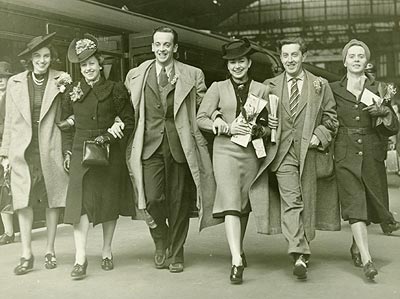
Members of the Sadler's Wells Ballet Company leave Victoria Station, London, for a tour of Holland, May 1940

Members of the Sadler’s Wells Ballet Company leave Victoria Station, London, for a tour of Holland, May 1940. Director Ninette de Valois is on the far right.

When the Germans invaded Holland on May 10, 1940, Ninette de Valois found herself trapped in The Hague. She was the director of the Sadler’s Wells Ballet Company from England. She and her 42 dancers had been on a Dutch tour. On the day of the invasion, de Valois had been sitting at a sidewalk café with two members of the dance company. It was noon. Suddenly, a stray bullet ricocheted from the pavement, passed between their heads, and crashed through the café’s plate glass window behind them. The bullet had been fired from a German plane swooping over the city square. The diners were rushed inside to safety.

That morning, some of the dancers had flocked to the rooftop of their hotel to watch German parachutists float down and land in the area around the Hague, where Queen Wilhelmina resided.  Thousands of leaflets also fluttered down from the enemy aircraft, some landing on the rooftop, that proclaimed:

Strong German troop units have surrounded the city. Resistance is of no use. Germany does not fight your country but Great Britain. In order to continue this battle the German Army has been forced to penetrate your country. The German Army protects the life and goods of every peace-loving citizen. However, the German troops will punish every deed of violence committed by the population with a death sentence.” 1

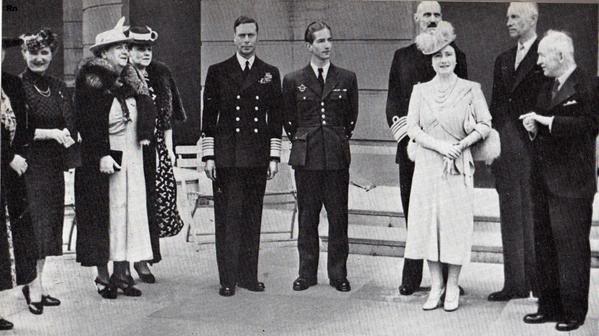
For five days, the Dutch army fought bravely, but it was no match for the German war machine. The Netherlands had a policy of neutrality and had had no recent experience of resisting outside invading forces. Queen Wilhelmina and the Dutch Royal Family from the Royal House of Orange-Nassau refused to accept the Nazi offer of protection and sailed to England on the HMS Hereford sent by King George VI.

The Exiled Royals with the King and Queen of England, WWII (photo undated). From left to right: Queen Marie of Yugoslavia,Miss Benesj,Queen Wilhelmina of the Netherlands,Miss Raczkiewicz,King George VI of England,King Peter of Yugoslavia,King Haakon of Norway, Queen Elizabeth (The Queen mother) of England, the President of Poland, M. Raczkiewicz and Dr. Benesj, President of Tsjecho- Slovakia.

The Exiled Royals with the King and Queen of England, WWII (photo undated). From left to right: Queen Marie of Yugoslavia,Miss Benesj,Queen Wilhelmina of the Netherlands,Miss Raczkiewicz,King George VI of England,King Peter of Yugoslavia,King Haakon of Norway, Queen Elizabeth (The Queen mother) of England, the President of Poland, M. Raczkiewicz and Dr. Benesj, President of Tsjecho- Slovakia.

The Netherlands surrendered on May 15.

For the next seven weeks, the citizens of Holland did not resist the German occupation. They buried their dead and mourned their losses. They were shocked and demoralized. They felt abandoned by their queen.

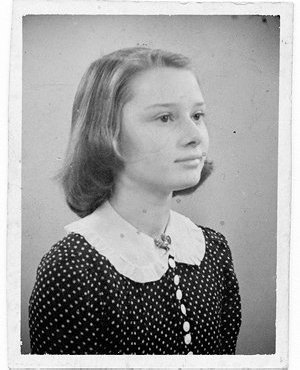
Audrey Hepburn-Ruston, ca. 1941 (age 12)

Audrey Hepburn-Ruston, ca. 1941 (age 12)

Audrey Hepburn was eleven years old when the Germans took over her town of Arnhem, Holland:

“The first few months we didn’t quite know what had happened.”

But Queen Wilhelmina reached out to her subjects across the North Sea via newsreels and BBC radio broadcasts, revitalizing Dutch hope for Allied liberation, and condemning German aggression. She urged them to resist the moffen (German Huns). For the next five years, the radio voice of the Queen would be the main source of inspiration for the Dutch Resistance Movement.

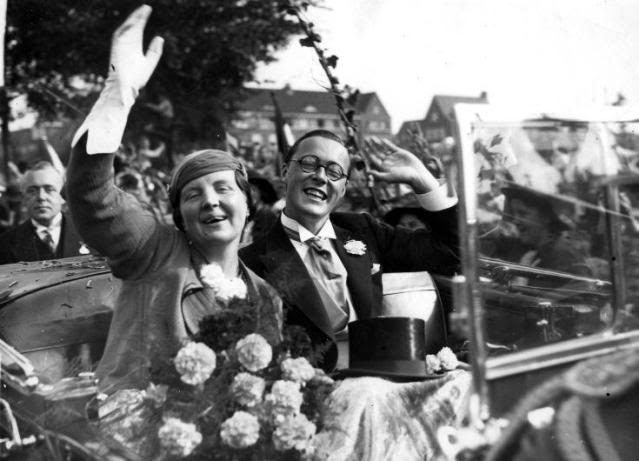
Princess Juliana and Prince Bernhard celebrate their engagement 1936. Note the white carnation in the Prince's lapel.

Princess Juliana and Prince Bernhard celebrate their engagement 1936. Note the white carnation in the Prince’s lapel.

An opportunity for the Dutch citizens to protest the German occupation arrived on June 29. It was the birthday of Prince Bernhard, the Queen’s son-in-law. Since he had been a student, the Prince had worn a trademark white carnation in his lapel.

So, on June 29, the Dutch people demonstrated their loyalty to Queen and country and their defiance of Nazi rule. People participated all across the country, but the activity was strongest in Amsterdam and The Hague.

People displayed vases full of carnations in the windows of homes and stores. Women and girls wore orange skirts, orange being the national color, symbolic of the Royal House of Orange. The Dutch flag was flown. Men pinned white carnations in the buttonhole of their coats, in imitation of Prince Bernhard, a German who was anti-Nazi.  Some people rode bicycles around town all dressed in orange.

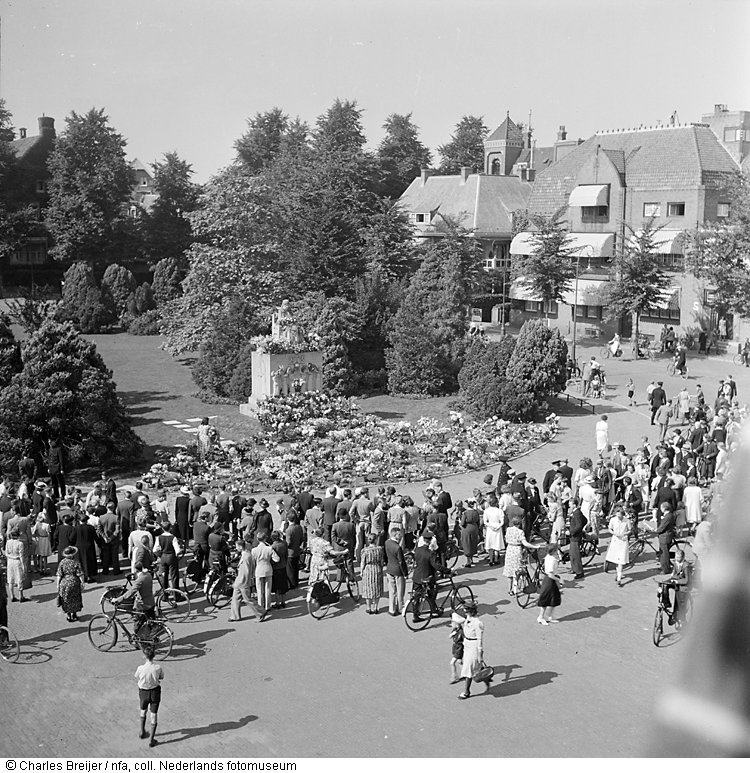
Crowds gathered at the statue of Queen Emma, Wilhelmina’s mother, in Amsterdam to lay flowers.

The Queen Emma monument is festooned with flowers on Carnation Day, 1940

The Queen Emma monument is festooned with flowers on Carnation Day, 1940

At first, only single flowers were placed on the statue’s lap. Then others arrived carrying great pots of flowers. Soon the area at the base of the statue was covered in flowers. On the nearby lawn, the letter B was formed with a clever flower arrangement. People brought cut-out pictures of the royal family and laid these beside the flowers.

A street organ began to play the national anthem. Softly at first, people began to sing. Shortly, though, more people lifted their voices in patriotic song. Emotion was running high.

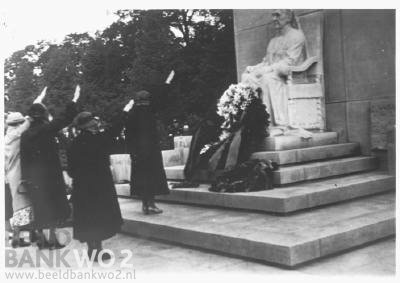
Men belonging to the WA, the military arm of the Dutch Nazi organization (NSB), shoved into crowds and started fights. The WA goons wore black shirts. Many people were injured.

NSB members (Dutch Nazis or collaborators) show up at a statue of Queen Emma on Carnation Day, giving the straight arm salute.

NSB members (Dutch Nazis or collaborators) show up at a statue of Queen Emma on Carnation Day, giving the straight arm salute.

People gathered at the Queen’s residence in the Hague, the Noordeinde Palace, to lay flowers on the balcony and to sign the birthday register.  The German commander of the Wehrmacht feared a riot. He ordered German fighter planes to fly above the city, diving now and then, but not to shoot, to get the crowd to disperse.

This day became known as Anjerdag, “Carnation Day.”

German propaganda minister Joseph Goebbels is shown at the entrance to Queen Wilhelmina's residence, the Noordeinde Palace in The Hague on Carnation Day. The nonviolent protest demonstration by the Dutch citizens greatly alarmed their German occupiers. Hitler was informed and the Nazis began their crackdown on Dutch life, liberty, and the pursuit of happiness.

German propaganda minister Joseph Goebbels (center) is shown at the entrance to Queen Wilhelmina’s residence, the Noordeinde Palace, in The Hague on Carnation Day. The nonviolent protest demonstrations by the Dutch citizens greatly alarmed their German occupiers. Hitler was informed and the Nazis began their crackdown on Dutch life, liberty, and the pursuit of happiness.

The Germans were furious with this civil act of disobedience. They ordered images of the Dutch Royal Family to be removed from all public places. Street names were renamed. The Prince Bernhard Square, for example, became “Gooiplein.” The Royal Library was soon referred to as the National Library. On the first of August, the top Nazi in Holland, Reichskommissar Seyss-Inquart, announced that it was forbidden to celebrate a birthday of a member of the Dutch Royal family.

Postnote:  In early 1941, a baby girl was born to a Mr. and Mrs. Niehot of The Hague. They wanted to name their newborn baby Nelia after their midwife, Nelia Epker, but she suggested they give their child an ‘Orange‘ name. The result was announced in the newspaper in a birth advertisement: Irene Beatrix Juliana Wilhelmina Niehot.

This announcement was met with great joy. Irene and Beatrix were the young daughters of Crown Princess Juliana.

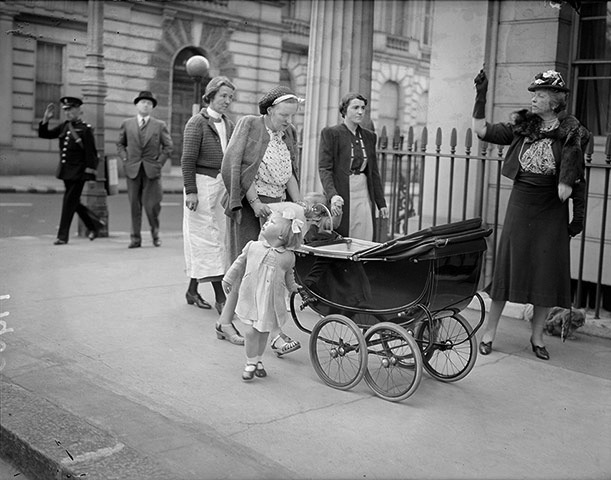
May 1940, London. Elizabeth Van Swinderen, wife of the former Dutch minister to Great Britain, points out London barrage balloons to Princess Juliana of the Netherlands. Juliana is with her children, Beatrix by her side and Irene in the baby carriage.

May 1940, London. Elizabeth Van Swinderen, wife of the former Dutch minister to Great Britain, points out London barrage balloons to Princess Juliana of the Netherlands, who is pushing the stroller. Juliana is with her children, Beatrix is by her side and Irene is in the baby carriage.

Perfect strangers sent cards, flowers, cakes and even money to the Niehot family. When the midwife Nelia Epker placed a thank-you advertisement in March 1941, listing the baby’s royal names once again, Nelia was arrested. She would not return to the Netherlands until August 1945, a survivor of Camp Ravensbrück. 2

1 Gottlief, Robert, ed. Reading Dance: A Gathering of Memoirs, Reportage, Criticism, Profiles, Interviews, and Some Uncategorizable Extras. New York: Pantheon Books, 2008.

2 Dutch Resistance Museum


Read Full Post »

George VI (Albert Frederick Arthur George; 14 December 1895 – 6 February 1952) was King of the United Kingdom and the Dominions of the British Commonwealth from 11 December 1936 until his death. He was the last Emperor of India, and the first Head of the Commonwealth.

George VI (Albert Frederick Arthur George; 14 December 1895 – 6 February 1952) was King of the United Kingdom and the Dominions of the British Commonwealth from 11 December 1936 until his death. He was the last Emperor of India, and the first Head of the Commonwealth.

It was Christmas, 1939, and Great Britain was at war with Nazi Germany. Like his father before him, King George VI would continue the holiday tradition of addressing the British Empire in a live radio message. That year, he would broadcast from the royal country house at Sandringham, where he and his family would spend Christmas.

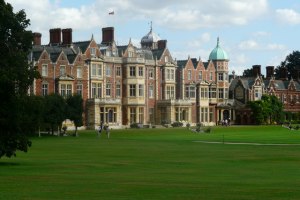
The Royal Residence at Sandringham, England

The Royal Residence at Sandringham, England

King George VI and his family leave Buckingham Palace, 1939, to spend Christmas at their country house at Sandringham. Pictured are the King and his wife Queen Elizabeth, daughters Princesses Elizabeth and Margaret Rose. Princess Elizabeth would become Queen Elizabeth upon the death of her father in 1952.

King George VI and his family leave Buckingham Palace, 1939, to spend Christmas at their country house at Sandringham. Pictured are the King and his wife Queen Elizabeth, daughters Princesses Elizabeth and Margaret Rose. Princess Elizabeth would become Queen Elizabeth upon the death of her father in 1952.

You will remember that King George VI was not a man comfortable with public speaking. His struggle to overcome a debilitating speech impediment – a stutter – was immortalized in the 2011 American Academy Award-winning film for Best Picture, “The King’s Speech.” A shy, nervous man, a heavy smoker and drinker (it would kill him at 56), King George VI would have preferred to have remained the Duke of York, living a quiet, out-of-the-public eye life with his sturdy wife and two rosy-cheeked daughters.

British Royal Princesses Elizabeth (l.) and Margaret Rose. February 1939, 7 months before the outbreak of WWII

British Royal Princesses Elizabeth (l.) and Margaret Rose. This photo was taken in February 1939, seven months before the outbreak of WWII.

King George VI – born Albert, called Bertie – never wanted to be king. He wasn’t supposed to be king. He was only king because his brother David had abdicated the throne in 1936 and he, Bertie, was next in line. Nevertheless, unwillingness aside, this unlikely monarch would rise to the occasion and be the very king the British people so sorely needed in a time of great trouble.

It was December 25, 1939, the day of the broadcast. Dressed in the uniform of the Admiral of the Fleet, the tall and too thin sovereign approached the table where two radio microphones were set up, taking his seat.

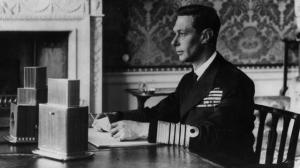
King George VI addresses his people on September 19, 1939, at the outbreak of WWII.

King George VI addresses his people on September 19, 1939, at the outbreak of WWII.

Taking a few deep breaths, he began to speak, slowly yet solidly. Measuring his words carefully, he spoke from the heart:

“A new year is at hand. We cannot tell what it will bring. If it brings peace, how thankful we shall all be. If it brings us continued struggle we shall remain undaunted.”

Toward the end of his nine-minute broadcast, he said:

“I feel that we may all find a message of encouragement in the lines which, in my closing words, I would like to say to you:”

He then read from a poem given to him by his 13-year-old daughter, Princess Elizabeth,

I said to the man who stood at the Gate of the Year,
‘Give me a light that I may tread safely into the unknown.’
And he replied, ‘Go out into the darkness, and put your hand into the Hand of God.
That shall be better than light, and safer than a known way.’”*

He finished by saying,

“May that Almighty Hand guide and uphold us all.”

For a king not known for compelling speeches, this one would be a landmark. It united King and Country in common cause and inspired the people to hold fast. After all, at this point in history, no one knew that the Allies would triumph. Britain was to face five more years of war and brutal bombing by Hitler before the day of liberation would arrive. The end of 1939 was a shaky time and great leadership by King, Queen, and Prime Minister Winston Churchill would hold Britain steady against the Nazi aggressors.

Queen Elizabeth and King George VI of Great Britain stop at Vallence Road, Stepney, in the East End, London, to examine the debris following an air raid in the Second World War. October 4, 1945

Queen Elizabeth and King George VI of Great Britain stop at Vallence Road, Stepney, in the East End, London, to examine the debris following an air raid in the Second World War. October 4, 1945

King George VI pins a Distinguished Service Medal on Chief Petty Officer C.L.Baldwin in December 1939.

King George VI pins a Distinguished Service Medal on Chief Petty Officer C.L.Baldwin in December 1939.

Listen to the last four minutes of the King’s Christmas 1939 message here:

For more about the British Royal Family on this blog, click here.

Click here for the full text of the King’s 1939 Christmas Message plus The REAL austerity Christmas: How a nation gripped by fear kept calm and carried  on three months after outbreak of war in 1939

*“The Gate of the Year,” by Minnie Haskins (1908)

Read Full Post »

Is Kate pregnant? While William, 29, plus the Danish Crown Prince and Princess tasted peanut paste at a recent visit to a global supply center for Unicef, Kate politely refused -- and reportedly gave her husband of six months a knowing look.

Tabloids are abuzz with speculation that Kate Middleton, the Duchess of Cambridge, is expecting her first child with Prince William. Buckingham Palace refuses to deny or confirm such a statement but there are hints that there may be some truth to the rumor.

It is all started with Kate refused to sample some peanut paste in a Unicef food packet in a royal visit to Copenhagen. (Doctors warn expectant mothers against eating nuts.) She further fueled speculation  on another occasion when she refused a glass of champagne while hosting a charity dinner on behalf of Prince Charles. (Expectant mothers shouldn’t drink alcohol.)

In Touch magazine claims that Kate is six weeks pregnant. In Touch‘s sources have been reliable in the past, having correctly revealed both the couple’s honeymoon plans and the Queen‘s wedding gift to Kate.

Learn more at The Daily Beast.

Readers: For more on Kate, the Duchess of Cambridge, on Lisa’s History Room, click here.

Read Full Post »

In 2009, British Esquire named Prince Charles the World's Best Dressed Man. "He is perfectly turned out in a double-breasted suit," they claim. "Admirably, the prince keeps his wardrobe in appropriate style: we're told he has a room laid out like a tailor's shop."

Not in Front of the Corgis,  a new book to be released in June 2012 by biographer Brian Hoey, gives us a “behind closed doors” look at the British Royal Family.  Here’s a preview of a section on Prince Charles and Camilla:

Prince Charles employs 133 staff to look after him and Camilla, more than 60 of them domestics: chefs, cooks, footmen, housemaids, gardeners, chauffeurs, cleaners, and his three personal valets—gentleman’s gentlemen—whose sole responsibility is the care of their royal master’s extensive wardrobe and choosing what he is to wear on any particular day. A serving soldier polishes the prince’s boots and shoes every day—he has 50 handmade pairs each costing over £800 ($1275) by Lobb of St James’s—and a housemaid washes his underwear as soon as it is discarded.

Nothing Charles or Camilla wears is ever allowed near a washing machine. Particular attention is paid to handkerchiefs, which are monogrammed and again all hand-washed, as it was found that when they were sent to a laundry, some would go missing—as souvenirs. HRH’s suits, of which he has 60, cost more than £3,000 ($4780) each, and his shirts, all handmade, cost £350 ($558) a time (he has more than 200), while his collar stiffeners are solid gold or silver. Charles’s valets also iron the laces of his shoes whenever they are taken off.

Source: The Daily Beast

Readers: For more on the British Royal Family on this blog, click here.

Read Full Post »

At a 1968 British society wedding in Kent, Hollywood legend Elizabeth Taylor snaps a souvenir picture of the Queen Mum (seated), mother of Queen Elizabeth II. The Queen Mum

At a 1968 British society wedding in Kent, Hollywood legend Elizabeth Taylor cannot resist snapping a souvenir picture of "the Queen Mum" (seated), mother of Queen Elizabeth II.

“The Queen Mum,” born Elizabeth Bowes-Lyon (1900-2002), was the beloved British Royal Family matriarch from 1953 until her death at age 101. Of Scottish birth, she served as Queen consort to her husband King George VI from 1936 until his death in 1952, when their daughter Princess Elizabeth took the throne as Elizabeth II.

During the London Blitz in WWII, the Queen Mum – who was then naturally referred to as Queen Elizabeth – insisted that she and the King remain in Buckingham Palace after it was bombed by the German luftwaffe. The Queen remarked to her mother-in-law that she was more affected by the bombing of the East End of London than by the bombing of the Palace:

“I’m glad we have been bombed,” she said. “Now, I can look the East End in the eye.” (1)

British King George VI and his wife Queen Elizabeth (later Elizabeth, the Queen Mother) survey the damage to Buckingham Palace from German bombs. Both the King and Queen were in the Palace when the attack hit the palace grounds and chapel on the morning of September 13, 1940. As they made their way to the palace shelter, they felt the Palace shake under the assault of high explosive and incendiary bombs. They were unhurt. Undeterred by the danger, the royal couple vowed to stay in London in the Palace.

I am still just as frightened of bombs as I was at the beginning,” the Queen wrote to a favourite niece. “I turn bright red and my heart hammers….I’m a beastly coward but I do believe that a lot people are, so I don’t mind! Well, darling, I must stop. Tinkety tonk old fruit and down with the Nazis.”(2)

Her indomitable spirit in the face of German aggression boosted British morale to such a degree that Adolf Hitler called her “the most dangerous woman in Europe.”

Her scary skinny sister-in-law, Wallis, the Duchess of Windsor, hated and mocked her, calling her by the unflattering nickname “Cookie” behind her back, mocking her love of sweets and resulting plumpness. The Queen Mum, however, did not hide her love of fun, jokes, champagne, and good food. In the 2010 movie, “The King’s Speech,” the Queen Mum, played by Helena Bonham Carter, is shown eating candies in the backseat of a car.

Her ultimate accolade for anyone or anything was “delicious.”(2)

Elizabeth, the Queen Mother

A new book by British monarchy chronicler, Brian Hoey, gives us yet another “behind the palace walls” glimpse of the Queen Mum enjoying her sweets.  Not in Front of the Corgis, scheduled for a June 2012 release, relates this anecdote: 

Lord Callaghan, when he was prime minister (1976-1979), was a frequent guest of the Queen Mother’s at Clarence House. Once, when just the two of them were present, she was eating from an enormous box of chocolates when he arrived.  She asked him if he would like one. He said, “Yes.” She then pointed to one in the middle of the box and said, “Have that one.” During the time he was eating his one specified chocolate, she ate three more. 

She then invited him to take another, once again selecting the one he should have. This went on for the remainder of the morning, with Her Majesty always pointing to the ones he could have.

As Callaghan left, he spoke to The Queen’s Page, asking why he was offered only particular chocolates by the Queen. The Page let him in on the secret:

“Those are the ones with hard centers. Her Majesty only eats the chocolates with soft centers.”(3)

(1) Source: BBC

(2) Source: The Daily Beast

(3) Source: The Daily Beast

Faithful readers:

  •  For more on the Queen Mum on this blog, click here.
  • For more on the British Royal Family on this blog, click here.
  • For more on Elizabeth Taylor on this blog, click here.
  • For more on Wallis, the Duchess of Windsor on this blog, click here.

Read Full Post »

British Prime Minister David Cameron’s government is moving ahead with plans to change succession laws so that if Will and Kate have a daughter, she will be able to ascend to the throne. Under existing rules, if the Duke and Duchess of Cambridge‘s first child is a girl but their second child is a boy, the son would pass over his sister and inherit the throne. Cameron wrote,

We espouse gender equality in all other aspects of life, and it is an anomaly that in the rules relating to the highest public officer we continue to enshrine male superiority.”

Read more at People.

For more on this blog about Will & Kate, click here.

Read Full Post »

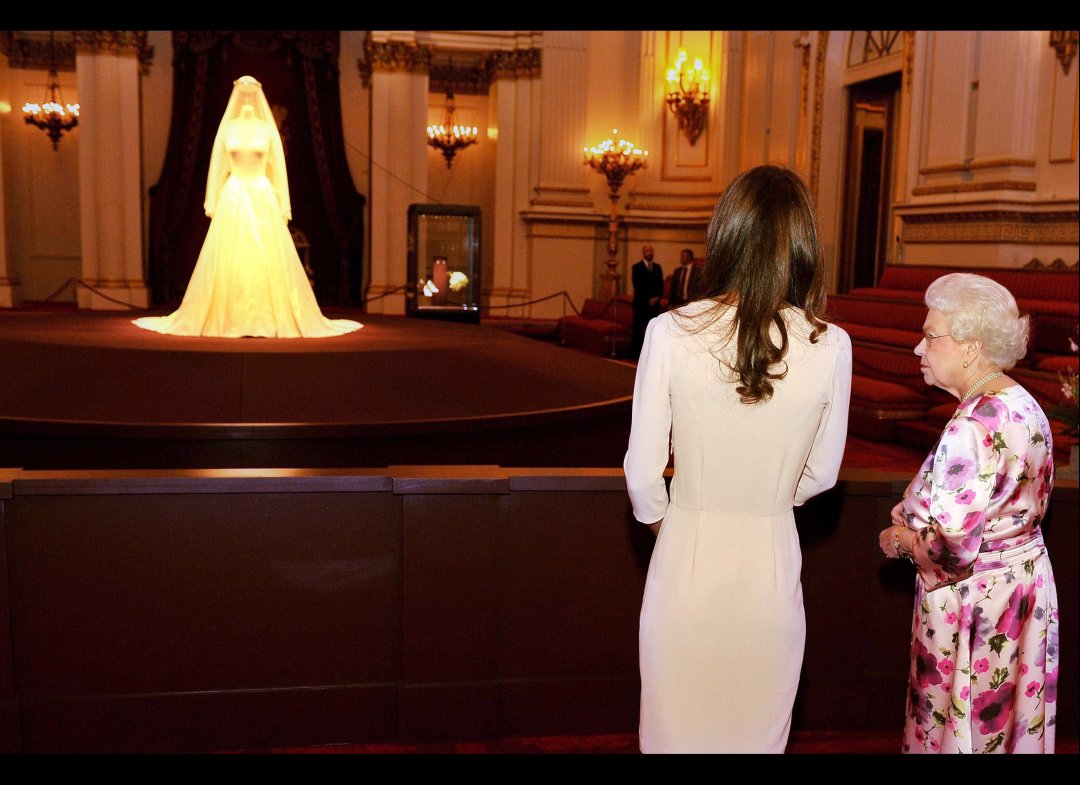
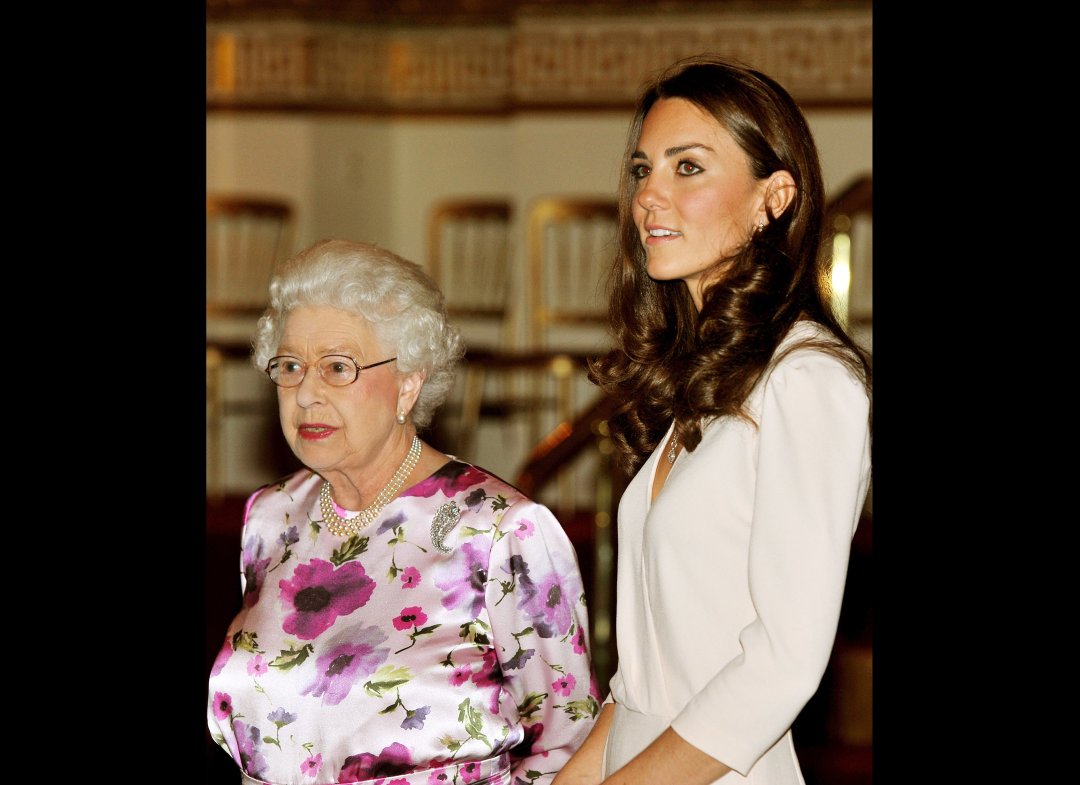
Queen Elizabeth II and Catherine, the Duchess of Cambridge, took a preview tour of Buckingham Palace’s royal wedding exhibit on Friday. 

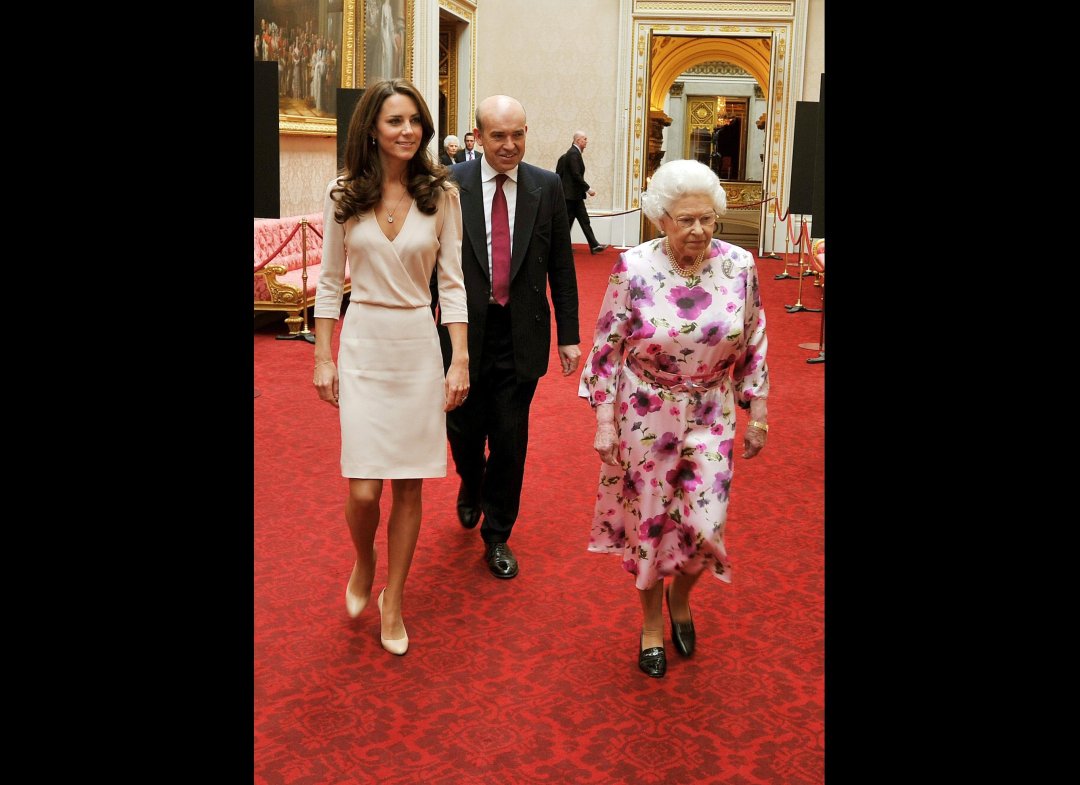
Catherine, Duchess of Cambridge, and her grandmother-in-law, Queen Elizabeth II of Great Britain, are on their way to view Buckingham Palace's royal wedding exhibit, July 22, 2011. Uncharacterically, the Queen is not carrying her trusty handbag.

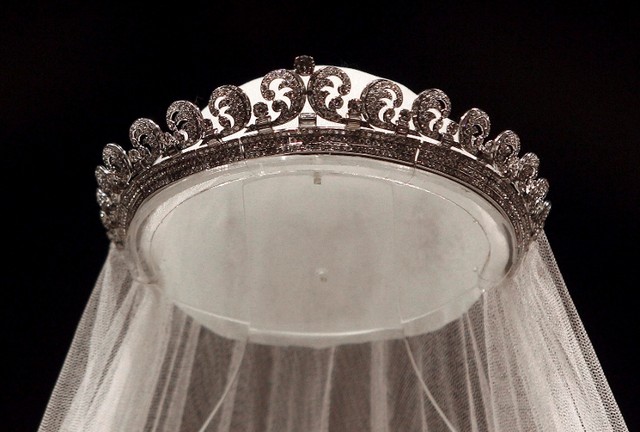
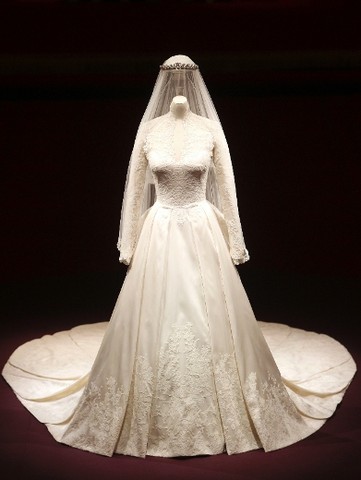
The Royal Collection show, called “The Royal Wedding Dress: A Story of Great British Design,” opened to the public today. It brings together the Duchess of Cambridge’s Alexander McQueen white and ivory Irish lace wedding dress, shoes, tiara, earrings, and a replica bouquet for the public to view up close.

Among the items displayed at the Queen's London residence include the Cartier Halo tiara, worn by Kate Middleton on her wedding day. The understated headpiece was made in 1936 and purchased by the Duke of York (later King George VI) for his wife, Elizabeth's mother (also Elizabeth). Queen Elizabeth received it as an 18th-birthday present, at which time she was Princess Elizabeth. The delicate diamond tiara was lent to Kate by the Queen.

The Palace expects over 500,000 people to buy tickets to the ten-week exhibit. Both at home and abroad, Prince William and Kate are wildly popular, as evidenced by the overwhelmingly warm reception they received earlier this summer on their 2011 Royal Tour of Canada with a detour to Hollywood.

Kate Middleton's bridal shoes will be on display at Buckingham Palace this summer. Custom made by Alexander McQueen's Sarah Burton to match her wedding dress, Kate's elegant pumps are made of ivory duchesse satin with lace hand-embroidered by the Royal School of Needlework.

Kate and William’s wedding cake was a fruit cake designed by Fiona Cairns. It was covered in cream and white icing, decorated with over 900 sugar paste flowers and elaborate scrollwork. Fiona Cairns’ cakes are in huge demand; Sir Paul McCartney orders one every Christmas.

Kate designed her wedding cake to match its surroundings. She took into account that her wedding reception was to be held in the Picture Gallery in Buckingham Palace. The room has high ceilings so she chose a cake that towered but was not too tall or thin. She wanted something with presence. Architectural elements in the room, for instance, garlands on the walls, were reproduced loosely on the fourth tier piping: roses, acorns, ivy leaves, apple blossom and bridal roses. The cakemaker would not reveal her exact recipe but did disclose that she used a range of produce from dried fruits such as raisins and sultanas to walnuts, cherries, grated oranges and lemon, French brandy and free-range eggs and flour to create her historic confection.

Of course, the centerpiece of the exhibit was Kate’s wedding dress and veil. An ongoing tradition, viewing royal wedding gowns has wide public appeal. For instance, Princess Diana‘s 1981 Elizabeth Emanuel wedding gown continues to be viewed and is currently part of a travelling exhibition. 

Kate and the Queen view Kate's wedding gown display in Buckingham Palace. July 20, 2011.

Upon viewing the installation of Kate’s wedding dress and veil, the Queen was heard to exclaim, 

“Horrid, isn’t it? Horrid and dreadful!”


The Queen is not amused.

The ivory and white Alexander McQueen gown is displayed in a dark and gloomy fashion with the veil and tiara hovering eerily above. 

The Duchess of Cambridge's wedding gown is displayed without a mannequin.

It appeared the mannequin’s lack of a head may have upset the Queen.

Source: HuffStyle 

Readers: For more on Lisa’s History Room about the British Royal Family, click here.

Read Full Post »

Prince William and Catherine, the Duke and Duchess of Cambridge, braved temperatures in the nineties as they continue their Royal Tour of Canada at a stop in Ottawa. Kate wore a striking red hat adorned with the Canadian maple leaf as well as a brooch loaned from the Queen. In his speech, Prince William referred to his grandmother as the “Queen of Canada.” Queen Elizabeth II remains Canada’s head-of-state.Prince William waves to the Ottawa crowd as Catherine steps out in a striking red hat adorned with red maple leaves, a symbol found on the Canadian flag. July 2011  

Kate flashes a smile as we get a close-up of her red hot fascinator by Sylvia Fletcher for Lock and Co.

Kate wears a family heirloom loaned to her by Queen Elizabeth II: a diamond brooch of a maple leaf, Canada's national emblem.

Queen Elizabeth II wore the maple brooch when she toured Canada 60 years earlier, in 1951.

The flag of Canada features a red, 11-tipped maple leaf against a white field, flanked by vertical red bands. Canada is a federal state that is governed as a parliamentary democracy and a constitutional monarchy with Queen Elizabeth II as its head of state. It is a bilingual nation with both English and French as official languages at the federal level.

Readers: For more on the British Royal Family here on Lisa’s History Room, click here

Read Full Post »

Center, Prince Albert of Monaco and his fiancé Charlene Wittstock pose with the band The Eagles, performing in Monaco to celebrate the wedding of Albert and Charlene. June 30, 2011.

Prince Albert of Monaco and Charlene Wittstock of South Africa are scheduled to wed today in Monte Carlo despite revelations in the French Press earlier in the week that the never-before-married Prince Albert, 53, may have fathered a third love child. Upon learning of the Le Monde article, Miss Wittstock, 20 years Albert’s junior, reportedly tried to flee the tiny Riviera principality.

As reported in The Daily Mail, “the couple’s lawyers have furiously denied a rift, while police have claimed that Miss Wittstock even

had her passport confiscated at the Nice airport to stop her getting on a flight.” 

Despite this hiccup, the wedding is going ahead as planned. The engaged couple put on a happy show of unity last night as they attended a concert by The Eagles. The free show was held at Monaco’s stadium and attracted thousands of fans from the principality and neighboring areas.

The wedding nuptials include a civil ceremony today and a Catholic Church ceremony tomorrow. 

In this June 2011 photo for Vogue magazine, Charlene Wittstock shows off her impressive physique. She was a South African Olympic swimmer who will become Princess Charlene of Monaco on Friday, July 1, 2011, when she weds Prince Albert of Monaco. Prince Albert is the son of the late Grace Kelly, American film actress, and Prince Rainier III of Monaco.

Charlene Wittstock stands on a precipice in Monaco.
To see a gallery of Charlene Wittstock photos at the Daily Beast, click here.  

The nuptials at Monte Carlo may rival the British royal wedding in lavishness and excess. While newlyweds William and Kate, the Duke and Duchess of Cambridge, are unable to attend the festivities because they are currently in Canada on a North American tour, the guest list is still expected to be impressive. Shrouded in secrecy, it is rumored to include crowned heads of Europe, politicians, and glitterati such as international supermodel Naomi Campbell, German haute couture designer Karl LagerfeldFrench President Nicolas Sarkozy and his wife, First Lady Carla Bruni.

Musician and former model Carla Bruni is expecting her second child, her first with Sarkozy.

The June 2011 issue of French magazine Elle features First Lady of France Carla Bruni Sarkozy with her growing pregnancy bump. Carla Bruni is a former model, and has graced the cover of Elle many times.

Before she was the First Lady of France: Carla Bruni models a designer bikini and pearl-rimmed sunglasses.

READERS: For more on Lisa’s History Room about Carla Bruni, click here  


In the photo above, Prince Albert’s mother, Princess Grace of Monaco, is shown climbing the stairs of the Princely Palace in Monaco, ca. 1960. Princess Grace is the Hollywood actress Grace Kelly who gave up her film career to marry Rainier III, Prince of Monaco, in 1956. Together they raised three children: Caroline, Princess of Hanover, Albert II, Prince of Monaco, and Princess Stéphanie of Monaco.

Readers: For more on Lisa’s History Room about Princess Grace, click here.

Read Full Post »

Landing in Ottawa, Canada, Prince William and Catherine begin the Royal Tour of 2011, their first tour as husband and wife.

Prince William and Catherine, the Duke and Duchess of Cambridge, are in Canada today, the first leg of the Royal Tour 2011 of North America. For more, click here.

For more about the British Royal Family on this blog, Lisa’s History Room, click here.

Read Full Post »

This week's current Newsweek cover featuring a fantasy image of what Princess Diana, had she lived, might have looked like at age 50. The image has sparked tremendous backlash.

The Daily Beast has provided a photo gallery of Princess Diana over the years. Had she lived, she would have turned 50 today, July 1, 2011: “Princess Diana’s 50th Birthday.”

Newsweek’s Tina Brown has written a really strange futuristic look at what Diana might have been like at 50: “Diana at 50.”

For other posts on Diana on this blog, Lisa’s History Room, click here.

Read Full Post »

Peterhof Palace, St. Petersburg, Russia

They first met at the 1884 wedding of his uncle to her sister. She called him Nicky; he called her “Alix” or “Sunny.”  Although Alix was only 12, she knew at that moment that Nicky was “The One.” It was on this occasion she carved their names on the window of the Peterhof Palace.

Alix of Hesse as a young girl ca. 1878

After the wedding, Alix bid her sister and Nicky goodbye, returning to the Darmstadt Palace in Germany which was her home. Alix was a royal princess.

Alix of Hesse ca. 1888

Young Nicholas II of Russia, before he ascended the throne in 1894

Five more years would pass before Princess Alix would return to Russia and see Nicky again. During that visit, the two fell even more deeply in love. Nicky was determined to make Alix his bride.

But Nicky’s parents wouldn’t hear of Nicky marrying a German princess. They hated Germans as did almost every Russian. But Nicky’s parents weren’t just any Russians.  Nicky’s parents were the Romanov rulers of Russia: Tsar Alexander III and Tsarina Marie Feodorovna . They were the Royal Emperor and Empress. Nicky – Nicholas Alexandrovich- being their oldest son – was the Tsarevitch – the heir to the Russian throne.

Alix returned to Germany.

Princess Alix of Hesse, seated, prepares for her first ball. 1889.

More years passed. Love letters written in English flew back and forth between the lovesick pair.

Meanwhile, Nicky carried on a torrid and scandalous three-year affair with the famous Russian ballerina, Mathilda Kschessinska.

Mathilde Kschessinska (1872-1971)

Nevertheless, Nicky’s heart still belonged to Alix.  He wrote in his diary:

It is my dream to one day marry Alix H. I have loved her for a long time, but more deeply and strongly since 1889 when she spent six weeks in Petersburg. For a long time, I have resisted my feeling that my dearest dream will come true.”

Nicky’s parents continued to wage a fierce campaign to find Nicky a suitable bride. The Tsar hoped to land a bigger catch for his son than Princess Alix (even though she was his godchild!), parading a series of royal princesses in front of his son. But Nicky stood firmly against each proposed match, declaring flat out to his folks that he’d become a monk rather than marry anyone ugly and boring when he could have the tall and lovely blue-eyed beauty Princess Alix as his wife and royal consort.

Queen Victoria of the United Kingdom comforts her German granddaughters, the Princesses of Hesse; left to right, Victoria, Ella, and, the youngest, Alix. Their mother, Princess Alice, had just died. Alice was Victoria's second daughter.

Meanwhile, alone in Germany, Alix was equally resolute to marry Nicky, doing her own bit in  turning down royal suitors. She even stood up to her domineering grandmother, Queen Victoria of the United Kingdom, when the Queen tried to marry her off to her grandson, the Duke of Clarence. Alix declined to marry the Duke stating to “Granny” that she did not love him. Victoria – notorious for her royal matchmaking – surprisingly

“was proud of Alix for standing up to her, something many people, including her own son, the Prince of Wales did not do.”

 
For five years, Tsar Alexander III had stood firmly against his son’s wishes. But, in 1894, he became ill and relented, the couple announcing their engagement in April of 1894.

1894 official engagement photo of Princess Alix of Hesse (later Alexandra Feodorovna) and Tsarevitch Nicholas (later Tsar) of Russia

Princess Alix of Hesse-Darmstadt and by Rhine & Tsarevich Nicholas Alexandrovich, London, 1894

Alix, as a requirement for the engagement, converted from Lutheranism to the Russian Orthodox religion and took the Russian name “Alexandra Feodorovna” to strengthen her appeal to the Russian people. Nicholas and Alexandra planned a spring 1895 wedding.

But their plans were thrown in disarray by Alexander’s sudden death in November and Nicholas’s subsequent ascension to the throne as His Imperial Majesty, Tsar Nicholas II. Nicholas insisted that the wedding date be moved forward, as he wanted Alix by his side to help him rule. They married a swift three weeks later. He was 26.  Alix, now called Empress Alexandra,was 22.

Wedding of Russian Emperor Nicholas II (1868-1918) and Grand Princess Alexandra Fedorovna (1872-1918) by Laurits Tuxen, 1895

Read Full Post »

« Newer Posts - Older Posts »